



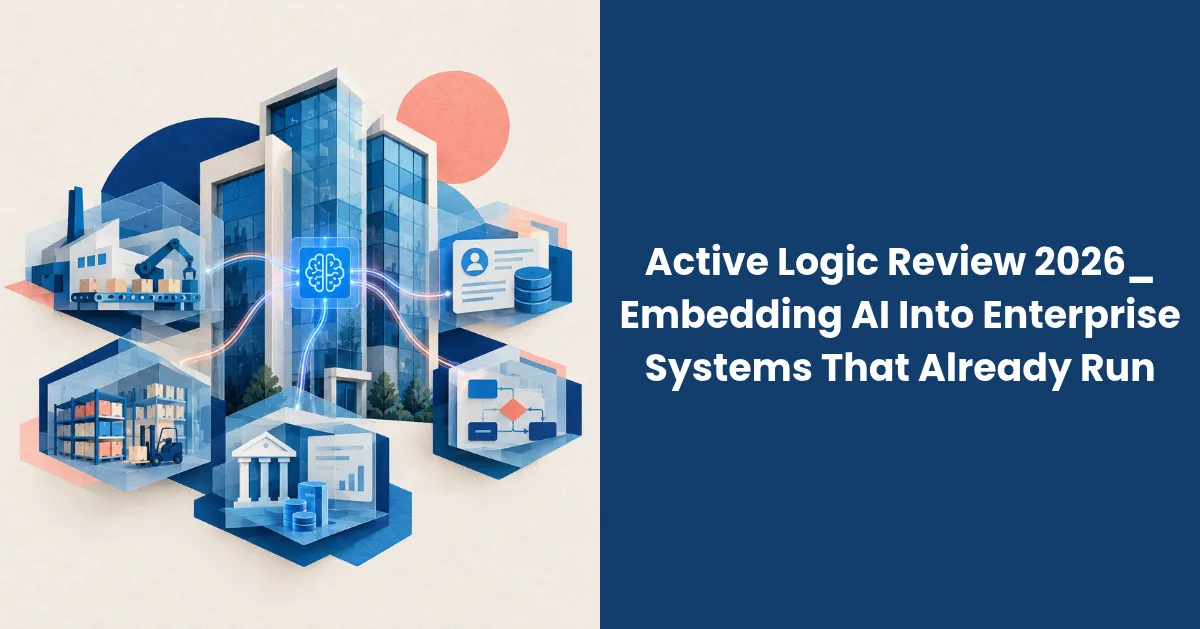
Active Logic takes a different approach, one built around placing AI inside the CRM, ERP or internal portal a company already runs rather than stacking a new interface on top of it. Founded in 2014 and headquartered in Leawood, Kansas, in the Kansas City metro, the firm works with enterprise and growth-stage companies that need software built to last, not a proof of concept that stalls after launch.
What Active Logic Actually Builds
This is a custom software development company, not an AI tooling vendor or a staffing firm. The team builds web, mobile, AI and data systems for clients that include Abbott, Nelnet, the University of Kansas and Kansas State University and it has delivered 200+ projects since opening in 2014.
The firm's client list points to a few regional strongholds. In Kansas City, that means healthcare, logistics and financial services work, alongside manufacturing and financial services clients in Chicago and fintech, healthcare and logistics accounts in Miami. That spread suggests a practice built for companies with established operations, not startups shopping for a minimum viable product.
The AI Differentiator: Inside the Workflow, Not Bolted On
The detail that separates Active Logic from a typical development shop is where the AI actually lives. Instead of adding a separate AI layer on top of existing software, the firm builds AI into the CRM, ERP, portal or internal tool a business already depends on, so the system scores a lead the moment it arrives, drafts a customer email from real account data, or flags a problem before it turns into an incident. The person using the software doesn't have to type a prompt or open a new tab to get the benefit. It just happens as part of the workflow they already know.
Two production examples back this up. The Airez platform runs a large language model pipeline with edge inference for sensor intelligence work and an AI-powered sales CRM built for GTS Associates serves the aerospace and defense sector. Neither is a demo or a lab project. Both are live systems doing a specific job for a specific client.
Who Actually Writes the Code
A recurring worry with any software vendor is who ends up accountable when something breaks in production. Active Logic answers that by keeping every line of code with senior engineers based in the United States, with no offshore or nearshore handoffs passing work between time zones and teams. The firm counts 30+ full-time senior engineers and 4 Directors of Engineering and that director-led governance structure means architecture, security and scalability decisions stay with people who answer for the outcome.
That matters more with AI in the mix, not less. The firm uses AI tools to write code faster, but a senior engineer still owns the architecture, security and scalability of what ships, so the result is production software rather than a prototype stitched together by AI with nobody checking the seams. Companies that have watched an AI-assisted build turn into a maintenance headache will recognize why that distinction gets called out specifically.
Model Choice and Monitoring
Active Logic doesn't commit to a single AI vendor by default. The firm is model-neutral, drawing on OpenAI, Anthropic, Google or classical machine learning depending on what a given use case actually needs and it scopes every AI feature with a specific model choice, a cost estimate and ongoing accuracy monitoring rather than treating the model as a one-time decision. For a lead-scoring feature, that might mean a smaller classical model that is cheap to run at volume. For drafting customer emails from account data, a large language model makes more sense. The point is that the decision gets made deliberately, with a cost figure attached, instead of defaulting to whichever model is trending.
Companies weighing a build-versus-outsource decision on a core system often underestimate how much of the real cost is architecture and governance rather than the initial build. The National Institute of Standards and Technology's AI Risk Management Framework covers why ongoing monitoring of an AI system's accuracy and behavior matters well past launch day, which lines up with how Active Logic frames its own scoping work.
What You Get and What You Don't
What a client is paying for here is fewer handoffs and one accountable team instead of a patchwork of contractors and a separate AI vendor. A director-led team that owns architecture end to end tends to catch integration problems before they reach production, which is a different value proposition than hiring the cheapest available developer hours.
Strengths worth weighing:
AI embedded in existing tools. The lead-scoring, email-drafting and incident-flagging work happens inside systems employees already use, which lowers the adoption barrier that kills a lot of standalone AI pilots.
Senior-only, U.S.-based delivery. No offshore or nearshore handoffs means one team carries a project from scoping through production, which simplifies accountability when something needs to change.
A verifiable project history. Clients like Abbott, Nelnet and two Kansas universities, plus named production systems like Airez and the GTS Associates CRM, give this firm a track record that's more concrete than a generic case-study page.
Honest trade-offs to consider:
Senior-only staffing with no offshore layer usually means a higher rate than a mixed-seniority or offshore-blended team would charge, which can matter for a company comparing options purely on hourly cost. The firm's named client roster also skews toward larger, established organizations, so a very early-stage startup might find the engagement model built for more mature needs than theirs. And because the practice is built around integrating AI into systems a company already runs, a business starting from scratch with no existing CRM or ERP won't see the same advantage that an established operation would.
None of these are dealbreakers. They're the kind of trade-offs that come with hiring a senior, accountable team instead of a cheaper, looser one, a tension covered in more general terms in this guide to custom software development project planning.
Who Fits and Who Should Look Elsewhere
This firm fits a company that already has a CRM, ERP or internal portal in place and wants AI working inside it rather than next to it. It also fits an organization that has been burned before by a vendor that treated staffing like a volume game instead of an engineering discipline. Companies in Kansas City's healthcare, logistics and financial services sectors, or similar industries in Chicago and Miami, are the clearest match given the firm's existing client concentration there.
A company still validating its product idea, with no production system to integrate against yet, is probably better served by a smaller shop built around rapid prototyping. The same goes for a buyer whose main decision criterion is lowest hourly rate rather than who owns the architecture after launch. For companies evaluating their broader options in this space, this roundup of custom software development companies is a useful comparison point.
The Verdict
Active Logic earns its place among serious options for an enterprise or growth-stage company that wants AI doing real work inside the software it already runs, not a chatbot wedged on top of it. The combination of senior, U.S.-based delivery, director-led governance and a client list that includes Abbott, Nelnet and two Kansas universities gives this firm more to point to than most pitches in this category.
It isn't the cheapest route and it isn't built for a company starting from a blank slate with no existing systems to integrate.