



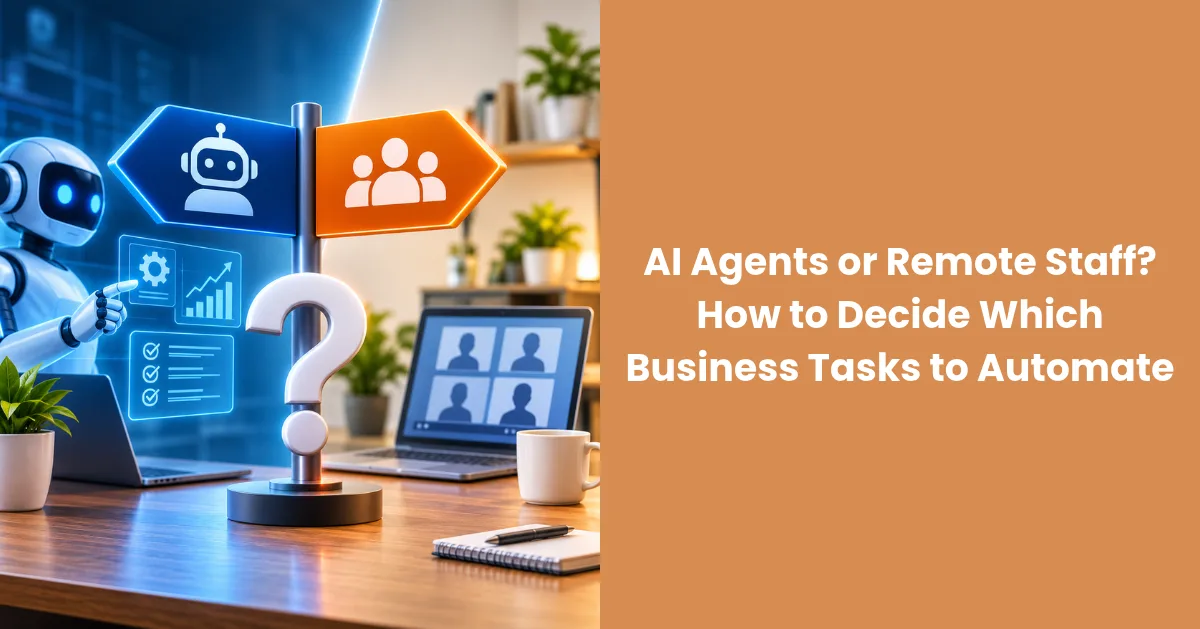
To choose, check each task for frequency, written rules, stored data and the cost of a mistake. Give the frequent, rule-based tasks to an agent, and give judgement calls and exceptions to a person.
What an AI agent can handle and what still needs a person
Give an AI agent tasks with clear rules and data stored in your systems, and keep work involving judgement, negotiation or empathy with people.
An AI agent is software you set up to read information from your systems and take actions within rules you write. Those actions include replying to a customer email, updating a record or sending a reminder. Suitable tasks include answering repeat questions about prices, dates or order status, routing incoming requests, sending follow-ups and drafting replies for someone to check.
Keep complaints, refunds and negotiations with clients or suppliers with a person. Do the same for cases where information is missing or conflicting, and for any task where you could lose a client or break a rule with a wrong answer.
McKinsey estimated that generative AI and other current technologies have the potential to automate work activities that account for 60 to 70 percent of employees’ time. McKinsey measured activities within jobs, so a business can automate parts of a role and keep a person for the rest.
How to sort your tasks
List the tasks your team repeats each week and ask four questions about each one:
- How often does your team do it? You’ll recover the setup time faster on a task your team handles dozens of times a week.
- Can you write the rules down? If you can explain the task in a short checklist, you can turn that checklist into instructions for an agent.
- Is the data already in a system? To automate the task, connect the agent to the system where that information is stored, through an integration or an API. A training provider whose bookings are stored in EduAdmin, for example, can connect an agent through EduAdmin’s open API.
- What does a mistake cost? If a customer receives a wrong delivery estimate, you apologise. If a customer receives a refund promise your policy doesn’t allow, you lose money and trust.
Automate tasks with three yes answers and a low cost of mistakes. Give tasks with a high cost of mistakes to a person, or let the agent draft and a person approve.
If the data is spread across several tools, plan to connect AI to your existing systems before you automate any task.
How AI agents and remote staff work together
Set up the agent to handle the volume and flag anything outside its rules. Then give one person the job of reviewing those flags, handling exceptions and improving the rules each week.
Write down the cases you want a person to handle, such as an angry customer, a refund request or a question with no answer in your data. Ask the person to read a sample of the agent’s replies each week, correct mistakes and update the instructions.
With this review in place, a named person stays accountable for what your business tells customers.
Worked example: a training provider
A training provider can automate booking messages and routine questions, and keep refunds, complaints and custom quotes with a coordinator.
Say the provider runs public courses and manages them in commercial training management software. Staff set the system to send booking confirmations, email and SMS reminders, payment requests and alerts before certificates expire.
The provider then adds an AI agent to its website and inbox. Staff set it up to answer questions from the course data, such as “Where is the venue?” or “Is there a seat left in March?”. They also set it to draft replies to group booking requests.
A remote coordinator reviews those drafts, handles refund requests and complaints, rebooks attendees when a trainer is ill and prepares quotes for in-house training.
How to hire the person who works alongside the agent
Hire for judgement, clear writing and comfort with software, and test those skills before you make an offer.
Job titles for this role include operations coordinator, customer support specialist and virtual assistant. Give candidates a short paid task based on real cases, such as three agent drafts to correct and one complaint to answer. Check that their working hours overlap with your customers’ time zones.
You can recruit the person yourself through job boards, or compare top outsourcing companies that find and vet remote staff for you. Either way, give the new hire the agent’s instructions and your escalation rules in their first week.
How to start: pilot one task
Pick one task that scores well on the four questions and automate it for a month. Track the time saved, the error rate and how many items your coordinator has to handle.
Move to the next task once your coordinator no longer needs to fix the first one each day. If you can’t connect an off-the-shelf tool to your data or set it to follow your rules, consider custom AI agent development.
Summary: deciding between AI agents and remote staff
Give AI agents the frequent, rule-based tasks whose data is already in your systems and whose mistakes are cheap to fix. Keep judgement, exceptions and relationships with a person, and give that person the job of reviewing the agent’s work. Start with one task, measure it and expand from there.


