



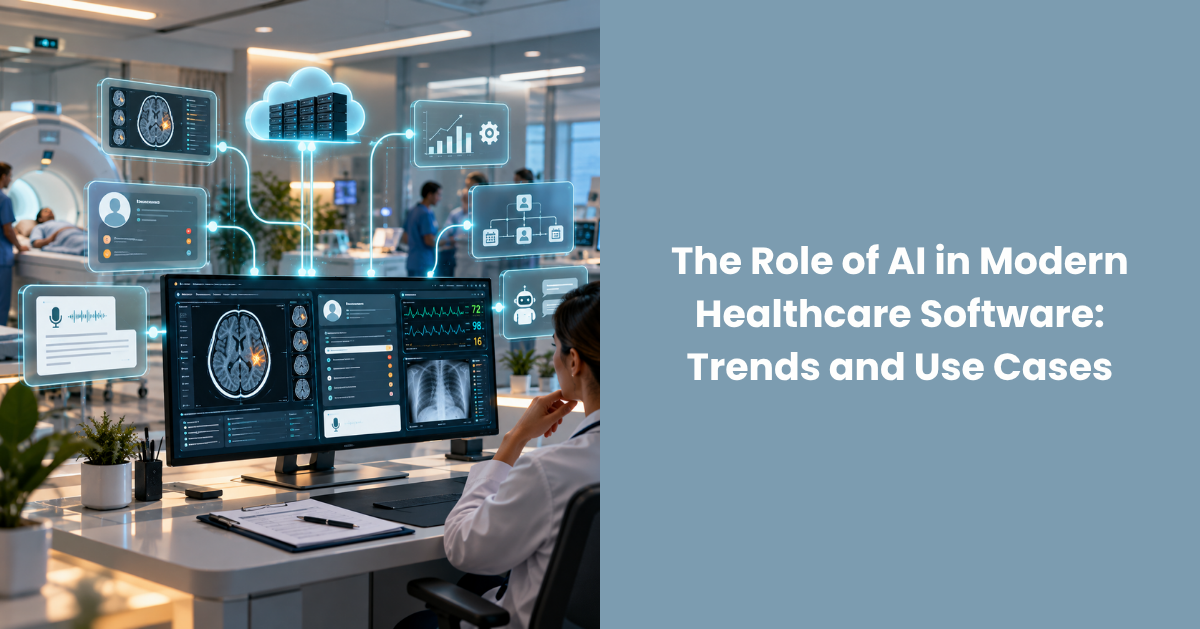
From automating documentation to helping practices manage appointments, billing, and patient communication, AI is making healthcare systems more efficient while reducing repetitive work for healthcare professionals.
Modern healthcare software is moving beyond simply storing information. AI is helping these systems understand data, automate processes, identify patterns, and provide useful insights at the right time.
How AI Is Changing Healthcare Software
Traditional healthcare software primarily focused on recording and organizing information. Electronic health records stored patient data, practice management platforms handled administrative operations, and scheduling systems coordinated appointments.
AI adds another layer of intelligence to these systems.
Instead of requiring users to manually perform every task, AI can assist with activities such as:
- Summarizing clinical information
- Automating medical documentation
- Extracting important information from patient records
- Supporting clinical decision-making
- Predicting administrative and operational trends
- Automating patient communication
- Identifying potential billing and coding issues
- Improving appointment scheduling
- Analyzing large healthcare datasets
The goal is not necessarily to replace healthcare professionals. Instead, AI can help reduce repetitive administrative work and give professionals more time to focus on patients.
Key AI Trends in Healthcare Software
1. AI-Powered Clinical Documentation
Clinical documentation is one of the areas where AI is having a significant impact.
Healthcare professionals spend considerable time documenting patient encounters. AI-powered tools can listen to conversations, identify relevant clinical information, and generate structured documentation.
An AI Medical Scribe can, for example, assist with creating clinical notes from a patient-provider conversation. Depending on the system, the generated information may include elements such as symptoms, diagnoses, treatment plans, and follow-up instructions.
The provider can then review and edit the documentation before it becomes part of the patient's record.
This approach can help reduce manual documentation and allow providers to spend more attention on patient interactions.
2. Smarter EHR Software
Modern EHR Software is increasingly incorporating AI capabilities to make patient information more accessible and useful.
Instead of simply displaying large amounts of medical information, AI can help organize and summarize relevant information from a patient's record.
Potential applications include:
- Patient record summarization
- Clinical note assistance
- Relevant information retrieval
- Identification of potential medication conflicts
- Clinical workflow assistance
- Automated documentation
- Patient history analysis
For example, when a provider opens a patient's record, AI could help surface relevant information from previous encounters rather than requiring the provider to manually review every document.
However, AI-generated information should be reviewed by qualified healthcare professionals, particularly when it could influence clinical decisions.
3. AI in Practice Management
AI is also changing administrative healthcare workflows.
Traditional Practice Management Software can already support scheduling, billing, patient registration, insurance processes, and other administrative activities. AI can make some of these workflows more automated and adaptive.
Examples include:
- Automated appointment scheduling
- Appointment reminders
- No-show prediction
- Insurance verification assistance
- Claims analysis
- Revenue cycle workflow automation
- Patient communication
- Administrative task prioritization
For example, an AI system could analyze historical appointment patterns and identify patients or appointment types that have a higher likelihood of cancellation or no-show. Staff can then use that information to adjust reminder strategies.
4. AI-Powered Medical Coding
Medical coding is another area where AI can assist healthcare organizations.
AI systems can analyze clinical documentation and identify information that may correspond to medical codes. This can potentially reduce some of the manual effort involved in reviewing documentation for coding purposes.
AI-assisted coding may help organizations:
- Identify relevant diagnosis information
- Suggest potential codes
- Review documentation
- Detect inconsistencies
- Identify missing information
- Support coding quality checks
Human oversight remains important because coding decisions can have financial and compliance implications.
5. AI for Patient Engagement
Healthcare organizations are increasingly using AI to improve communication with patients.
AI-powered virtual assistants and chatbots can help answer common questions, provide basic information, assist with scheduling, and direct patients to appropriate resources.
For example, instead of calling a practice to ask about office hours or appointment availability, a patient may interact with an automated assistant.
AI can also personalize communication based on information such as appointment history, patient preferences, or the type of service being provided.
AI and Predictive Analytics
One of the most important capabilities of AI is its ability to analyze large amounts of data and identify patterns.
Healthcare organizations generate enormous volumes of information through EHRs, practice management systems, billing platforms, patient portals, and other technologies.
AI can analyze this information to support areas such as:
- Patient population analysis
- Appointment forecasting
- Operational planning
- Revenue cycle analysis
- Risk identification
- Resource planning
- Patient engagement
Predictive analytics does not mean that an AI system knows exactly what will happen. Rather, it can identify patterns in historical and current data that may help organizations make more informed decisions.
AI and Revenue Cycle Management
Revenue cycle management is another area where AI can potentially improve efficiency.
Healthcare organizations process large amounts of information related to insurance eligibility, claims, payments, denials, and billing.
AI can help analyze these workflows and identify patterns associated with claim denials or payment delays.
Potential applications include:
- Claims review
- Denial pattern identification
- Eligibility verification
- Payment analysis
- Coding assistance
- Prior authorization workflow support
- Revenue forecasting
By identifying repetitive problems, AI can help revenue cycle teams focus their attention on cases that require human intervention.
AI-Powered Automation
Automation is likely to remain one of the biggest trends in healthcare software.
Many healthcare workflows involve repetitive tasks that do not necessarily require a healthcare professional to perform manually.
AI can help automate activities such as:
- Collecting information
- Processing information
- Identifying relevant data
- Generating summaries
- Routing tasks
- Triggering notifications
- Supporting follow-up workflows
This creates the possibility of healthcare software becoming more proactive rather than simply responding to user commands.
AI, Data Privacy, and Security
The increasing use of AI also creates important considerations around privacy and security.
Healthcare software handles highly sensitive information, including medical histories, diagnoses, medications, insurance information, and personal details.
Organizations implementing AI should therefore consider:
- Data security
- Access controls
- Encryption
- Audit trails
- Data retention
- Vendor security
- Appropriate use of patient information
- Regulatory requirements
- Human oversight
AI capabilities should be implemented within appropriate security and compliance frameworks rather than treated as a standalone technology.
The Importance of Human Oversight
AI can process information quickly, but it can also produce incorrect or incomplete results.
Healthcare is a particularly sensitive environment because inaccurate information can have serious consequences.
For this reason, AI should generally function as an assistive technology rather than an unquestioned authority.
Healthcare professionals should be able to review AI-generated documentation, recommendations, summaries, and other outputs before relying on them where appropriate.
This human-in-the-loop approach combines the speed and scalability of AI with professional judgment and accountability.
What the Future of Healthcare Software May Look Like
The future of healthcare software is likely to involve increasingly integrated AI capabilities.
Instead of having separate systems for documentation, scheduling, billing, communication, and analytics, healthcare platforms may increasingly connect these functions through intelligent workflows.
A future healthcare platform could potentially:
- Capture a patient encounter using an AI Medical Scribe
- Update the EHR
- Assist with coding
- Identify billing requirements
- Check administrative information
- Schedule follow-up appointments
- Send patient communications
- Provide operational insights to practice managers
The technology is moving toward a model where healthcare software does more than store information. It can increasingly assist users in understanding information and completing workflows.
Conclusion
AI is becoming an important component of modern healthcare software. Its applications range from clinical documentation and EHR Software to Practice Management Software, medical coding, patient engagement, analytics, and revenue cycle management.
The most meaningful opportunity may not be replacing existing healthcare systems but making them more intelligent and easier to use.
As AI technology continues to develop, healthcare organizations will need to balance automation and efficiency with privacy, security, accuracy, regulatory requirements, and human oversight. The healthcare software platforms that successfully combine these elements can help providers spend less time on repetitive administrative work and more time on delivering patient care.
