



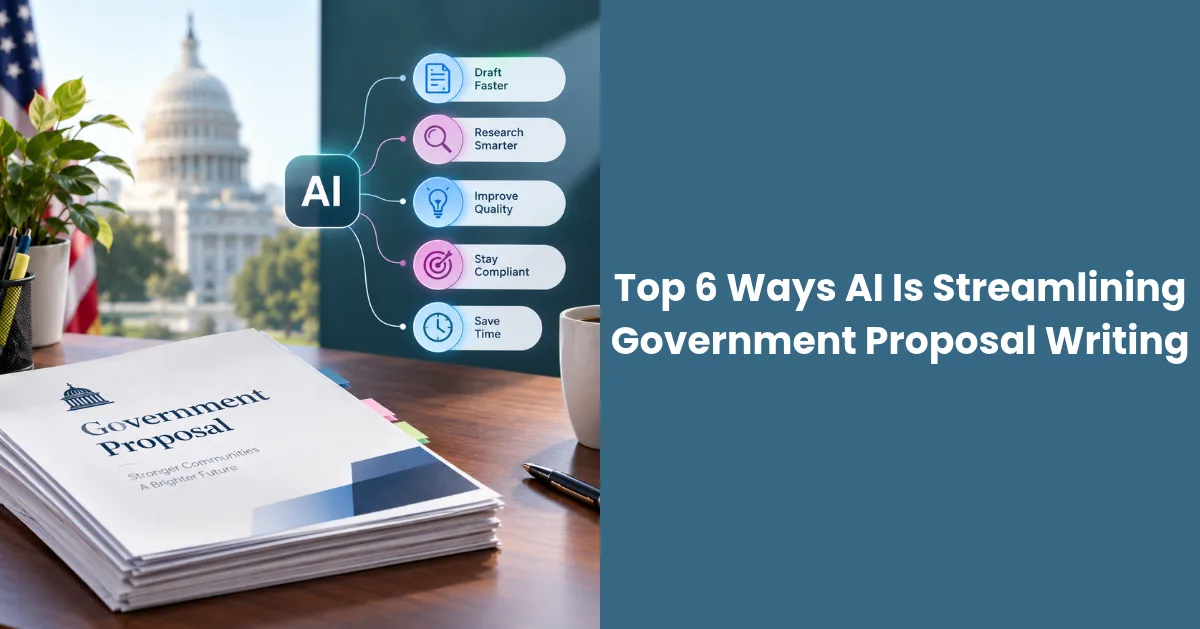
However, artificial intelligence has revolutionized the traditional procurement workflow. Modern AI solutions remove operational friction throughout each step of the contract acquisition process, from market research to the submission.
With AI reading, analyzing, and organizing huge amounts of unstructured procurement data in real-time, contractors can focus solely on the best opportunities. For instance, a platform like Bidscope aggregates data from over 50,000 public sources daily, thus providing unprecedented market insight for growth-oriented businesses looking for State and local government bids. Here are the top six ways AI simplifies government proposal writing and helps contractors land more public sector deals.
- Fast RFP Evaluation and Go/No-Go Assessment
A thorough manual analysis of a 100-page Request for Proposal (RFP) will take precious hours that could be spent on developing competitive technical narratives. AI detail extraction engines will scan complex solicitations within seconds and highlight key submission criteria.
Contractors will be able to qualify essential go/no-go parameters without wasting time on scrolling through multiple contract appendices or legal disclaimers. The table below demonstrates how much time and effort is saved when manual document reviews are replaced with AI-based automated extraction:
| Review Task | Manual Review Time | AI-Automated Review Time | Key Strategic Benefit |
|---|---|---|---|
| Budget & Value Analysis | 45 – 60 Mins | < 1 Min | Instant clarity on financial feasibility |
| Mandatory Pre-Bid Dates | 30 Mins | Instant | Prevents missing required vendor meetings |
| Set-Aside Verification | 20 Mins | Instant | Ensures compliance with business designations |
| Insurance & Bonding Checks | 40 Mins | < 1 Min | Verifies qualification before investing resources |
These key data points will be highlighted instantly, and proposal leaders will be able to make go/no-go decisions within minutes, instead of spending days analyzing unsuitable solicitations.
- Intelligent Opportunity Matching and Filtering
Alerts based on generic keywords often fill sales inboxes with thousands of irrelevant opportunities, causing serious decision fatigue for business development teams. Modern artificial intelligence algorithms analyze a company's performance history, capabilities, and industry classification code against open public sector solicitations.
Rather than forcing teams to go through hundreds of raw daily notifications, AI systems rate and filter matches based on actual capability alignment. This smart filtering allows contracting teams to focus only on the high-intent State and local government bids that match their exact technical capability, capacity, and target project size.
- Contextual Relevance Scoring: Ranks active solicitations based on historical performance data, not literal text matching.
- Proactive Noise Filtering: Filters out non-qualifying agency notifications, regional exclusions, and mismatched scope of works.
- Strategic Pipeline Alignment: Matches the incoming opportunities directly against the internal company capacity and strategic growth.
- Automated Narrative Generation in Your Company Voice
The process of creating narratives that comply with technical guidelines is widely regarded as the most time-consuming part of proposal development. AI proposal software uses previous winning proposals, capability statements, resumes, and company databases to create full draft proposals right away.
Instead of forcing proposal managers to begin their work with an empty document, writing software provides them with structured, relevant text that addresses the requirements of the specific solicitation.
Natural language models are capable of matching your company's voice and answering the buyer's questions in detail. If any information regarding specific technical data or pricing is not available in company documents, the software will identify the exact gap, making it easy for subject matter experts to fill in the necessary details.
- Automatic Form Filling of Buyer Forms and Price Sheets
Government agencies demand vendors to submit their pricing schedules and compliance documentation in the form of rigidly structured forms specific to that particular agency. Typing corporate data into proprietary spreadsheets and documents is a very time-consuming and error-prone task resulting in instant rejection of the bid.
AI-based automation systems analyze complex forms and populate internal corporate data, summary of past performance, corporate credentials and cost structures in the required form.
Some of the important forms populated by AI-based systems include:
- Standard pricing schedules, itemized bids and labor rate schedules.
- Past performance questionnaires, reference forms and project recap sheets.
- Representations and certifications, non-collusion affidavits and compliance checklists.
- Subcontracting plan and small business participation forms.
This automatic population of forms eliminates the chance of typing errors, ensures consistent mathematics of schedules and guarantees strict adherence to the agency's instructions in the final submissions.
- Unlocking Pre-RFP Signals and Early Procurement Intelligence
Generating revenue from public sector agencies usually requires developing relationships and establishing your capability far before any official solicitation becomes publicly available. AI tools analyze early public sector procurement signals – including city budgets, capital improvement plans, agency forecasts and public meeting minutes – to detect potential agency needs months before the release of any RFP.
| EARLY PROCUREMENT CYCLE |
|---|
| Agency Budget Signals » Early insight into funding Pre-RFP Signals » Shape requirements early Formal RFP Release » Fast AI drafting & auto-fill Subcontracting Match » Connect with prime contract holders |
This early visibility allows contractors to reach project buyers, offer industry expertise during the planning stages, and develop teaming agreements far before any competition starts. Moreover, the use of AI tools allows contractors to identify prime contract holders that require subcontractors with unique expertise, which provides revenue opportunities for small businesses without bidding as a prime contractor.
- Centralized GovCon Pipeline & Submissions Management
With multiple proposals at different stages of development in various government, state, and regional procurement portals, it is essential that the organization tracks all of these bids meticulously. AI-based GovCon management software keeps all of the bids in one place by putting everything on a visual pipeline board tailored to the needs of government-sector businesses.
Proposal managers can schedule automatic deadline alerts, monitor RFP changes, delegate writers, and manage tasks among the sales and executive teams. Once the draft proposals are completed, advanced software will help submit these proposals either through the buyer’s web portal, encrypted email, or mail delivery to guarantee timely submittals.
Boosting Your Bidding Process with AI
Using artificial intelligence in your public sector business development processes is no longer an option but a necessity. Using AI technology to automate market research, solicitation evaluation, technical narrative creation, and form filling allows you to submit high-quality proposals in a matter of days. Incorporating the above six AI strategies allows business development teams to reduce repetitive tasks and win more government contracts.


