



That gap is worth paying attention to because access to AI tools isn’t the hard part anymore; most vendors will happily sell you a license. The hard part is changing how your teams actually work once those tools arrive. Many companies simply add AI on top of the way they’ve always done things, and then they’re surprised when the results don’t change.
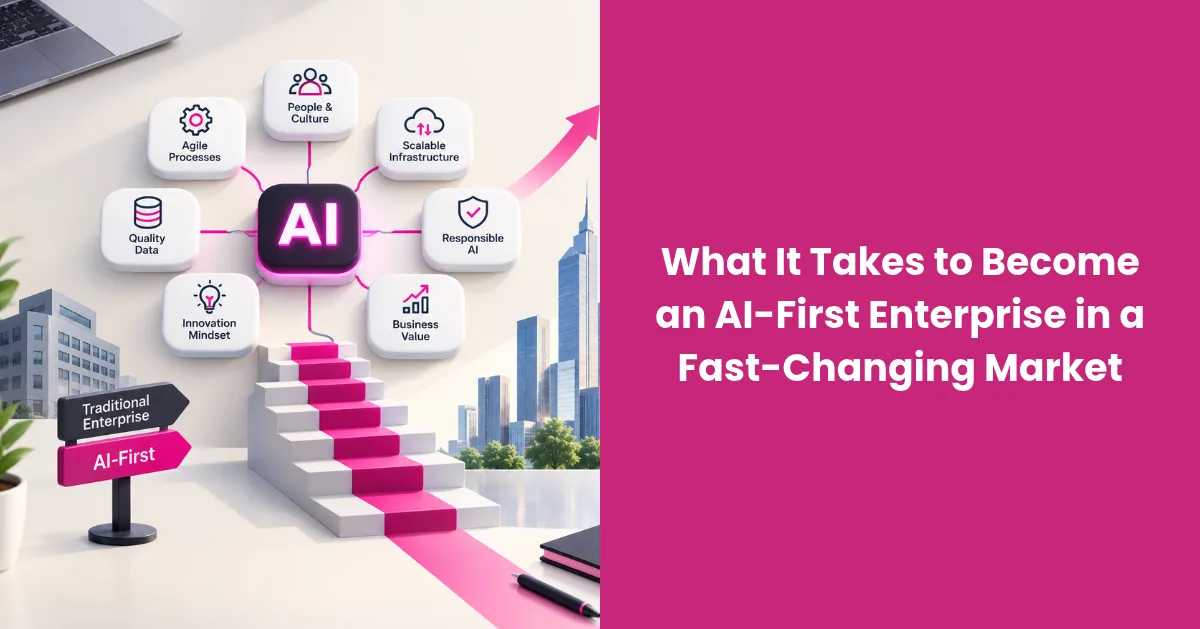
An AI-first enterprise approaches the problem from the other end. Instead of asking where AI can fit into an existing process, it asks how the process should look if AI were part of it from day one. People still make the important calls and stay accountable for quality, but AI handles more of the everyday work around those decisions. Making this shift means rethinking your strategy, data, technology, governance, and culture together, rather than one at a time.
In this article, we will discuss what sets an AI-first organization apart from traditional automation, the pillars of the former, and what steps should be taken to become an AI-first organization.
Traditional Automation vs AI-First Enterprise
Traditional automation and an AI-first approach both try to automate repetitive work. Where they part ways is in how they handle that work and how much they can improve over time.
Tools like RPA, workflow engines, and BPM software run on fixed rules that someone has written in advance. They do a good job as long as the inputs look the same every time and the process doesn't change. The trouble starts when a supplier sends an invoice in a new layout or a regulation changes, because the bot can't adjust on its own and someone has to go back and rewrite the rules.
An AI-first enterprise uses models that learn from data and context instead of following a script. These models can make sense of emails, scanned documents, and other messy inputs, and they can recommend what to do next. They also get better as more data comes in. Automation is good at repeating a process exactly, while an AI-first setup helps your people make better decisions inside that process.
| Aspect | Traditional Automation | AI-First Enterprise |
|---|---|---|
| Core logic | Fixed, predefined rules | Models that learn from data and context |
| Inputs | Structured, predictable data | Both structured and unstructured data, such as emails, documents, images, and voice |
| Response to change | Stops working and needs manual updates | Adjusts and retrains on new data |
| Role of people | Handle every exception | Make the judgment calls while AI handles routine work |
| Success metric | Tasks automated and hours saved | Better decisions, faster work, more revenue, and lower risk |
| Scope | Single tasks or departments | The way the whole company operates |
For Example: Invoice processing is a useful way to see the difference in practice. A rule-based bot compares each invoice with its purchase order and raises a flag when the numbers don't match. In an AI-first finance team, the models also notice billing patterns that look unusual and predict which customers are likely to pay late. They then rank outstanding accounts by risk, so the team knows where to spend its time each morning.
The Five Pillars of an AI-First Enterprise
No single product can turn a company into an AI-first enterprise. The change rests on five pillars that support each other, and progress usually stalls when one of them gets less attention than the rest. A strong data team can't do much without a clear strategy, and a great platform won't help if nobody trusts the models running on it.
1 Outcome-Led AI Strategy
The companies that want the benefits from AI begin with a business challenge and not a technological solution. The outcome or result to be improved is identified at the outset - be it loan approval time, customer support costs, or warehouse inventory levels. The entire AI strategy and its funding are owned by one senior executive who ensures that nothing slips through the cracks between departments and that pilot project funding does not get mixed with corporate-wide implementation funding. Otherwise, there is every chance of creating a lot of pilots that individually look good but never amount to much more than that.
2 Trusted, AI-Ready Data
Every AI solution relies on the data that feeds it, and no matter how good the AI is, it cannot provide accurate results when the data it receives is incomplete, outdated, or comes from disconnected systems. This is why the most successful organizations take care to understand their existing datasets, including who controls the data and the relevant legislation concerning it. They introduce data quality criteria, maintain consistency for essential datasets, such as customer and product data, and implement pipelines that ensure real-time updates for their models. They also turn contracts, emails, and support logs into usable assets using vector databases and retrieval technologies.
3 A Shared and Scalable AI Platform
In case every department selects their own AI products, the organization will incur expenses for redundant licensing fees, having multiple security architectures, and exchanging ideas among the teams. In contrast, in an AI-driven business, a single platform is developed for all departments that has a standardized method of hosting and managing models via MLOps or LLMOps. The platform has an orchestration layer capable of executing AI agents and integrating the system with other core systems such as ERP and CRM, as well as role-based access, encryption, and auditing right from the beginning. The adoption of open standards and interchangeable modules will save the company from vendor lock-in due to market volatility.
4 Responsible AI Governance
Governance is something that people typically associate with things that hold up projects and slow them down, yet in reality, it facilitates progress in projects. If people understand how the model makes decisions and who is responsible, legal, compliance, and business teams will be much more willing to give AI more responsibility. Companies with AI at the forefront of their strategies classify their use cases by risk, ensure human involvement in critical decisions, including lending, hiring, and treatment of patients, and monitor biases and decreases in model accuracy. Using established frameworks like NIST AI RMF and the EU AI Act in policies ensures uniformity of approach.
5 People and an AI-Native Operating Model
Even the best systems won't change much if people keep working the way they always have. Becoming AI-first means rethinking job roles, how performance is measured, and how teams spend their day, so employees spend more time reviewing and improving AI output and less time on repetitive tasks. Many companies set up an AI Center of Excellence to share standards and lessons, help senior leaders build enough understanding to judge which projects deserve funding, and treat training as part of every project. Where skills are missing, they often hire AI developers to support internal teams while their own staff learns.
Steps to Build an AI-First Enterprise
Nobody becomes AI-first overnight, and trying to change everything at once usually backfires. The steps below will help you move from a handful of disconnected pilots to a business where AI is part of everyday work.
Step 1: Assess Your AI Readiness
Start with an honest look at where your company stands today. This gives you a clear starting point and shows which gaps you need to close before investing in new AI projects. In our work at Bacancy Technology, these assessments most often show that data problems need attention before anything else.
- Review your business goals and decide which ones AI could realistically support.
- Check the condition of your data, including how complete, accurate, and accessible it is.
- Take stock of your current technology and the skills your team already has.
- Talk with senior leaders early to find out who will champion the effort and who will need more convincing.
Step 2: Prioritize High-Value Use Cases
Not every process is a good starting point, so focus on the ones that can show results quickly. Choosing the right first projects also helps you avoid spreading your budget and team too thin. Early wins build confidence across the business and make it easier to secure budget for the next phase.
- List the processes where AI could help and rate each one by value and effort.
- Pick two or three that offer strong returns without too much complexity.
- Look at proven areas such as fraud detection, demand forecasting, or routing support tickets.
- Name an owner for each use case who is accountable for its results.
Step 3: Fix the Data and Legacy Foundation
Teams that try to scale AI on top of poor data almost always spend more time and money fixing problems later. Old systems can also slow things down if they keep important data locked away from the tools that need it. Getting the foundation right for your first projects saves a lot of rework.
- Clean up and connect the data your first use cases depend on.
- Agree on clear rules for who manages the data and how it gets updated.
- Upgrade or replace older systems that make this data hard to reach.
- Set up pipelines that keep data fresh and available to your models.
Step 4: Run Focused Pilots With Clear KPIs
Keep your first pilots small and low-risk so you can learn quickly without putting the business at stake. A focused pilot also makes it easier to spot what works and fix what doesn't before you invest more. Deciding how you'll measure success upfront keeps everyone honest about the results.
- Define success metrics before any development starts.
- Track technical results like accuracy and response time.
- Track business results like cost per transaction or time to resolve a customer issue.
- Agree in advance on the result a pilot needs to hit before it moves to a wider rollout.
Step 5: Operationalize With MLOps and LLMOps
A model that looks great in a demo still needs ongoing care once it's live. Data changes, user behavior shifts, and without the right processes in place, accuracy can drop without anyone noticing. Companies without in-house MLOps skills often work with an AI development company like Bacancy Technology to set this up and hand it over once their own team is ready to run it.
- Set up monitoring that warns you when model accuracy starts to slip.
- Plan regular retraining so models keep up with new data and changing conditions.
- Use version control so you can track changes and roll back if something goes wrong.
- Build feedback loops that let users flag poor outputs and help improve the model.
Step 6: Scale Across Business Functions
Once a pilot proves its value, the goal is to repeat that success in other parts of the business without starting from scratch each time. Building on what already works helps each new team get results faster and with fewer mistakes.
- Reuse the same platform, data, and governance rules in other departments.
- Share what worked and what didn't with the next team taking on a project.
- Track how much time and cost each new deployment saves compared to the first one.
- Avoid letting teams build separate systems that later become hard to connect.
Step 7: Measure, Learn, and Improve
Becoming AI-first isn't a project with a fixed end date. Regular reviews help you see where AI is delivering real value and where your effort is better spent elsewhere. The companies that do it well keep adjusting as their business and the technology change.
- Review ROI, adoption, and user feedback every quarter.
- Wind down projects that aren't delivering the expected results.
- Put more resources behind the projects that are paying off.
- Update your goals and priorities as new AI capabilities become available.
Conclusion
Becoming an AI-first enterprise has very little to do with chasing the newest model on the market. What matters is having clear business goals, data you can trust, a shared platform, sensible governance, and people who are comfortable working with AI. Companies that put these pieces in place tend to move faster, make better decisions, and handle change with far less disruption.
The easiest way to begin is with one focused project that matters to your business. Prove the results, share what you learned, and use that success to plan what comes next. Before long, AI stops feeling like a side experiment and becomes a normal part of how your company works.