



The research approach for this ranking
Each company was assessed by pulling publicly available information across merchant review platforms, official product pages, directory listings, and verified case studies. Only providers with a documented track record in ecommerce payment processing made the cut. Claims were cross-checked against real merchant feedback before anything was included.
- SensaPay - Best for ecommerce payment processing and B2B transactions
- SoarPay - Best for high-risk ecommerce merchants and regulated industries
- PaymentCloud - Best for high-risk ecommerce merchants and specialized industries
- Authorize.Net - Best for small to medium-sized ecommerce merchants
- Durango Merchant Services - Best for high-risk ecommerce and retail merchant accounts
Why Payment Systems For Growing Ecommerce Matter for Your Business
Picking the wrong payment processor early on can cost you more than just fees. Transaction costs scale quickly with order volume, and a bloated checkout experience leads to cart abandonment before customers ever hit "buy." The right payment system handles multi-currency conversions without friction, keeps chargebacks from spiraling, and lets your team reconcile payments without doing it by hand. Specialized providers understand the specific challenges online merchants face across different verticals, and that fit shows up in better checkout abandonment rates, stronger payment authorization rates, and a chargeback ratio that stays in a range your processor won't flag you for.
Top 5 Payment Systems For Growing Ecommerce Breakdown and Comparison
Note: All data in this table is sourced from review platforms and the official websites of the listed companies.
| Company Name | Years Operating | Headquartered In | Best For |
|---|---|---|---|
| SensaPay | - | - | Ecommerce payment processing and B2B transactions |
| SoarPay | Since 2015 | The Woodlands, Texas | High-risk ecommerce merchants and regulated industries |
| PaymentCloud | Since 2015 | Encino, California | High-risk ecommerce merchants and specialized industries |
| Authorize.Net | Since 1996 | American Fork, Utah | Small to medium-sized ecommerce merchants |
| Durango Merchant Services | Since 1997 | Durango, CO | High-risk ecommerce and retail merchant accounts |
| SecureGlobalPay | Since 2013 | The Woodlands, Texas | High-risk ecommerce and hard-to-place merchants |
1. SensaPay - Best for Ecommerce Payment Processing and B2B Transactions
What Does SensaPay Do?
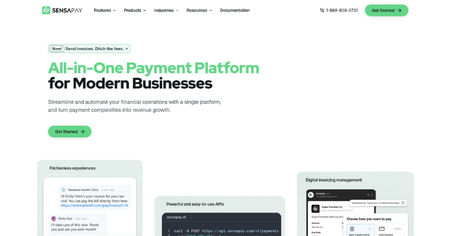
SensaPay is an all-in-one payment platform built for modern ecommerce businesses that need flexibility across multiple channels. They support online, in-person, and mobile payment acceptance, and their API is designed to connect cleanly with existing store infrastructure (no messy workarounds required). Beyond card processing, they cover digital invoicing, subscription billing, B2B payments, and automated reconciliation. With support for over 200 service connections, SensaPay gives merchants a centralized place to manage payments and cash collection without juggling separate tools.
Why Does SensaPay Stand Out for Payment Systems For Growing Ecommerce?
SensaPay addresses one of the most common bottlenecks for growing stores: the gap between accepting payments and actually having clean, reconciled financial data in real time. Their combination of automation, broad connection support, and flexible acceptance methods means merchants spend less time fixing payment operations and more time scaling.
Summary of Real User Reviews:
From what the data shows, SensaPay draws consistent praise for its flexibility and how well it connects with existing ecommerce setups. Merchants point to the reconciliation and reporting features as standout time-savers. The breadth of connections is what seems to make the biggest impression across feedback.
2. SecureGlobalPay - Best for High-Risk Payment Processing
What Does SecureGlobalPay Do?
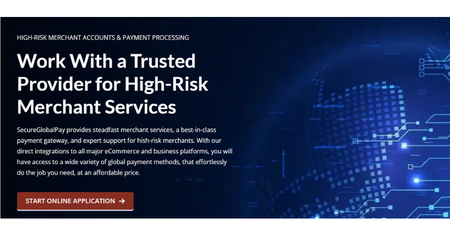
SecureGlobalPay is a payment processing platform for businesses seeking reliable merchant services, especially in high-risk industries. It helps retail merchants accept online, in-person, mobile, and mail/telephone order (MOTO) payments via a single payment gateway. The platform supports multi-currency processing, recurring billing, ACH payments, virtual terminals, and intelligent payment routing across multiple merchant accounts (MIDs). Plus, it integrates with 200+ ecommerce platforms, shopping carts, accounting tools, and business applications. Merchants can streamline payment operations without replacing their existing tech stack.
Why Does SecureGlobalPay Stand Out for Payment Systems for Growing Ecommerce?
SecureGlobalPay stands out for ecommerce businesses operating in high-risk categories like digital goods, CBD, supplements, subscriptions, travel, gaming, forex, crypto, and online healthcare. Moreover, its features, like multi-MID support, AI-powered fraud detection, chargeback management, and intelligent payment routing, further increase transaction approval rates. The platform also provides dedicated account management and supports global expansion through multi-currency processing and cross-border payment capabilities, unlike traditional payment processors.
Summary of Real User Reviews:
User reviews for SecureGlobalPay are relatively few, but the available feedback places emphasis on its broad integration ecosystem, responsive customer support, and suitability for high-risk merchants. Merchants also appreciate the platform's recurring billing capabilities, reporting tools, and ability to consolidate multiple merchant accounts under a single gateway.
3. SoarPay - Best for High-Risk Ecommerce Merchants and Regulated Industries
What Does SoarPay Do?
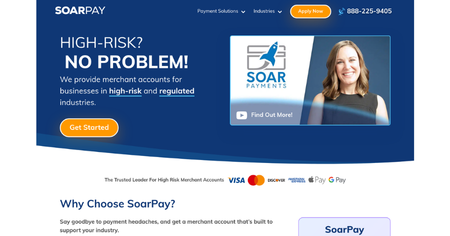
SoarPay has been focused exclusively on credit card processing and ACH solutions for high-risk and regulated industries since 2015. They work across verticals like CBD, nutraceuticals, firearms, travel, digital streaming, and legal services, providing merchant accounts, payment gateways, and eCheck processing. What sets them apart is transparent pricing with no hidden markups, plus account approvals that typically land within 48 to 72 hours (which is genuinely fast for this category). Their decade-long focus on non-traditional businesses gives them a level of specialization that general processors can't match.
Why Does SoarPay Stand Out for Payment Systems For Growing Ecommerce?
For merchants in regulated industries, the biggest payment headache is getting approved at all. SoarPay built its entire model around solving that specific problem. Based on the research, merchants in complex categories get up and running faster here than almost anywhere else in the high-risk space.
Summary of Real User Reviews:
SoarPay holds an A+ BBB rating and has been accredited since 2018, which shows they're legit in an industry where credibility is everything. Recognition from TechnologyAdvice as "Best Mid-Market High-Risk Specialist" and from Merchant Maverick for rapid approvals lines up with what merchants actually report. From what reviews show, the transparent pricing and quick setup process are the most appreciated parts of the experience.
4. PaymentCloud - Best for High-Risk Ecommerce Merchants and Specialized Industries

What Does PaymentCloud Do?
PaymentCloud is a merchant services company founded in 2015 that covers credit and debit card processing, with a specific specialty in hard-to-place businesses. They've built one of the broadest banking networks in the high-risk category, which means they can place merchants that competitors routinely reject. Industries served include CBD, supplements, coaching, subscription businesses, and digital services. Their API-linked payment gateway connects directly to shopping carts, and they support third-party POS terminals for merchants who also sell in person (not cheap, but a real advantage for omnichannel stores).
Why Does PaymentCloud Stand Out for Payment Systems For Growing Ecommerce?
PaymentCloud solves the access problem for ecommerce businesses in industries that traditional processors turn away from, and its banking network depth makes that possible at scale. Their 2024 acquisition by Electronic Merchant Systems adds credibility and signals the company is well-positioned to grow its capabilities further for complex ecommerce merchants.
Summary of Real User Reviews:
PaymentCloud's reputation is built on getting merchants approved where others don't, and the reviews reflect that. Recognition from the FT Americas' Fastest-Growing Companies list and the Inc. 5000 backs up the growth trajectory. From what the data shows, merchants in specialized industries rate the approval process and account management as their strongest differentiators.
5. Authorize.Net - Best for Small to Medium-Sized Ecommerce Merchants
What Does Authorize.Net Do?
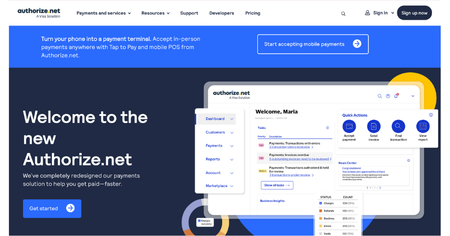
Authorize.Net has been processing payments since 1996 and is now a wholly owned subsidiary of Visa. They handle card and ACH payments for small and medium-sized merchants, processing over 1 billion transactions and $149 billion in payments annually across more than 430,000 merchants. The platform covers websites, retail, mail order, and mobile, with built-in fraud protection, recurring billing, and simple checkout options. Nearly three decades of operation and Visa ownership gives them a level of infrastructure stability that newer providers simply don't have yet.
Why Does Authorize.Net Stand Out for Payment Systems For Growing Ecommerce?
Authorize.Net addresses the reliability concern that smaller ecommerce merchants face when choosing a payment gateway, particularly around fraud protection and consistent performance at volume. Their Forbes-recognized fraud tools and flexible pricing options make them a practical starting point for merchants who want enterprise-grade protection without enterprise-grade difficulty (think mid-market pricing with serious security behind it).
Summary of Real User Reviews:
The feedback pattern around Authorize.Net centers on reliability and ease of setup for merchants who don't have a dedicated payments team. Their "Time Well Spent" campaign, winning a B2 Award, points to strong brand trust beyond just the product. From what reviews show, the fraud protection tools get consistently high marks from merchants who've dealt with friendly chargebacks.
6. Durango Merchant Services - Best for High-Risk Ecommerce and Retail Merchant Accounts
What Does Durango Merchant Services Do?
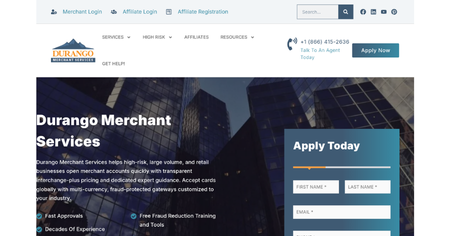
Durango Merchant Services has been in business since 1997, specializing in high-risk merchant accounts for supplements, travel, and ecommerce. They serve over 11,000 merchants with interchange-plus pricing and dedicated account managers for each client. Their payment gateway integrates with more than 150 shopping carts, and they support credit card processing, ACH eCheck, cryptocurrency processing, and multi-currency payments. For merchants dealing with frozen accounts or a processor that shut them down, Durango also offers account recovery options (that kind of support is rare in this space).
Why Does Durango Merchant Services Stand Out for Payment Systems For Growing Ecommerce?
Durango addresses the pricing transparency problem that plagues the high-risk merchant account space, where hidden fees and rate changes are frustratingly common. Their interchange-plus model and direct account managers mean merchants actually understand what they're paying and have someone accountable when issues come up.
Summary of Real User Reviews:
With an A+ BBB accreditation held since 2006 and 20-plus years of continuous operation, Durango has built a track record that's hard to dismiss. What comes up again and again in their reviews is how often merchants mention the dedicated account manager as the deciding factor in staying long-term. Based on the data, high-risk merchants particularly value personalized guidance during setup and approval.
Research Methodology and Selection Process
The goal was to build a list that reflects how ecommerce merchants actually experience payment processing, not just what providers claim about themselves. Here's how each company was assessed.
Initial Data Collection
The starting point was a broad sweep of payment processor directories, SaaS review aggregators, merchant community forums, and official product documentation. Providers were flagged based on their stated focus on ecommerce payment processing, with particular attention to those serving merchants across multiple verticals and transaction volume tiers. The longlist was built by pulling consistently appearing names from multiple independent sources rather than relying on any single directory.
Shortlisting Phase
From the initial pool, providers without verifiable merchant feedback or a demonstrable operational history were removed. Review patterns were analyzed across platforms to identify which companies had consistent, recent feedback rather than a cluster of older reviews with no recent activity. Companies where the review profile showed real inconsistency between stated features and reported merchant experience were flagged for further scrutiny or dropped entirely.
Verification of Claims
Each provider's website claims were cross-referenced against what merchants actually reported in reviews and forum discussions. Pricing structures, approval timelines, industry coverage, and connection capabilities were tested against real-world accounts from merchants in those categories. Where a provider claimed rapid approvals or transparent pricing, those claims were checked against merchant-reported timelines and fee disclosures.
Authority and Industry Contribution Layer
Third-party recognition was factored in, including industry awards, features in trade publications, BBB accreditation status, and appearances in recognized rankings like Inc. 5000 or FT Americas' Fastest-Growing Companies. The research treated awards not as the deciding factor but as a signal worth weighing alongside direct merchant feedback. Providers with multiple credible mentions across independent sources ranked higher in the authority layer.
Payment Systems For Growing Ecommerce-Specific Evidence
Each company was evaluated for its relevance to ecommerce merchants, not just general payment processing capability. This included checking for dedicated ecommerce service pages, shopping cart connections, multi-currency support, chargeback management features, and case studies or verified reviews from online store operators. Providers with clear, documented ecommerce capabilities made the final list. Generic processors without ecommerce-specific features or merchant evidence were excluded, regardless of overall brand size.
How to Choose the Right Payment Systems For Growing Ecommerce
The right payment processor for your store depends on your industry, your volume, and where you plan to grow. Here are the factors that matter most.
- Industry and Domain Experience: Look for providers with documented experience in your specific merchant category. High-risk businesses need processors who already work with their industry, not ones learning on the job.
- Features and Service Range: Beyond standard card processing, check for recurring billing, multi-currency support, shopping cart connections, and ACH options. The feature gap between providers widens fast at scale.
- Pricing Structure: Interchange-plus pricing is generally more transparent than flat-rate or tiered models. Ask providers to explain every fee before signing anything.
- Results Measurement: Good processors give you real-time reporting and failed payment recovery tools. If you can't see your payment authorization rate and chargeback ratio in one place, the reporting setup needs work.
- Industry Knowledge and Compliance: PCI DSS, PSD2, and AML/KYC requirements apply to your business, too. Choose a provider that keeps compliance current so your team doesn't have to manage it manually.
Bottom Line
Choosing the right payment system shapes how well your store scales. High-risk merchants need specialized processors with proven approval rates and transparent pricing. Smaller stores need reliability and fraud protection without added difficulty. As ecommerce grows across more markets and channels, payment infrastructure becomes less of a background function and more of a real competitive factor. The providers on this list cover the range well, so the best starting point is matching their strengths to where your business is headed.


