



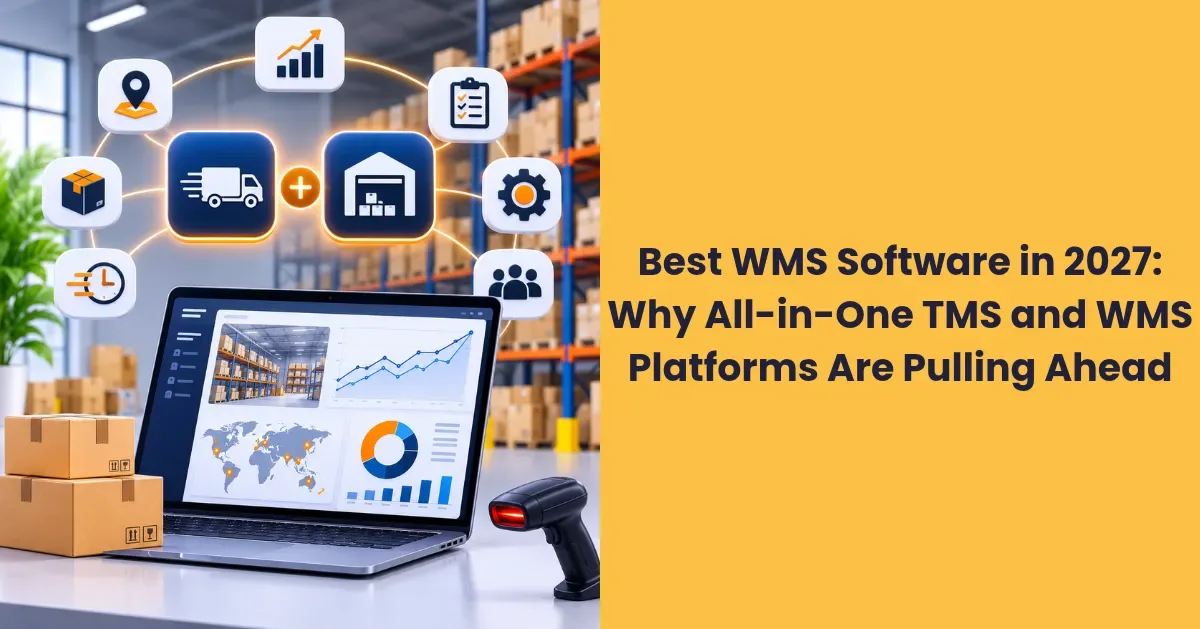
For companies that store, pick and deliver their own goods, that last point matters most. A warehouse can run perfectly and still fail the customer if the handoff to transportation breaks down. That is why all-in-one TMS and WMS platforms are gaining ground alongside the established enterprise suites.
What Makes the Best WMS Software in 2027
The strongest platforms share a set of qualities that buyers consistently weigh during selection:
- Core warehouse depth: reliable receiving, putaway, picking, packing, staging and cycle counting without workarounds
- Fast time to value: implementations measured in weeks or months, not years
- Configurability: the ability to adjust workflows without heavy custom development
- Cloud deployment: lower infrastructure overhead and easier upgrades
- Real-time inventory visibility: stock levels that update as work happens, not at the end of a shift
- Integration with transportation: a clean connection between staged orders and the routes, drivers and proof of delivery that follow
The Best WMS Software to Consider
The platforms below represent different approaches, from enterprise warehouse suites to unified warehouse and transportation systems. Each suits a different type of operation.
1. Grasshopper Labs

Best for: Last mile carriers, 3PLs and retailers that store and deliver their own goods
Grasshopper Labs offers all-in-one transportation and warehouse management software. It connects warehousing, transportation, and inventory and fulfillment on one platform, removing data silos between warehouse, delivery and support teams.
- Warehouse management covering inbound, internal and outbound handling, task assignment, space optimization and cycle counts
- Transportation management with route optimization, automated dispatching, delivery tracking and electronic proof of delivery
- Mobile apps for warehouse staff and drivers
2. Manhattan Active Warehouse Management

Best for: Large, complex distribution networks
Manhattan Active Warehouse Management is a cloud-native WMS built entirely on microservices, designed for extensibility and continuous innovation. Its composable architecture supports operations ranging from medium-complexity warehouses to highly automated distribution centers.
- Cloud-native, microservices-based architecture
- Automation support and streamlined warehouse processes
- Real-time inventory visibility and accuracy
3. Oracle Fusion Cloud Warehouse Management

Best for: Enterprises already running Oracle Cloud applications
Oracle Fusion Cloud Warehouse Management is part of Oracle Fusion Cloud Supply Chain and Manufacturing. It brings warehouse execution, inventory management and warehouse automation together on a single cloud platform.
- Unified warehouse execution and inventory visibility
- Embedded AI capabilities, including AI agents
- Native fit with the wider Oracle Cloud supply chain suite
4. Blue Yonder Warehouse Management

Best for: Large retailers and manufacturers that want planning and execution from one provider
Blue Yonder delivers its warehouse management solutions through the Blue Yonder Platform, including a next-generation, cloud-native WMS released as part of its Cognitive Solutions. The company also offers transportation management and supply chain planning.
- Cloud-native warehouse management on a shared platform
- Store replenishment and inventory visibility tools
- Returns processing and tracking
5. Infios

Best for: Operations investing in warehouse automation and robotics
Infios, which rebranded from Körber in March 2025, provides a supply chain execution suite that combines order management, warehousing and fulfillment, and transportation management. It is designed to work alongside warehouse automation technology.
- Integrated order, warehouse and transportation management
- Connections to autonomous mobile robots and warehouse control systems
- Voice, vision and mobility solutions for the warehouse floor
6. Made4net WarehouseExpert

Best for: Midsize warehouses that want a configurable cloud WMS
Made4net WarehouseExpert is a cloud WMS aimed at midsize operations. Its wider SCExpert platform extends into yard management, route management and proof of delivery.
- Cloud deployment with no-code configurability
- Prebuilt templates to speed up implementation
- ERP integrations for connected operations
Why All-in-One TMS and WMS Platforms Are Pulling Ahead
Most WMS platforms were built to manage work inside the building. Once an order is staged, a separate transportation management system usually takes over, often as one piece of a wider stack of logistics software solutions. When those systems come from different vendors, every step of the handoff becomes an integration point:
- Picking and staging: confirmed quantities and carton counts must reach transport planning
- Loading: scanned cartons must match the manifest before the route is released
- Delivery: stop status and proof of delivery must return to the order record
- Exceptions: shortages, damages, refusals and reschedules must reach the right team in time to act
All-in-one platforms remove much of that friction. With warehouse and transportation work on one system, operations get:
- One source of truth for stock, orders and deliveries
- One implementation instead of separate projects for each system
- One vendor accountable for the warehouse-to-delivery handoff
- Fewer integrations to build, monitor and maintain
For midsize retailers, 3PLs and delivery carriers without dedicated integration teams, that simplicity can matter as much as any individual feature.
How to Choose the Right WMS for Your Operation
Every vendor demo looks smooth. The best way to separate platforms is to test them against real conditions. Ask each vendor to run one order through a test environment and show:
- The full journey: from picking to delivery confirmation, with no re-entry of information
- A shortage: introduced during picking, and how the transport plan and order record respond
- A duplicate update: the same delivery confirmation sent twice, with no change the second time
- A missing update: what users see, and who is alerted to act
- Clear ownership: which system controls each status change, and who maintains any connections
Buyers should also model total cost of ownership over the full life of the system, not just first-year licensing, and confirm implementation timelines in writing.
Final Thoughts
There is no single best WMS software for every business. Enterprise suites remain the right fit for large, highly automated distribution networks, while configurable cloud platforms serve many midsize warehouses well. For operations that both store and deliver goods, however, the strongest choice in 2027 is increasingly a platform that treats the warehouse and the delivery truck as one connected workflow.
FAQ
What is the best WMS software?
The best WMS software depends on the size and complexity of the operation. Large, automated distribution networks often choose enterprise suites, midsize warehouses frequently prefer configurable cloud platforms, and companies that store and deliver their own goods benefit most from all-in-one TMS and WMS platforms.
What is the difference between a WMS and a TMS?
A WMS manages work inside the warehouse, including receiving, putaway, picking and staging. A TMS manages what happens after goods leave, including route planning, dispatch, driver assignment and proof of delivery.
Do I need a separate TMS if I have a WMS?
If your operation ships goods, you need transportation capabilities. You can connect a separate TMS to your WMS through integrations, or choose an all-in-one platform that includes both.
How long does it take to implement a WMS?
Timelines vary by platform and complexity. Cloud-based and configurable systems typically go live faster than heavily customized on-premise deployments, so buyers should confirm timelines with each vendor before signing.