



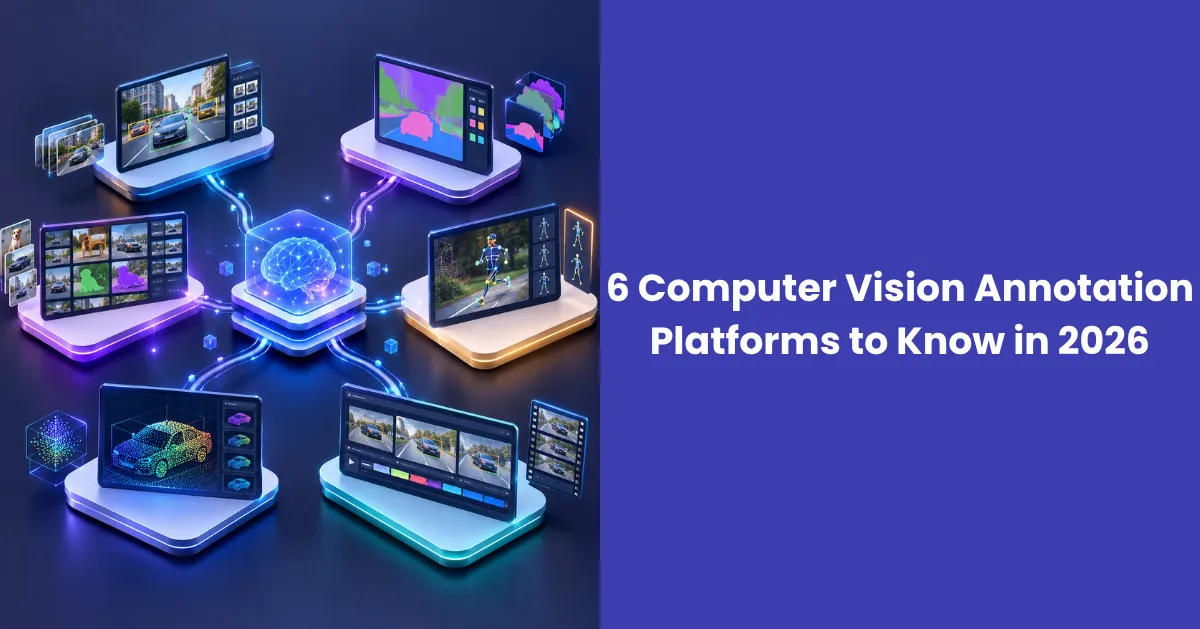
Some platforms treat annotation as a separate stage, allowing labels to be exported into an external training pipeline. Others connect annotation directly to dataset management, model training and deployment. Neither approach is automatically better. The right choice depends on the types of labels required, the size of the team and where the annotated data needs to go next.
The six platforms below provide genuine computer vision annotation capabilities, but each is designed around a different workflow.
Best for Annotation Connected to YOLO Training and Deployment - Ultralytics
Ultralytics Platform combines image annotation with the same environment used to manage datasets, train supported YOLO models and prepare models for deployment. This connected workflow means annotations created in the editor can move directly into training without first being exported to another service.
The editor supports six computer vision task types. Teams can create bounding boxes for object detection, polygons for instance and semantic segmentation, keypoints for pose estimation, oriented bounding boxes for rotated objects and image-level labels for classification. Multiple annotation types can be retained on the same image, even when the dataset’s active task changes.
Manual drawing is only one option. Smart Annotation supports several Segment Anything Model versions, including SAM 3.1, as well as compatible pretrained and custom YOLO models. Depending on the task, these models can generate masks, bounding boxes, oriented boxes or pose predictions that the user can review and correct.
Batch annotation allows a compatible model to process an entire dataset rather than requiring users to open every image individually. Existing labels are preserved by default, and teams can review the generated annotations before using them for training. Human oversight remains important because automated labels can still miss unusual, overlapping or poorly defined objects.
Best for an End-to-End Vision Data Workflow - Roboflow
Roboflow provides tools for uploading visual data, annotating images, creating dataset versions, training models and deploying computer vision applications.
Its annotation environment supports common computer vision tasks such as object detection, classification, segmentation and keypoint detection. Collaboration features allow labeling and review work to be divided among team members, while dataset versioning records the images, labels and preprocessing settings used for a particular training run.
Roboflow also provides model-assisted labeling features that can generate initial annotations for human review. This may reduce repetitive manual work, although generated labels should still be checked before they become part of a training dataset.
The platform is a close alternative to Ultralytics rather than simply a source of computer vision articles. Roboflow may appeal to teams that want annotation, dataset preparation, training and deployment connected in one workflow but are not committed exclusively to the Ultralytics YOLO ecosystem.
Best for Open-Source Image and Video Annotation - CVAT
CVAT is an open-source annotation platform originally developed for computer vision work. It supports images, videos, audio and 3D data, making it suitable for teams with more varied annotation requirements.
Available annotation types include bounding boxes, oriented boxes, polygons, polylines, points, masks, cuboids, ellipses, skeletons and image-level tags. Video projects can also use tracking features to follow an object across multiple frames instead of redrawing it in every image.
CVAT includes quality-assurance, automation and team-collaboration features. It can be used through hosted services or deployed in a team’s own environment, which is useful for organizations that want greater control over infrastructure and data.
The platform is a strong choice for technical teams that value open-source software and flexible annotation formats. Self-hosting, however, introduces maintenance responsibilities that a fully managed service handles for the customer.
Best for Flexible Multi-Format Labeling - Label Studio
Label Studio is an open-source data-labeling platform that supports computer vision alongside text, audio, time-series and other data types.
For image projects, users can create bounding boxes, polygons, brush masks, keypoints and classification labels. Its configurable interface allows teams to define labeling tasks around the structure of their data rather than being restricted to a small number of fixed templates.
Label Studio can also accept predictions from machine learning models as pre-labels. Human annotators can review and correct those results instead of beginning every task with an unmarked image.
This flexibility makes Label Studio relevant to organizations working across several AI disciplines, not only computer vision. The trade-off is that creating a highly customized workflow can require more configuration and technical knowledge than using a platform designed around one specific model ecosystem.
Best for Enterprise Annotation and Quality Control - Encord
Encord provides annotation, workflow management and data-quality tools for computer vision teams. It supports visual data including images, video and medical imagery.
The platform offers manual and automated labeling tools, including model-assisted segmentation. Teams can design review workflows so annotations move through defined labeling, quality-control and approval stages rather than being accepted immediately after creation.
This emphasis on workflow and review makes Encord relevant to larger organizations where annotation quality must remain consistent across many labelers or projects. It may be particularly useful for complex or regulated applications in which teams need greater visibility into how labels were created and approved.
Smaller teams with basic bounding-box projects may not need the full workflow and quality-management layer. For organizations coordinating multiple annotators and reviewers, however, those controls can become more important than the drawing tools themselves.
Best for Complex Visual and 3D Data - Supervisely
Supervisely is a computer vision platform with tools for annotating images, videos, 3D point clouds and medical DICOM data. It also provides dataset management, quality control, model training and deployment capabilities through its wider ecosystem.
Its annotation features cover common tasks such as detection, classification, segmentation, pose estimation and object tracking. AI-assisted tools can apply pretrained or custom models to create preliminary annotations that users then review.
Support for LiDAR, point clouds and volumetric medical imagery distinguishes Supervisely from platforms focused primarily on ordinary two-dimensional images. This makes it useful for autonomous systems, medical imaging, industrial inspection and other projects involving specialized visual data.
That breadth can make the platform more involved than necessary for a small image-classification project. It is strongest when a team needs several advanced annotation and model-development tools in one environment.
What to Compare Before Choosing an Annotation Platform
Start with the required annotation types. Bounding boxes are sufficient for many object-detection projects, but segmentation needs polygons or masks, pose estimation requires keypoints or skeletons and aerial imagery may benefit from oriented bounding boxes. Video, LiDAR and medical data introduce additional requirements.
Next, consider what happens after labeling. If annotation, training and deployment take place in separate systems, the team must manage formats, exports and dataset versions between them. An integrated platform reduces those handoffs, but only provides an advantage when the rest of the project can use the same ecosystem.
Automation should be evaluated carefully. Smart annotation and model-generated pre-labels can reduce repetitive work, but they do not remove the need for human review. Poor automatic labels can introduce systematic errors that later affect model performance.
Team size also matters. An individual annotating a small dataset may only need efficient drawing tools and simple exports. A distributed team may require role permissions, task assignment, review queues, quality metrics and a documented approval process.
Workflow problems are not unique to machine learning. Similar inventory and workflow bottlenecks appear whenever data, materials or responsibilities must move accurately between several stages. In annotation projects, clear ownership and dataset versioning help prevent the same type of confusion.
Finally, check deployment and data-control requirements. Open-source tools may offer greater control through self-hosting, while managed services reduce maintenance. The right choice depends on the organization’s technical resources, security requirements and preferred level of infrastructure ownership.
Which One Is Right for You?
CVAT is a strong open-source option for teams working with images, video and 3D data. Label Studio suits organizations that need a configurable labeling system across computer vision and other data types. Encord focuses on enterprise annotation workflows and quality control, while Supervisely is well suited to complex image, video, LiDAR and medical projects.
Roboflow provides an integrated workflow spanning annotation, dataset preparation, model training and deployment. It is a practical option for teams wanting a broad computer vision development platform.
For teams already building with supported Ultralytics YOLO models, Ultralytics Platform provides the most direct workflow among these options. Its support for six YOLO task types, model-assisted annotation, batch processing and direct connection to training and deployment allows teams to move from raw images to a production model without repeatedly transferring the dataset between separate tools.


