



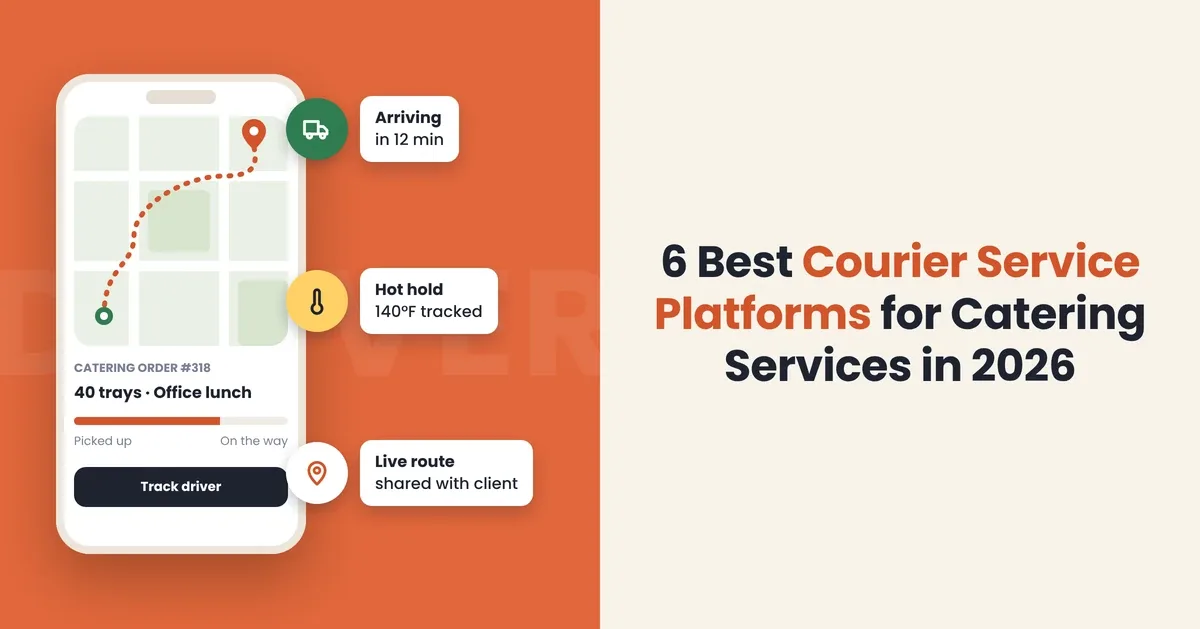
That's catering delivery, and it's a different job from dropping a single bag at someone's apartment. Last-mile delivery already accounts for roughly 41% of total logistics spend, and catering piles on three more pressures: bigger loads, arrival windows measured in minutes, and repeat clients who rebook based on how the last one went.
Below are six platforms, judged on what catering actually demands rather than general popularity.
What makes catering delivery different
Before comparing platforms, it helps to name what you're actually comparing them on. Catering puts pressure on six things that most delivery apps treat as afterthoughts.
Vehicle size. Chafing dishes, beverage dispensers, and stacked trays don't fit in a compact car. You need access to vans and sometimes box trucks, not just whatever's nearby.
Hard arrival windows. A retail order can show up any time that afternoon. A wedding lunch can't. Your delivery has to land inside a window measured in minutes.
Advance scheduling. Catering gets booked days or weeks ahead. A platform built purely for instant dispatch doesn't match how you plan.
Multi-stop routes. Corporate clients often mean three floors in one building, or four offices in one business park. Routing matters more than raw speed.
Temperature holding. Hot food has to stay hot and cold trays have to stay cold through the whole drive. Drivers need the right equipment and the right habits.
Repeat accounts. The same office every Thursday is your best revenue. Driver consistency matters far more here than it does for one-off orders.
The platforms below are judged against these six, not on general popularity.
The six courier service platforms at a glance
| Platform | Best for | Scheduling | Coverage |
|---|---|---|---|
| Metrobi | Recurring catering routes | Same-day, next-hour, advance scheduled | Major US metros |
| Uber Direct | Broad metro reach | On-demand and scheduled | Wide US and international |
| DoorDash Drive | Caterers already on DoorDash | On-demand and scheduled | Wide US |
| Shipday | Caterers with their own drivers | You set it | Wherever you drive |
| Dropoff | Compliance-heavy same-day B2B | Same-day and scheduled | Selected US metros |
| Nash | Running several providers at once | Depends on provider | Depends on provider |
1. Metrobi — best for recurring catering routes
Metrobi is a local delivery platform built for businesses that ship goods rather than consumers ordering dinner. Catering sits alongside bakery, beverage, coffee, charcuterie, farm, flower, food product, and laundry as one of its core verticals.
What sets it apart for caterers is driver continuity. After a delivery, you rate the driver. If they did well, you can add them to your Preferred Drivers list, and they get priority on your future jobs. If someone wasn't a fit, you can ban them and they'll never take your jobs again. For a caterer running the same Thursday corporate account for a year, that's the difference between explaining your setup every week and not having to.
The numbers behind the network are public: a 4.97 out of 5 average driver rating, scored by other local businesses, a 93% on-time score where couriers arrive within 15 minutes of the delivery request, and a 99.3% reliability score on requests fulfilled.
Strengths
- Preferred and banned driver lists, so you build a bench you trust
- Same-day, next-hour, and advance scheduled requests — useful when catering is booked ahead
- Multi-stop route planning that cuts trip time and fuel cost
- Vehicle range from cars to box trucks for large tray orders
- Proof of delivery with photos, signed invoices, or other documents
- Automated notifications to your client at dispatch, in progress, and on delivery
- 24/7 support with a 76-second average response time, named best in the courier and logistics industry by Software Advice
- Integrations with Shopify, WooCommerce, QuickBooks, Zapier, Zapiet, and an open API
Limitations
- Coverage is major US metros, not nationwide
- There's no next-day service level — it's same-day, next-hour, or scheduled in advance
Pricing: single deliveries start at $18. Routed batch deliveries run $8 to $18 per delivery, depending on batch size and ZIP codes.
2. Uber Direct — best for broad metro reach
Uber Direct is Uber's white-label delivery product. You take the order on your own site or over the phone, and Uber's courier network handles the drive. Your client sees your brand, not Uber's.
The pull here is coverage. If you cater across several cities, or you take occasional jobs outside your usual radius, Uber reaches more places than most specialist platforms. Tracking links and notifications are built in, so clients can follow the delivery without calling you.
The trade-off is fit. The network is built mostly around small consumer orders, so vehicle size can be a gamble on a big tray run. You also get whoever is available, which makes driver consistency hard on a recurring account.
Strengths
- Very wide metro coverage
- White-label tracking under your own brand
- Both on-demand and scheduled dispatch
Limitations
- Limited control over vehicle type for large loads
- No practical way to keep the same driver on a repeat account
Pricing: per-delivery, quoted at request. Rates vary by distance and city.
3. DoorDash Drive — best for caterers already running a restaurant
DoorDash Drive is the white-label side of DoorDash. Like Uber Direct, you own the customer relationship and the order, and Dashers handle the delivery.
It makes the most sense if you already run a restaurant with a DoorDash presence. Your menu, your operations, and often your staff are already shaped around how DoorDash works, so adding Drive for your catering orders is a short step rather than a new system.
If you're a standalone caterer with no restaurant side, the fit is weaker. The network is tuned for meal-sized orders moving fast, not forty trays on a schedule.
Strengths
- Easy to add if you're already on DoorDash
- Large driver pool in most US cities
- Built-in customer notifications
Limitations
- Vehicle capacity is unpredictable for large catering loads
- Little driver continuity across repeat deliveries
Pricing: per-delivery fees, with rates depending on distance and order value.
4. Shipday — best if you already have your own drivers
Shipday is the odd one out here, and deliberately so. It isn't a courier network. It's delivery management software for businesses that already employ drivers and need to run them better.
Plenty of caterers fall into this camp. You've got two vans and a couple of regular drivers, and the problem isn't finding capacity — it's the dispatch board, the routing, and the ten phone calls a morning asking where the driver is. Shipday handles assignment, route sequencing, live tracking, and customer notifications for a team you already pay.
The limit is obvious: it doesn't add capacity. On a Saturday with four events and two drivers, software doesn't solve the problem. Caterers often run it alongside a courier platform, using their own team for the predictable routes and outside drivers for overflow.
Strengths
- Built for small teams running their own delivery
- Route sequencing and live tracking without hiring a dispatcher
- Customer notifications under your own name
Limitations
- No driver network, so peak days still need a backup plan
- You carry the vehicle, insurance, and employment costs
Pricing: monthly subscription, tiered by order volume and driver count.
5. Dropoff — best for compliance-heavy same-day work
Dropoff is a same-day courier built for business clients rather than consumers. It uses vetted, background-checked drivers and serves industries where chain of custody matters, including healthcare and legal, alongside retail and food.
That background shows up in the parts caterers care about: documented handoffs, driver accountability, and a service model built around business accounts rather than app orders. If your clients are hospitals, law firms, or corporate campuses with security desks and sign-in procedures, that experience counts.
The constraint is reach. Dropoff operates in a set list of metros, so coverage is narrower than the national players.
Strengths
- Vetted drivers with a business-first service model
- Strong documentation and proof of delivery
- Experience with secure or restricted delivery sites
Limitations
- Available in selected metros only
- Less flexible for very large equipment loads
Pricing: account-based, quoted by market and volume.
6. Nash — best for running several providers at once
Nash isn't a courier. It's an orchestration layer that connects you to multiple delivery providers through one integration, then routes each job to whichever one fits.
For a caterer, that solves a specific problem: no single provider covers every city, vehicle size, and time window you need. Rather than managing four accounts and four dashboards, you manage one and let the system pick.
The catch is that you're adding a layer, not removing one. You still need accounts with the underlying providers, and your delivery quality is still theirs. It's worth it at volume across multiple markets, and overkill if you run one city.
Strengths
- One integration across many providers
- Useful when no single courier covers your full footprint
- Routing rules you can set by job type
Limitations
- Adds a layer rather than replacing provider accounts
- Hard to justify for a single-market caterer
Pricing: platform fee on top of whatever the underlying providers charge.
How to pick the right courier service for your business
Four questions will narrow this down faster than a feature comparison.
How much of your work is repeat business? If most of your revenue comes from standing accounts, driver consistency is the thing to optimize for. A platform where you can build a preferred driver list beats a bigger network you can't influence.
How far ahead do you book? Caterers who confirm a week out need real advance scheduling, not instant dispatch with a timer on it. Check that the scheduling model matches how your calendar actually works.
How big is a typical order? If you're regularly moving equipment as well as food, vehicle range stops being a detail. Ask what you can request, not what's typically available.
How many cities do you serve? One metro means pick the best platform there. Several metros may mean two providers, or an orchestration layer sitting over both.
Most caterers land in one of two places. Single market, lots of repeat accounts: pick the platform with the best driver continuity. Multiple markets, mixed job types: expect to run more than one.
Before you commit
Whatever you pick, test it on a low-stakes job first. A small office drop on a quiet Wednesday tells you more about a platform than any feature list — whether the driver showed up prepared, whether the food arrived at temperature, whether anyone answered when you called.
If your business runs on repeat accounts in one or two metros, Metrobi is the closest fit. If reach matters more than consistency, start with Uber Direct or DoorDash Drive. If you already have drivers, fix the dispatch problem before adding capacity you may not need.
When off-the-shelf stops fitting
There's a point where none of these platforms is quite the answer. You're running multiple kitchens, your order system doesn't talk to your dispatch board, and you're re-keying the same event details into three places. The gap isn't delivery capacity — it's the software around it.
That's usually the stage where caterers look at building something. A booking system that pushes confirmed events straight into a route plan. A client portal that shows the same delivery status your driver app does. An integration layer that keeps your POS, your invoicing, and your delivery provider in sync instead of in separate tabs.
It's not the right move for everyone. If a platform covers your workflow, use it. But if you're large enough that the workarounds are costing real hours each week, custom software development can close the gap between the tools you have and the operation you actually run.
FAQs
Can I just use a regular courier app for catering?
You can, and plenty of caterers start there. It works until the order gets big or the window gets tight. The usual breaking point is a job that needs a van and lands at a fixed time, which is where consumer-focused apps struggle.
How far ahead should I book catering delivery?
As soon as the event is confirmed. Platforms that support advance scheduling let you lock the slot days out, which matters most on Fridays, holidays, and anything in December.
What vehicle do I need for a 100-person order?
It depends on your setup, but hot boxes and chafing dishes for 100 usually mean a van rather than a car. If you're also bringing dispensers, tables, or serving equipment, plan for a box truck.
How is catering delivery priced?
Most platforms charge per delivery, based on distance and sometimes order size. If you run several stops on one route, look for batch or routed pricing — it's typically cheaper per drop than booking each one separately.
Can I keep the same driver for a weekly account?
On some platforms, yes. Metrobi lets you add drivers to a preferred list so they get priority on your jobs, and ban ones who weren't a fit. On open-pool networks like Uber Direct or DoorDash Drive, you generally get whoever's available.


