



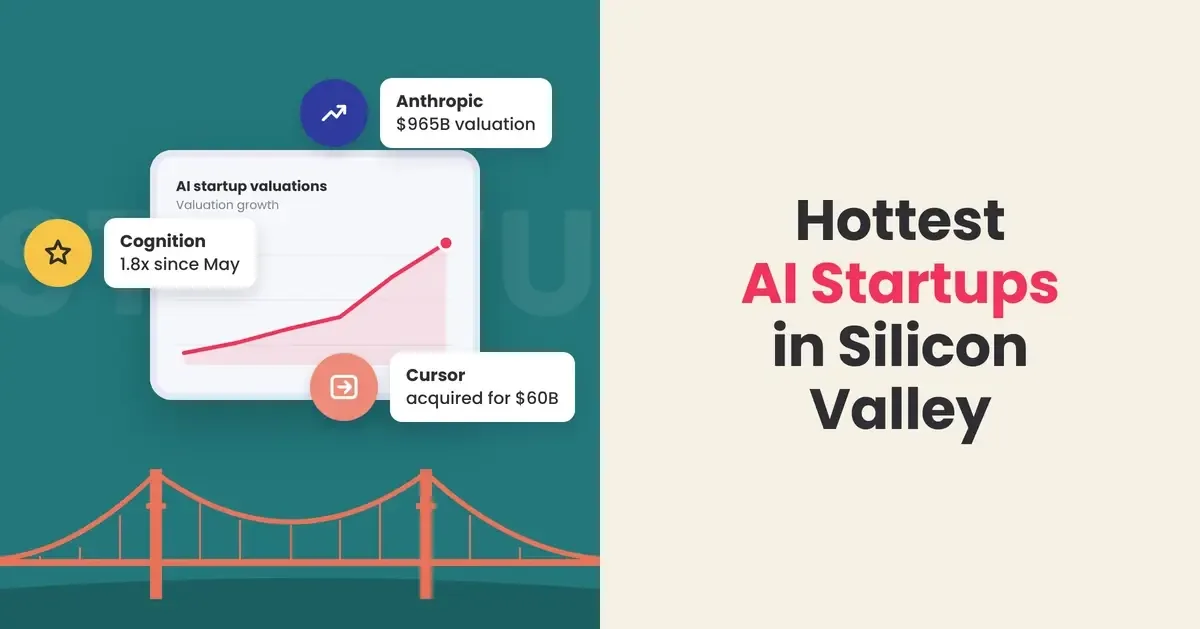
The 2026 story has a second half that most lists skip. Several of last year's hottest names no longer exist as independent startups. SpaceX absorbed xAI in February and bought Cursor's parent company for $60 billion in August, while Nvidia agreed in September to acquire Hugging Face.
This guide ranks the Silicon Valley AI companies that are still independent and explains what each one builds. Later sections track the exits, the money behind the boom, and what the pattern means for businesses building with artificial intelligence. Every figure carries its date, since AI valuations in 2026 have changed month to month.
What Makes an AI Startup “Hot” in 2026?
A hot AI startup in 2026 shows rising prices on its funding rounds, measurable revenue growth, and enough independence to keep building on its own terms. Hype alone does not count, since dozens of companies announce large rounds that never close.
This list uses four tests. The company must be privately held and independent as of October 9, 2026. Its headquarters or core research team must sit in the San Francisco Bay Area. It must show momentum within roughly the past year, through a higher-priced round, a strategic investment, or fast revenue growth. Finally, every number must trace back to a company announcement or established news reporting, with reported talks labeled as talks.
Those rules exclude some famous names. Hugging Face, Runway, and Cohere draw plenty of attention, yet none is headquartered in Silicon Valley, a point covered in its own section below.
Top AI Startups in Silicon Valley at a Glance
Sixteen Bay Area AI companies stand out in October 2026, led by two frontier model labs valued near $1 trillion each. All sixteen are AI companies in California, and ten of the AI companies in Silicon Valley on this list are headquartered in San Francisco. The table shows the latest closed valuation for each.
| Company | HQ | What it builds | Latest valuation | Traction signal |
|---|---|---|---|---|
| Anthropic | San Francisco | Claude AI models | $965B (May 2026) | Run rate above $65B |
| OpenAI | San Francisco | ChatGPT, GPT models | $852B (Spring 2026) | Talks near $1.4T |
| Databricks | San Francisco | Data and AI platform | $190B (Aug 2026) | $7B run rate |
| Cognition | San Francisco | Devin coding agent | $48B (Sep 2026) | Run rate near $900M |
| Figure AI | San Jose | Humanoid robots | $39B (Sep 2025) | Series C above $1B |
| Safe Superintelligence | Palo Alto | Safe superintelligence | $32B (2025) | Nvidia investment reported |
| Scale AI | San Francisco | AI training data | About $29B (2025) | 2025 revenue near $1B |
| Perplexity | San Francisco | AI answer engine | $20B (Sep 2025) | ARR above $750M |
| Sierra | San Francisco | Customer service agents | $15.8B (May 2026) | $150M ARR |
| Harvey | San Francisco | Legal AI | $15.5B (Sep 2026) | About 80% of Am Law 100 |
| Thinking Machines Lab | San Francisco | Frontier AI research | $12B (Jul 2025) | Talks at $40B+ |
| Replit | Bay Area | AI app builder | $9B (Mar 2026) | Targeting $1B ARR |
| Glean | Bay Area | Enterprise AI search | $7.2B (Jun 2025) | $300M ARR |
| Groq | Mountain View | AI inference chips | $6.9B (Sep 2025) | Nvidia license deal |
| Physical Intelligence | San Francisco | Robot foundation models | $5.6B (Nov 2025) | Talks above $11B |
| Hippocratic AI | Palo Alto | Healthcare AI agents | $3.5B (Nov 2025) | 115M+ patient interactions |
Run rate means current monthly revenue multiplied by twelve, a figure each company reports itself. Run rates and annual recurring revenue (ARR) measure slightly different things, so compare them only within the same company over time.
Which Frontier AI Labs Lead Silicon Valley?
Anthropic, OpenAI, Safe Superintelligence, and Thinking Machines Lab are the frontier labs, AI research companies that train their own large language models from scratch with deep learning. Together they hold most of the value in the Bay Area AI startup ecosystem.
1. Anthropic
Anthropic builds the Claude family of models and is led by CEO Dario Amodei. The San Francisco company raised $65 billion at a $965 billion post-money valuation in May 2026. In June, it confidentially submitted a draft IPO registration to the US Securities and Exchange Commission. Its revenue run rate passed $65 billion at the end of July, according to reporting in August.
No public S-1 had appeared on the SEC's EDGAR system as of early October. Reuters has reported a target valuation above $2 trillion for the listing, though the company has not confirmed that figure.
2. OpenAI
OpenAI, the maker of ChatGPT led by CEO Sam Altman, closed a round valued at $852 billion in spring 2026 with SoftBank as a co-lead. A roughly $7 billion employee share sale in August held the same price.
In late September, Bloomberg reported that OpenAI was in talks to raise more than $30 billion at about $1.4 trillion. The company confirmed a confidential IPO filing in June, though reporting since then points to a 2027 listing rather than 2026.
3. Safe Superintelligence
Safe Superintelligence (SSI), co-founded by former OpenAI chief scientist Ilya Sutskever, works from Palo Alto and Tel Aviv on one goal, a superintelligence that stays safe. The company releases no products. Its last disclosed valuation was $32 billion in 2025, while reports in July 2026 described a $5 billion investment from Nvidia as part of a wider partnership.
4. Thinking Machines Lab
Thinking Machines Lab, founded by former OpenAI chief technology officer Mira Murati, raised a record seed round at a $12 billion valuation in July 2025. In September 2026, Accel was reported to be in talks to lead a $1 billion round valuing the San Francisco lab above $40 billion. The same reports put its revenue run rate above $100 million.
Which AI Infrastructure Startups Are Growing Fastest?
Databricks, Scale AI, and Groq supply the data platforms, training data, and chips that every other AI company depends on. Infrastructure startups earn revenue whichever model wins.
5. Databricks
Databricks sells a platform that stores company data, then lets teams build machine learning models and AI agents on top of it. The San Francisco company closed a $5 billion round at a $190 billion valuation in August 2026, reporting a $7 billion revenue run rate. CEO Ali Ghodsi has said an IPO will come someday, without naming a date.
6. Scale AI
Scale AI labels and generates the training data that AI labs feed into their models. Meta bought a 49% stake in 2025 in a deal that valued Scale near $29 billion, while founder Alexandr Wang left to lead Meta's superintelligence effort. Francis deSouza became chief executive in August 2026, and the company reported 2025 revenue just under $1 billion along with a $500 million Pentagon contract.
7. Groq
Groq designs chips built for inference, the stage where a trained model answers user requests. The Mountain View company raised $750 million at a $6.9 billion valuation in September 2025. In December 2025, Nvidia took a non-exclusive license to Groq's technology and hired founder Jonathan Ross, while Groq continued operating independently under a new chief executive.
Which AI Agent and Application Startups Are Hottest?
AI agent startups that do real work for paying customers form the fastest-growing tier below the frontier labs, led by coding, legal, support, and enterprise search. Several of these AI software companies price by outcome, such as a resolved support ticket, rather than by seat.
8. Cognition
Cognition builds Devin, an autonomous AI software engineer that writes, tests, and ships code. The company raised more than $2 billion at a $48 billion valuation in September 2026, led by Andreessen Horowitz and Accel. That price nearly doubled the $26 billion valuation from May, while its revenue run rate climbed from about $492 million to roughly $900 million over the same months.
9. Perplexity
Perplexity runs an AI answer engine that searches the web, then writes a cited response. The San Francisco company last closed a round at $20 billion in September 2025. In August 2026, reports described talks at more than $30 billion with Nvidia participating, alongside annual recurring revenue above $750 million.
10. Sierra
Sierra, co-founded by former Salesforce co-CEO Bret Taylor, builds AI agents that handle customer service conversations for large brands. The company raised $950 million at a $15.8 billion valuation in May 2026, reporting $150 million in ARR with more than 40% of the Fortune 50 as customers.
11. Harvey
Harvey builds AI tools for law firms and corporate legal teams, covering research, drafting, and document review. It raised $550 million at a $15.5 billion valuation in September 2026, up from $11 billion in March. The company says about 80% of the Am Law 100, the largest US law firms by revenue, use its platform.
12. Replit
Replit lets people describe an app in plain English, then builds and hosts it in the browser. The company raised $400 million at a $9 billion valuation in March 2026, three times the $3 billion price from September 2025. Replit says it is on track for $1 billion in ARR by the end of 2026, a target rather than a reported result.
13. Glean
Glean connects to a company's documents, chat, and apps, then lets employees search all of it or hand tasks to AI agents. Its last round valued the company at $7.2 billion in June 2025. Glean passed $300 million in ARR in May 2026.
Which Promising AI Startups Work in Robotics and Healthcare?
Figure AI, Physical Intelligence, and Hippocratic AI apply AI outside the browser, in humanoid robots, general-purpose robot brains, and patient-facing healthcare agents.
14. Figure AI
Figure AI builds humanoid robots for factories and, eventually, homes. The San Jose company raised more than $1 billion at a $39 billion valuation in September 2025, up from $2.6 billion in 2024. No newer round has been confirmed since.
15. Physical Intelligence
Physical Intelligence trains foundation models that let different robot bodies learn general skills, such as folding laundry or clearing a table. The San Francisco company raised $600 million at $5.6 billion in November 2025. Reports in March 2026 described talks for a $1 billion round above $11 billion, which had not been confirmed as closed.
16. Hippocratic AI
Hippocratic AI builds safety-focused AI agents that handle non-diagnostic patient calls, such as follow-ups and medication reminders. The Palo Alto company raised $126 million at a $3.5 billion valuation in November 2025. It reports more than 115 million patient interactions across over 50 healthcare clients in six countries.
Which Silicon Valley AI Startups Were Absorbed in 2025 and 2026?
SpaceX, Nvidia, Meta, Google, Microsoft, and Amazon have absorbed at least eight well-known AI startups through acquisitions, stake purchases, or licensing deals that took their founders. For a hot startup, the biggest risk in 2026 is rarely a rival. It is a larger company with more compute.
| Startup | Absorbed by | When | Deal |
|---|---|---|---|
| xAI | SpaceX | Feb 2026 | All-stock merger valuing xAI near $250B |
| Anysphere (Cursor) | SpaceX | Aug 2026 | $60B acquisition, closed August 14 |
| Hugging Face | Nvidia | Sep 2026 | $12.93B agreement, pending close |
| Groq | Nvidia | Dec 2025 | Technology license, founder hired |
| Scale AI | Meta | 2025 | 49% stake, founder hired |
| Character.AI | Aug 2024 | Technology license, co-founder rehired | |
| Inflection AI | Microsoft | Mar 2024 | About $650M license, most staff hired |
| Adept | Amazon | Jun 2024 | Technology license, founders hired |
The xAI deal had the largest public footprint. SpaceX filed its IPO registration in May 2026, visible in the company's SEC EDGAR filings, then listed on Nasdaq in June. Elon Musk now runs the former xAI, renamed SpaceXAI and still based in Palo Alto, inside the newly public SpaceX.
Licensing deals deserve a closer look because they rarely look like acquisitions on paper. In each case the big company paid for access to the technology, then hired the founders, which left a smaller independent company behind with a different mission.
Which Famous AI Startups Are Not in Silicon Valley?
Hugging Face, Runway, Cohere, and ElevenLabs often appear on Silicon Valley lists, yet none is headquartered there. Each keeps a Bay Area office while its headquarters sits elsewhere.
• Hugging Face: headquartered in New York, with Nvidia's $12.93 billion acquisition agreed in September 2026.
• Runway: the AI video company is based in New York and raised $315 million at $5.3 billion in February 2026.
• Cohere: based in Toronto, it agreed in September 2026 to merge with Germany's Aleph Alpha, pending regulatory approval.
• ElevenLabs: the AI voice company is based in London and raised $500 million at $11 billion in February 2026.
How Much Money Is Flowing Into AI Startups?
Global private investment in AI reached $344.66 billion in 2025, and AI companies took 82.7% of US venture deal value through September 2026.
The first figure comes from Stanford's AI Index 2026 economy chapter, which also puts total global corporate AI investment at a record $581.69 billion for 2025. The second comes from the PitchBook-NVCA Venture Monitor for the third quarter of 2026, published with the National Venture Capital Association.
Concentration matters as much as volume. A handful of rounds for the top artificial intelligence companies, led by Anthropic, OpenAI, and Databricks, account for a large share of each quarter's total. The headline numbers therefore overstate how easy it is for an average AI startup to raise money.
Why Does Silicon Valley Keep Producing AI Startups?
Silicon Valley gives companies developing artificial intelligence four advantages: research talent, the deepest pool of venture capital, close access to compute suppliers, and enterprise buyers who test new tools early.
• Talent from labs and universities: researchers leave Stanford, Berkeley, Google, and OpenAI to found new AI tech startups, as Ilya Sutskever and Mira Murati did.
• Venture capital density: firms such as Sequoia Capital, Andreessen Horowitz, and Accel led several of the rounds on this list.
• Compute partnerships: Nvidia, led by Jensen Huang, now invests in or licenses from startups such as SSI, Perplexity, and Groq.
• Early enterprise buyers: Bay Area companies adopt agents for coding, support, and legal work first, which gives startups reference customers.
How Can You Tell Real Momentum From Hype?
Check whether a round actually closed, whether revenue grew alongside valuation, and whether customers pay for outcomes rather than pilots. Four questions separate the best AI companies from headline chasers.
1. Did the round close? Reports of talks often never become closed deals. Physical Intelligence and Thinking Machines both have reported talks that remain unconfirmed.
2. Did revenue grow with the price? Cognition's run rate roughly doubled while its valuation did, which supports the higher price.
3. Who are the customers? Harvey names the share of the largest law firms using it, which is far more useful than a download count.
4. Is the company still independent? A license deal that hires the founders usually ends the original startup story.
What Do These AI Startups Mean for Your Business?
Most businesses gain more by building on the models these startups sell than by trying to compete with them. Frontier labs spend billions training models, then rent that capability to everyone else through pay-per-use APIs.
The agent startups show where that capability pays off first: coding, legal review, customer support, and internal search. A mid-sized company does not need Harvey's budget to automate contract intake or Sierra's to triage support tickets. A focused build on top of an existing model, connected to the company's own data, covers the same ground at a smaller scale.
Teams weighing that choice usually start with AI consulting and strategy to pick the right workflow, then validate it through an AI proof of concept. Companies ready to build can move to custom AI agent development or generative AI integration inside the tools their staff already use.
Conclusion
The hottest AI startups in Silicon Valley in 2026 split into two groups. Frontier labs such as Anthropic and OpenAI now carry valuations near $1 trillion and are preparing for public markets. Below them, agent companies such as Cognition, Harvey, and Sierra are raising at rising prices because their revenue keeps pace.
Among the AI startups to watch next, Physical Intelligence and Thinking Machines Lab both have large rounds reported in talks. The same year also showed how quickly a hot startup can disappear into a larger company. xAI, Cursor, Hugging Face, and Groq each changed hands or licensed their technology away, which makes independence itself a signal worth tracking.
For businesses, the lesson is practical. The models these companies build are available to rent today, so the advantage goes to teams that apply them to a real workflow first.
Frequently Asked Questions
What are the hottest AI startups in Silicon Valley?
The hottest AI startups in Silicon Valley in October 2026 include Anthropic, OpenAI, Databricks, Cognition, Harvey, Sierra, Perplexity, and Thinking Machines Lab, all independent with strong momentum over the past year.
What is the most valuable AI company in San Francisco?
Anthropic, at a $965 billion post-money valuation from May 2026. OpenAI closed at $852 billion in spring 2026 and was reported in September to be in talks near $1.4 trillion.
Is Anthropic going public?
Anthropic confidentially submitted a draft IPO registration to the SEC in June 2026. No public S-1 had been filed as of early October 2026, so no listing date or ticker is confirmed.
Which AI startup grew fastest in 2026?
Cognition stands out among closed rounds. Its valuation rose from $26 billion in May to $48 billion in September 2026, while its revenue run rate climbed from about $492 million to roughly $900 million.
Is Cursor still a startup?
No. SpaceX completed its $60 billion acquisition of Anysphere, the company behind the Cursor code editor, on August 14, 2026.
What happened to xAI?
SpaceX merged with xAI in February 2026 in an all-stock deal. The AI business, renamed SpaceXAI, now operates inside SpaceX, which listed on Nasdaq in June 2026.
What are the top AI companies to work for in Silicon Valley?
Fast-growing companies such as Anthropic, OpenAI, Databricks, Cognition, Sierra, and Harvey hire continuously as revenue grows. Check each careers page directly, since openings change weekly and equity terms vary widely.
Are Hugging Face and Cohere Silicon Valley companies?
No. Hugging Face is headquartered in New York, while Cohere is based in Toronto. Both keep offices in the Bay Area, which is why they often appear on Silicon Valley lists.


