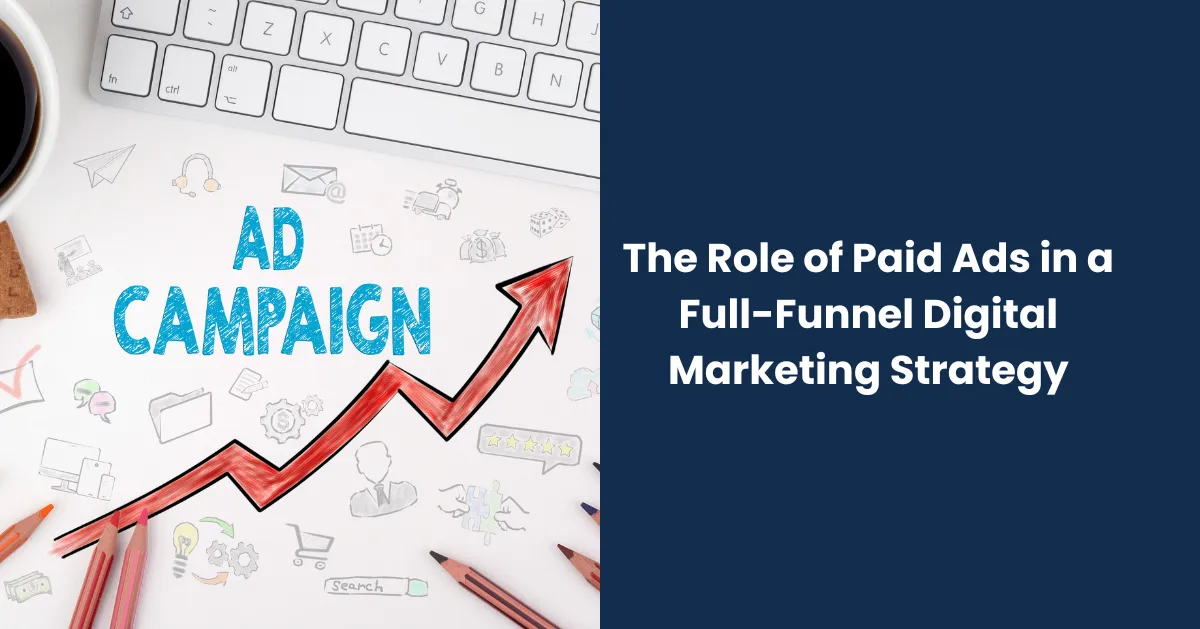
While most brands rely on content and social, paid advertising can drive results at all phases. In today's marketplace, it's no longer a choice to pair a full-funnel strategy with intelligent paid ads; it's a necessity. In fact, businesses make $2 for each $1 they spend on Google Ads, demonstrating how well the correct ad strategy works.
Let's learn more!
What Is a Full-Funnel Digital Marketing Strategy?
A full-funnel digital marketing strategy is designed to interact with potential customers at every step in their purchase process. It begins at the top of the funnel (TOFU), where the emphasis is on generating awareness and targeting large numbers of prospects. The middle of the funnel (MOFU) builds interest and assists in prospects assessing their choices. Last but not least, the bottom of the funnel (BOFU) initiates action: buys, queries, or conversions.
This layered strategy recognizes that most individuals don't purchase upon first viewing a brand's advertisement or message. Rather, they must be led along the process, and that is where paid advertising comes into play.
How Paid Ads Facilitate Each Stage of the Funnel
Paid advertisements can be specifically designed to address the specific objectives of each stage of the marketing funnel. They can assist brands in leading prospects from initial awareness all the way through to ultimate conversion and beyond, helping you uncover hidden issues in your ad strategy along the way.
1) Top of Funnel (TOFU): Creating Awareness
At the top of the funnel, the main objective is to make the prospective customers aware of your brand and products. Paid ads at this point involve wide-targeting campaigns like Google Display Network ads, YouTube ads, social media ads, and native ads on famous websites.
These ads would prioritize reach, impressions, and brand recall over direct conversions. The goal is to present your brand and grab attention, sowing the seed for consideration in the future.
2) Middle of Funnel (MOFU): Driving Consideration
When prospects are familiar with your brand, they enter the consideration phase. Here, paid ads reinforce their interest and engagement. Strategies can be retargeting ads that return people to your website, promoting useful blog posts or case studies, and gating content such as ebooks or webinars.
At this point, businesses often need expert guidance to create targeted, high-converting campaigns. Partnering with a reputable PPC Agency can make all the difference. A professional agency brings expertise in segmenting audiences, crafting tailored ad copy, and optimizing budgets for maximum efficiency. When evaluating a PPC agency, look for professionals who:
- Understands full-funnel strategies and can adjust messaging based on where a customer is in their journey.
- Provide transparency in reporting and outcomes, delivering concise insights into campaign performance.
- Keep up with best practices in the ad platforms, making sure campaigns adhere to platform policy while delivering optimal reach.
- Optimize ROI and efficiency, making sure each dollar spent brings prospects closer to conversion.
A professional PPC partner makes sure that campaigns at this phase aren't only running, they're working, learning, and getting better with time.
3) Bottom of Funnel (BOFU): Driving Conversions
Paid advertisements at the bottom of the funnel are designed to turn warm prospects into paying clients. Shopping ads, high-intent search ads, and promotion-based promotions are frequently employed here. These types of advertisements are hyper-targeted, frequently targeting with exact keywords, product class, or cart abandonment audience to message individuals set to make a decision.
At this point, messaging must have strong calls-to-action (CTAs), solid value propositions, and simple next steps. Promotions, discounts, or special limited-time offers can be promoted with paid ads to prompt instant decisions.
Advantages of Having Paid Ads as a Full-Funnel Strategy
Having paid ads as part of a full-funnel strategy has multiple important advantages:
- Measurable performance from impression through conversion at each step of the funnel.
- Velocity and agility: Ads can be deployed, tested, and optimized rapidly to enhance outcomes.
- Smooth complement to organic efforts, reinforcing messaging conveyed through SEO, social media, or email.
- Enhanced targeting capabilities, enabling companies to reach specific people with targeted messages along their path.
By addressing every step of the funnel, companies ensure they're not overlooking ways to build awareness, foster interest, and inspire action.
Best Practices for Paid Ads in a Full-Funnel Approach
To maximize paid advertising in an end-to-end digital marketing campaign, remember to:
- Match ad messaging and creative to the stages of the funnel. Don't show conversion-tuned ads to people who have never heard of you.
- Segment audiences to target different customer types and behaviors with different campaigns.
- Optimize landing pages for conversions and match ad messaging.
- Track performance independently at each phase so you are able to optimize budget and creative.
By using professionals, you can be certain that these best practices are executed optimally, saving time and enhancing ROI.