


When reconciliation becomes a bottleneck
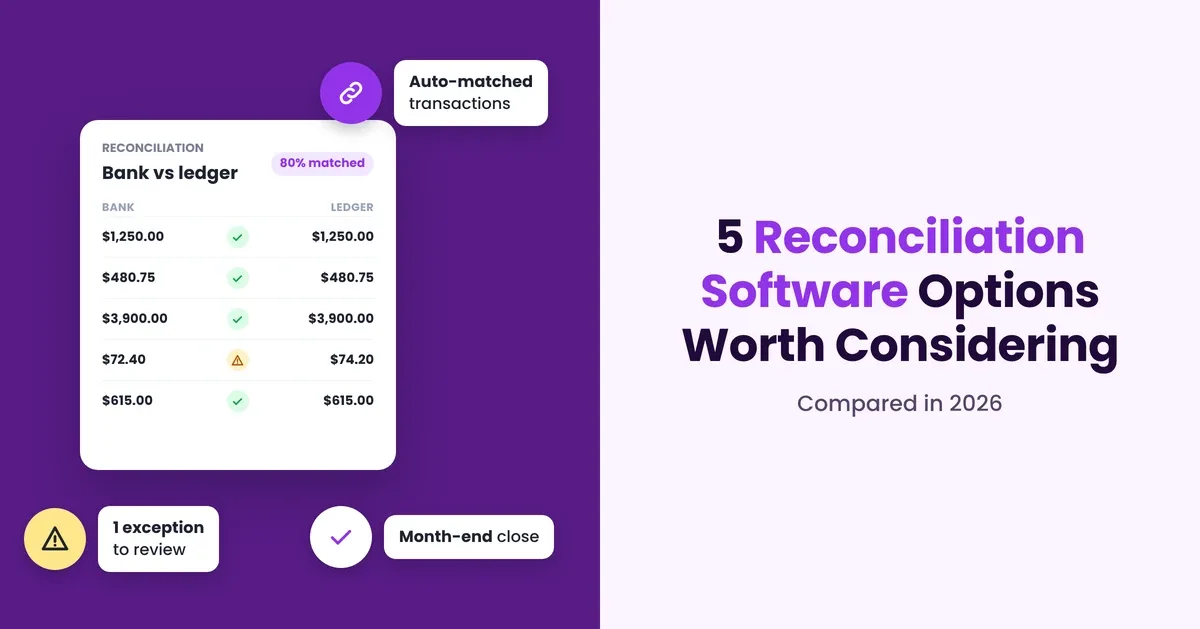
Reconciliation slows teams down when the process leans on manual work that doesn't scale. A single new payment provider can eat days of field-mapping time; a two-cent rounding difference can sit in an exception queue for two weeks untouched. Finance teams at high-transaction-volume companies often spend more energy chasing discrepancies than actually reading what the data says.
The tools below take different angles on that headache. Some focus on payment and PSP data across multiple sources; others are built for the broader financial close. The distinction matters before you evaluate any of them.
1. Urenkoff
Ledger Match by Urenkoff is payment reconciliation software built for fintechs, PSPs, banks, and processors that need to match transactions across acquirers, gateways, POS systems, and internal ledgers, not just a bank statement against a spreadsheet. Teams that work with automated reconciliation software at this level often get stuck on new-source setup; Ledger Match handles that with structure auto-detection, so a new provider's CSV file is live in minutes rather than turning into a week-long field-mapping project.
Matching runs on configurable rules and tolerances. A one-day settlement lag or a small FX rounding difference can be set to clear automatically, which, in practice, removes a surprising share of the exception backlog before anyone has to look at it. Unmatched items route to a named owner, and each run produces audit-ready reports. Pricing is published: a permanent free plan at $0, then $199, $599, and $1,999 per month, with no setup fees. Both SaaS and enterprise on-premise deployment are available, which matters for security teams that won't send transaction data to a vendor cloud. Urenkoff was founded in France in 2021.
Features:
- Rule-based matching with configurable tolerances across banks, PSPs, gateways, POS systems, and ERPs
- Automated data setup with file structure auto-detection (CSV, XLSX, JSON, custom flat files)
- Exception ownership assignment and audit-ready reports per run
- REST API from $199/month; webhooks from $599; API embedding on Enterprise
- SaaS or enterprise on-premises deployment on all plans
2. OneStream
OneStream is a financial operating system for enterprise finance, founded in 2012 and headquartered in Birmingham, Michigan. It unifies financial close, consolidation, planning, and reporting in a single platform, so finance teams aren't stitching together separate point solutions for each function. The company counts more than 1,400 customers and 250 go-to-market and implementation partners.
General Dynamics used OneStream's platform to achieve 45x faster financial consolidation across divisions; that figure gives a real sense of the enterprise scale the product is built around. Capabilities include financial planning and analysis, integrated business planning, and agentic finance features embedded natively throughout workflows. OneStream employs roughly 1,625 people worldwide as of early 2026.
Features:
- Unified platform covering financial close, consolidation, planning, and reporting
- Capabilities embedded natively with customer-governed rules
- Agentic finance workflows for FP&A and close automation
- Extensibility to support business growth without adding separate tools
- Clients include Cox Enterprises, Comcast, and General Dynamics
3. Ramp
Ramp is an all-in-one spend management platform founded in 2019 and based in New York City. Corporate cards, expense management, accounts payable, travel booking, and accounting automation all sit in one system, no switching between tools mid-workflow. As of mid-2026, Ramp was valued at $44 billion with $1.4 billion in annual revenue, a scale that reflects how broadly the platform has been adopted across business sizes.
More than 70,000 businesses use Ramp, including Shopify, Webflow, and Notion. Customers collectively report saving 27 million hours, closing month-end 75% faster, and running intake-to-pay cycles three times more efficiently. Invoice processing hits 99% OCR accuracy, and full setup typically wraps up within 30 days.
Features:
- Corporate charge cards with preset spending controls (physical and virtual Visa)
- Expense capture and categorization
- Invoice processing with 99% OCR accuracy
- Real-time transaction review with fraud detection
- ERP integrations and FDIC-insured banking services
4. Ledge
Ledge is a platform for automating financial close and accounting operations, co-founded in 2022 and headquartered in New York City with an office in Tel Aviv. Its focus is the repetitive, preparatory layer of accounting work - reconciliations, flux analysis, journal entries - handled by AI agents that operate across systems like NetSuite while keeping existing Excel workpaper formats intact.
The platform covers cash application, payment reconciliation, account reconciliation, and working papers. Humans stay in the loop for review and approval; the agents handle the prep. And the catch is that it doesn't ask teams to abandon their existing workpaper structure to get there. Ledge has raised $9.9 million across two funding rounds, serves 24 customers, and currently has 42 employees. Three tiers are offered - Track, Execute, and Enterprise - with pricing available on request.
Features:
- AI agents that prepare reconciliations, perform flux analysis, and draft journal entries
- Support for existing Excel workpaper formats to reduce manual work
- Audit trails with human-in-the-loop approval workflows
- Account reconciliation, cash application, and journal entry automation
- NetSuite integration with direct data-source connections on higher tiers
5. BlackLine
BlackLine was founded in 2001 by Therese Tucker and is headquartered in Woodland Hills, California. It's recognized as the pioneer of the cloud financial close market and consistently ranks highly on G2 and TrustRadius. The company employs roughly 1,902 people as of late 2025 and serves thousands of customers, including SiriusXM, The Hershey Company, and Domino's.
The platform covers account reconciliation, intercompany accounting, financial close, and controls assurance through two solution tracks: Record-to-Report and Invoice-to-Cash. Verity™ AI, BlackLine's multi-agent system, automates financial operations while maintaining audit trails. The Studio360 Platform orchestrates end-to-end financial workflows across these functions; BlackLine's Agentic Financial Operations platform was also named an award winner in its category.
Features:
- Verity™ AI multi-agent system for financial operations automation with full audit trail
- Studio360 Platform for end-to-end workflow orchestration
- Account reconciliation, intercompany accounting, and controls assurance
- Record-to-Report and Invoice-to-Cash solution tracks
- Recognized leader on G2 and TrustRadius in the cloud financial close market
What to look for in reconciliation software
The right fit depends heavily on what "reconciliation" actually means for your team. Payment operations teams matching transactions across PSPs, gateways, and banks need configurable matching rules and tolerance settings, the discrepancy that matters is a settlement lag, not a journal entry. Accounting close teams need exception workflows, approval chains, and ERP connectivity. Those aren't the same problem.
A few practical questions narrow the field fast: Does the tool handle the specific data sources the team actually works with? Is pricing published, or does evaluation require a sales call first? Can the product deploy on-premise if data residency is a constraint? Teams that answer those three questions before scheduling demos tend to spend their time far more productively.
But scale matters too. A team processing millions of transactions monthly has different ceiling requirements than one running 20,000 records a week, and plan caps, seat limits, and API access vary significantly across these platforms. So don't assume the tier that looks right on a pricing page will hold up once volume grows.
Bottom Line
Finance and payment teams evaluating reconciliation software will find that these five platforms cover meaningfully different ground. Enterprise close automation, spend management, payment-specific matching, AI-driven accounting prep, and cloud financial close are genuinely distinct problems. Honestly, the best option isn't the one with the longest feature list, it's the one that addresses the team's actual bottleneck. Testing against real data before committing is always the most effective way to find out.