



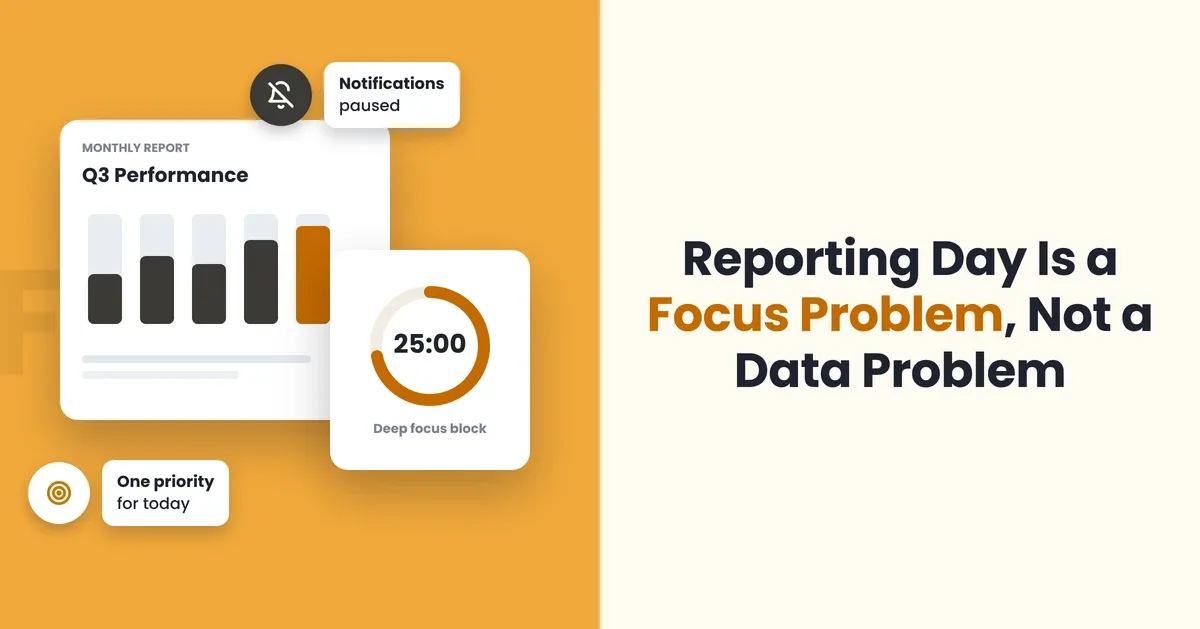
Teams that handle reporting well tend to protect that stretch deliberately, treating attention as the scarce input rather than the data itself. On a typical Tuesday, the seo team at a mid-sized agency might pull rankings, traffic and conversion data into one view, and the useful write-ups come from the people who block out ninety quiet minutes to do it, not from whoever has the fanciest dashboard.
Where the Hours Actually Go on Reporting Day
Time studies of knowledge workers keep landing on a similar figure: after an interruption, it takes roughly 23 minutes to get back to the original task. A reporting day with a dozen pings can therefore burn most of a morning on recovery alone, before a single chart is finished.
The table below splits a typical eight-hour reporting day into its real components. The numbers are illustrative, drawn from the pattern many analysts describe, but the proportions will look familiar.
| Activity | Share of the day | What it costs |
|---|---|---|
| Pulling and cleaning data | 30% | Mostly mechanical, easy to batch |
| Writing the narrative | 25% | Needs long, uninterrupted focus |
| Answering chat and email | 20% | Fragments everything around it |
| Reformatting for stakeholders | 15% | Low value, high irritation |
| Actual analysis | 10% | The part everyone wanted to do |
Only a tenth of the day goes to the thinking that gives a report its worth. Everything else is admin work, and admin work is where interruptions sneak in. Analysis loses to inbox traffic nearly every time, and nobody planned it that way. A few small habits reclaim a surprising amount:
- Batch data pulls into one early block, before messages start arriving.
- Set a visible status signal so colleagues know when not to knock.
- Write the headline finding first, then fill in supporting charts.
- Schedule review calls after the draft exists, never before.
Making Focus Visible to the Rest of the Office
Focus fails mostly for social reasons. People interrupt because they cannot tell whether you are busy, and asking costs them nothing. The fix is making your state legible without a conversation.
Open-plan offices make this harder, but remote teams have the same issue in a different costume: a green dot in a chat app tells nobody whether you are mid-sentence in a forecast or idly scrolling. Consider a four-person marketing group closing the quarter. Three of them need the same revenue breakdown, so each one messages the analyst separately, and each message costs her a context switch. A single shared signal and a single shared thread would have cut those three interruptions to none.
Physical and Digital Status Signals
A small USB light that glows red during deep work does the job faster than any calendar note. Colleagues glance at it from across the room, and the decision to wait takes less than a second. Others link the light to their chat status, which keeps both signals telling the same story. It costs about as much as a modest lunch, and results appear within days: fewer drop-in questions, longer uninterrupted drafts, and far less late-afternoon dread over an empty report.
Low-tech versions work too. A paper sign on the monitor during the first Thursday of each month works the same way, and a team soon learns to read it like a closed door.
Rhythms That Survive a Busy Month
Signals only help if the schedule behind them is realistic. A reporting block of 90 minutes, followed by a 20-minute open window for questions, gives colleagues a predictable moment to reach you. Most urgent requests turn out to be answerable in that window, and the genuinely urgent ones still get through by phone. Over a month, the open window also reveals which questions repeat, which makes them easy candidates for a short shared document instead of another meeting.
Rotating the quiet hours also helps. If the whole team goes dark at once, requests pile up. Staggering blocks means someone is always reachable, and nobody carries the full burden of being the responsive one. Reporting will never be a joy, but it can stop being a recurring crisis. Protect the stretch, make it visible, and the numbers tend to tell their own story.


