



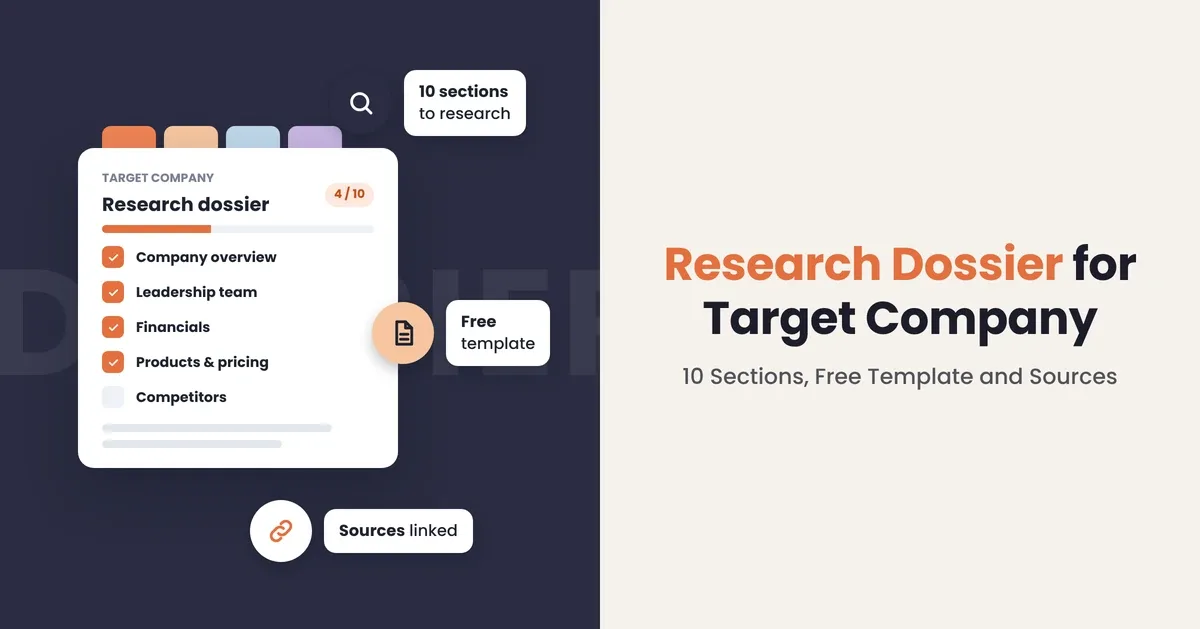
Good dossiers answer a specific decision rather than collecting everything available. A sales team preparing for a pitch needs different depth than an investment analyst screening an acquisition target.
What a company research dossier is
A company research dossier is a working document that combines company background research, financial analysis, market research and risk assessment in one place. Analysts treat it as an intelligence product, closer to a due diligence report than to a marketing brochure. Teams in business intelligence, strategy or sales all rely on the same basic format.
Depending on the team, the same file may be called a business intelligence dossier, a competitive intelligence report or simply a target company report. A one-page company fact sheet or corporate profile sits at the light end of the range, while a company due diligence dossier sits at the heavy end.
Unlike a public press release or a company's own website, a dossier separates verified facts from claims. Rumors or speculation either stay out of the file or carry a clear "unconfirmed" label.
Who builds target company dossiers?
Business analysts, market research analysts, and competitive intelligence analysts build most dossiers inside larger companies. Corporate research teams often share the result with leadership as a corporate research report. Sales representatives create lighter versions for account planning, while investment analysts prepare deeper files for mergers and acquisitions.
Research dossier vs company profile vs due diligence report
People often use these terms interchangeably, though each one serves a different purpose and depth.
| Document | Purpose | Typical depth |
|---|---|---|
| Target company profile | A short company overview document for quick reference | One or two pages of public facts |
| Research dossier | Evidence for a specific business decision about a target company | Five to 30 pages with sources and dates |
| Due diligence report | Formal verification before a deal closes | Detailed legal, financial and operational review |
Deal teams usually work from a formal company due diligence checklist covering legal, tax and operational records. A research dossier stays lighter, built to answer one business question with verified facts.
What to include in a research dossier: 10 core sections
Most dossiers follow the same skeleton, whatever the purpose. Adjust the depth of each section to the decision you are supporting, keeping the executive summary at the top.
1. Executive summary
The executive summary gives the key findings, the open questions, and a clear recommendation in half a page. Write it last, once every other section is finished.
2. Company overview
The company overview records the legal name, registration number, headquarters, founding year, industry, and official website. Small errors here, such as the wrong legal entity, can undermine every later section.
3. Products, services and pricing
List the core offerings, the customers each one serves, and how the company charges for them. Pricing pages, product documentation and public tender records usually show more than marketing copy does.
4. Ownership and corporate governance
Show who owns the business, including parent companies, major shareholders, and board members. An organizational chart makes complex group structures far easier to follow.
5. Leadership and management biographies
Management biographies cover the career history of key stakeholders such as senior executives, with a source and date for every role. Focus on professional track records rather than private details.
6. Financial statements and health
Pull revenue, profit, cash flow, and debt from audited filings wherever possible. For private companies, credit reports and funding announcements give rough signals instead of exact figures.
7. Market analysis and competitors
An industry analysis sets out market size, industry trends and the competitive landscape. A short SWOT analysis then turns those findings into strengths, weaknesses, opportunities and threats.
8. Customers and positioning
Note who buys from the company, which segments it targets and how it describes its own advantage. Case studies, customer logos and review patterns help confirm whether the positioning matches reality.
9. Legal, regulatory and intellectual property risks
The risk assessment covers lawsuits, regulatory actions, sanctions exposure, and the status of trademarks or patents. A single unresolved dispute can change the whole recommendation for a deal.
10. Recent news, timeline and sources
A timeline of funding rounds, acquisitions, leadership changes, or product launches shows where the company is heading. The final section holds the sources and citations behind every claim in the file. Each entry carries its publication date next to a reliability grade.
Where to find verified company data
Knowing how to research a target company starts with knowing where trustworthy data lives. Free public records should form the backbone of any dossier, since they carry legal weight that marketing material lacks. Commercial databases then fill gaps in private company data.
SEC filings for U.S. public companies
The SEC's EDGAR system gives free public access to millions of filings, with full-text search covering more than 20 years. Annual 10-K reports are the richest company reports available for a listed business.
According to Investor.gov, a 10-K covers the business, its risk factors, and audited financial statements. A separate section gives management's discussion and analysis of the year's results. Start with the business section for context, then read the risk factors, which companies generally list in order of importance.
Current events appear in 8-K reports, which most companies must file within four business days after the triggering event under the SEC's Form 8-K instructions. Recent leadership changes or deals therefore show up quickly in these filings.
Company registries in the United Kingdom and other markets
Companies House lets anyone check UK company information for free, including the registered address, incorporation date and officers. Previous company names and insolvency records are also free to view. Most U.S. states run similar business entity searches through the secretary of state's office.
Sanctions and compliance checks
Every dossier that supports a deal or supplier decision should include a sanctions check, a core part of company verification. The U.S. Treasury's Office of Foreign Assets Control runs a Sanctions List Search that uses fuzzy matching to find possible matches on its sanctions lists.
Court records and trademarks
Litigation history often reveals more than any press release. The federal PACER system charges $0.10 per page, with a cap of $3 per document. Fees are waived when a user's charges stay at $30 or less in a quarter.
Trademark ownership shows which brands a company controls and whether any conflicts exist. The USPTO trademark search lets you check registered marks before you rely on a company's branding claims.
Search engine techniques
Advanced search operators uncover documents that a normal search misses. Combining the company name with operators such as site:, filetype:pdf, or a date range surfaces old annual reports, conference slides, and regulatory letters.
Set up news alerts for the company name, its executives, and its main products. Alerts keep the recent news section current without repeating the whole search every week.
Commercial databases for private company data
Private companies publish far less, so analysts rely on paid databases for credit reports, ownership trees, funding history, and market intelligence.
| Data type | Common commercial sources |
|---|---|
| Credit and firmographic data | Dun & Bradstreet, including the former Hoover's database |
| Financial and market data | Bloomberg, S&P Global, Moody's |
| Startup funding and investors | Crunchbase |
| Industry statistics | Statista |
Treat database entries as leads rather than final facts. Confirm key figures against filings or the company's own reports before they reach the executive summary.
Research dossier target company reviews: what feedback adds

Research dossier target company reviews from customers, employees and suppliers reveal problems that filings rarely mention. Repeated complaints about late deliveries or unpaid invoices can signal cash flow trouble months before it shows up in accounts.
Read reviews as patterns rather than as single opinions from unhappy customers. Ten reviews describing the same billing issue matter more than one angry post, so record the theme, the count and the date range in the evidence log.
How to create a target company dossier step by step
A clear process keeps the dossier focused on the decision instead of turning into a pile of links. Treat the steps below as a company research checklist and work through them in order.
1. Write down the decision the dossier must support, such as an acquisition, a partnership or a sales pitch.
2. List the five to ten questions the decision maker needs answered.
3. Collect official records first, including filings, registry entries and sanctions checks.
4. Add commercial data, news coverage, review patterns and interviews where needed.
5. Grade each fact for reliability, logging its source with a date.
6. Draft the sections, then write the executive summary last.
7. Ask a colleague to challenge the conclusions before the dossier is shared.
Research dossier for target company template
The company research template below works for most business research dossiers. Copy it into your document tool, deleting any rows you do not need.
| Section | Questions to answer | Best source |
|---|---|---|
| Purpose | Which decision does the dossier support, by what deadline? | Internal brief from the decision maker |
| Company facts | Legal name, registration number, headquarters, website, founding year | State registry or Companies House |
| Ownership | What does the ownership and organizational structure look like? | Annual filings, registry records |
| Leadership | How long have the current executives and board members served? | Filings, company website, verified news |
| Financials | What do the latest audited figures show about revenue, profit and debt? | 10-K, audited accounts, credit reports |
| Market position | How does the company differ from its main competitors? | Industry reports, competitor websites |
| Risks | Any litigation, sanctions matches, regulatory actions or reputational issues? | PACER, OFAC search, regulator websites |
| Opportunities | Where could the partnership, deal or sale create value? | Your own analysis of the evidence |
| Evidence log | Every source with its date and grade, kept in an appendix | All of the above |
| Recommendation | Proceed, proceed with conditions, or stop, with reasons | Analyst judgment, reviewed by a colleague |
Research dossier example: a filled-in summary
The short example below shows how the template looks once completed. The company is fictional, created only to illustrate the format.
| Section | Finding | Grade |
|---|---|---|
| Purpose | Decide whether to sign a two-year logistics contract with Northwind Freight (fictional) | Internal brief |
| Company facts | Delaware corporation founded in 2014, headquartered in Columbus, Ohio | A |
| Ownership | Majority owned by a private equity fund since 2021 | A |
| Financials | Revenue grew for three years, though debt rose after a 2024 acquisition | B |
| Risks | One pending contract dispute with a former customer, filed in 2025 | A |
| Reviews | Repeated driver complaints about late payroll in the last six months | C |
| Recommendation | Proceed with conditions: shorter contract term and quarterly payment checks | Analyst view |
The grade column makes the weakest evidence in the file obvious at a glance. The payroll complaints are only grade C evidence, so the analyst recommends extra checks instead of rejecting the deal outright.
How to verify conflicting information
Sources often disagree, especially on headcount, revenue or leadership titles. A simple rule settles most conflicts: the newest official record beats an older or unofficial one.
Suppose a business directory lists a former CEO, while a registry filing from last month names a new one. The filing wins, while the directory entry goes into the evidence log as outdated.
Keep a small verification worksheet for every disputed fact in the file. Record the claim, each source, its publication date and a final status of confirmed, disputed or unverified.
How teams use target company dossiers
Mergers and acquisitions
In M&A work, the dossier becomes an early screening tool before the formal due diligence process starts. An M&A target profile highlights deal breakers early, saving legal fees on companies that fail basic due diligence research. Once talks advance, the seller's virtual deal room replaces public sources with private documents.
Sales enablement: how sales teams use target company research dossiers
Sales teams use lighter dossiers for prospect research and account planning. Key findings usually live in CRM software such as Salesforce or HubSpot, so every rep sees the same target company intelligence before a call. Stakeholder mapping then shows which executives influence the buying decision.
A focused prospect brief also improves lead generation for the whole team. Reps who understand a target's priorities can tailor outreach instead of sending generic pitches.
Vendor risk and KYC files
Procurement and compliance teams build vendor risk assessments or KYC files before signing contracts. Their versions lean heavily on ownership checks, sanctions screening and financial stability.
Investment research
Investors use dossiers to test a thesis before committing capital. An investor briefing pack typically adds valuation context, cap table details and management track records.
Partnerships and job interviews
Founders checking a potential partner use a short dossier to confirm the other side's finances and reputation. Job seekers can apply the same structure on a smaller scale, researching a target employer's products, leadership and recent news before an interview.
How to grade source reliability
A dossier is only as strong as its weakest key fact. A simple grading scale makes the quality of each claim visible to the reader.
| Grade | What qualifies |
|---|---|
| A | Official or audited records, such as regulatory filings, registry entries and audited accounts |
| B | Reputable secondary sources, such as established news outlets, commercial databases and industry reports |
| C | Unverified claims, such as anonymous reviews, social posts or a single unconfirmed interview |
Base every recommendation on grade A facts wherever the records allow it. Flag any conclusion that rests mainly on grade C evidence, so the decision maker knows where uncertainty remains.
Ethics and legal limits of company research
Corporate intelligence work has firm legal and ethical boundaries. The Strategic and Competitive Intelligence Professionals code of ethics asks practitioners to comply with all applicable laws, domestic and international.
The same code calls for accurately disclosing your identity and organization before every interview. Pretexting, hacking or paying insiders for confidential data crosses legal lines in most jurisdictions.
Personal data about executives needs particular care during research. Privacy laws in the United States, the United Kingdom and other global markets limit how much personal information you can collect. Keep the research focused on professional roles rather than private lives.
Common mistakes in target company research dossiers
● Collecting without a question: A dossier without a clear decision behind it grows long without becoming useful.
● Mixing facts with assumptions: Every estimate should be labeled as such, with the reasoning shown.
● Relying on one source: Cross-check every important figure against at least two independent sources.
● Ignoring dates: A revenue figure from three years ago can mislead badly if the source date is missing.
● Skipping the sanctions check: One missed sanctions match can derail a deal or create legal exposure.
Using AI to speed up company research
AI tools can draft a first company overview, summarize long filings or flag news mentions in minutes. Data scraping tools for research explains how automated collection saves time on public records. Human review stays essential for any fact that reaches a decision maker.
Teams that prepare research dossier files every week can automate company data collection with custom AI agents connected to filings, registries or a CRM.
Conclusion
A research dossier for target company decisions works best when it answers a clear question with graded, dated evidence. Official records come first, with commercial data filling the gaps. Reviews then add a useful view from outside the company.
Keep the dossier focused on one decision, flagging uncertainty openly. Respect legal limits on how you gather information, especially when interviewing people. A well-built file turns a risky decision into an informed one.
Frequently asked questions
What is the difference between dossier and report formats?
A backgrounder or company research report usually presents findings on one topic for a general audience. A dossier compiles evidence about one specific company to support a single decision, with sources attached to every fact.
What should a target company research dossier contain?
At minimum, include an executive summary, company overview, ownership, leadership, financials, market position, risks and an evidence log. Add valuation or account details depending on whether the purpose is investment or sales.
How long does it take to build a company research dossier?
A sales brief can take an hour or two, while an acquisition dossier may need several days. The time depends mostly on how much public data exists. Interviews with customers or former staff add extra days.
How do sales teams use target company research dossiers?
Sales teams use them to understand a prospect's priorities, decision makers and recent news before outreach. The findings are usually stored in the CRM so the whole team works from the same facts.
How do you research a private company?
Start with state registry records, court filings and trademark searches, since private companies rarely publish accounts. Credit reports, funding announcements and interviews with customers then fill in the financial picture.
How often should a research dossier be updated?
Review an active dossier at least every quarter, or sooner after major news such as a funding round or leadership change. A dossier used for a one-off decision only needs updating if the decision is reopened.
Can AI build a research dossier for you?
AI tools can draft summaries and gather public information quickly, though they sometimes produce errors or outdated facts. Verify every AI-generated claim against a primary source before it enters the dossier.
Is there a free target company research dossier template?
The template table in this guide is free to copy. Adapt the rows to your purpose, then add an evidence log so every claim keeps its source.


