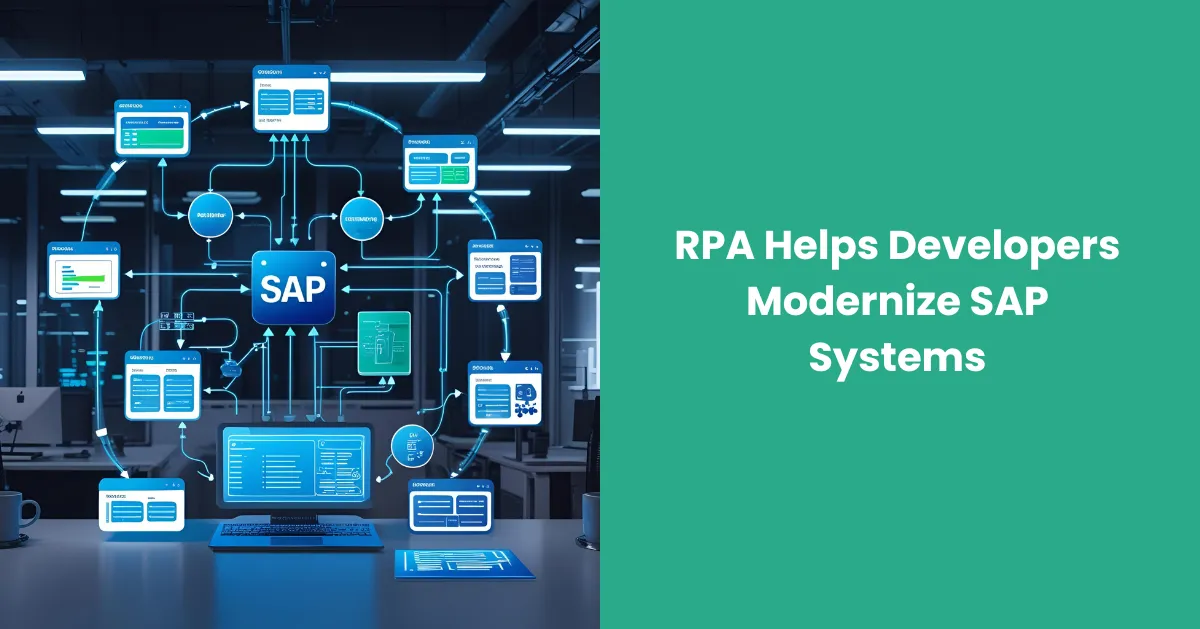
Developers know the pain. You get tasked with "modernizing" a SAP system that's been running since 2003, and suddenly you're staring at a maze of custom ABAP code, legacy workflows, and integrations that nobody documented. The business wants cloud-native solutions and real-time analytics, but the SAP system speaks a different language entirely.
That's where Robotic Process Automation (RPA) comes in. Not as a replacement for proper modernization, but as a bridge. A way to make legacy SAP systems play nice with modern applications without ripping everything apart and starting over.
The SAP Modernization Dilemma
SAP systems weren't built to be agile. They were built to be stable, comprehensive, and bulletproof. Mission accomplished — but that same stability makes them incredibly difficult to modernize.
Most enterprises have SAP implementations that are heavily customized. Years of business requirements have created a web of custom code, modified workflows, and integrations that work perfectly for their specific needs. The problem? These customizations make standard upgrades nearly impossible.
Then there's the data. SAP systems often hold decades of transactional data, customer records, and business processes that can't simply be migrated to a new platform. The cost and risk of a full-scale replacement are astronomical.
So most companies end up stuck. They need modern capabilities — APIs, cloud integration, real-time analytics — but their SAP systems can't deliver them without massive overhauls. This is where emerging techs revolutionizing the future of software development become crucial bridge solutions.
Enter RPA: The Pragmatic Solution
RPA bots don't care about your technical debt. They don't need APIs or database access. They work with SAP systems exactly the way humans do — through the user interface.
That means they can interact with any SAP system, regardless of version, customization level, or integration complexity. They click buttons, fill forms, and extract data just like a human would, but faster, more accurately, and without taking coffee breaks.
For developers, this opens up possibilities that would otherwise require months of custom development. Want to sync SAP data with a modern CRM? An RPA bot can log into SAP, extract the relevant records, and push them to your CRM via API. Need to automate invoice processing? The bot can handle the entire workflow, from data entry to approval routing.
The power of RPA robotic process automation lies in its ability to work with legacy systems without requiring deep integration or extensive API development. This makes it particularly valuable for SAP environments where traditional integration approaches can be complex and time-consuming. Modern RPA tools have evolved beyond simple task automation to include AI and machine learning capabilities, enabling them to handle more complex, judgment-based processes that were previously considered too sophisticated for automation.
Real-World Applications That Actually Work
The beauty of RPA in SAP modernization isn't theoretical. It's happening right now, solving real problems for real development teams, with some programs reporting overall manual effort cut by 40%.
Data Migration and Synchronization: RPA bots can extract data from legacy SAP systems and format it for modern applications. They handle the messy work of dealing with different data structures, field mappings, and validation rules that would normally require custom ETL development.
Workflow Automation: Many SAP processes involve multiple systems and manual handoffs. RPA can automate these workflows end-to-end, even when they span legacy and modern applications. A bot can start a process in SAP, update records in a cloud application, and send notifications through modern collaboration tools. In a large-scale SAP automation initiative at a manufacturing firm, over 6,000 repetitive SAP tasks were automated, saving more than 2,200 work hours annually.
Report Generation and Distribution: SAP's reporting capabilities are powerful but often complex to use. RPA bots can automatically generate reports, format them for different stakeholders, and distribute them through modern channels like Slack, email, or dashboards.
Integration Without APIs: Not every SAP system has robust API capabilities, especially older versions. RPA provides a way to integrate these systems with modern applications without the need for custom middleware or extensive SAP configuration.

The Developer's Perspective: Why RPA Makes Sense
From a development standpoint, RPA offers something rare in enterprise software: immediate results without massive infrastructure changes.
Traditional SAP modernization projects can take months or years. You need to understand the existing system architecture, plan data migration strategies, develop custom interfaces, and coordinate with multiple stakeholders. RPA lets you start solving problems immediately.
The learning curve is also manageable. Most RPA platforms use visual, drag-and-drop interfaces that don't require deep SAP expertise. A developer can learn to build basic SAP automation in days, not months.
There's also the testing advantage. RPA bots can be tested in isolated environments without affecting production SAP systems. You can develop, test, and deploy automation incrementally, reducing risk and proving value quickly.
Getting Started: The Practical Path Forward
The key to successful SAP modernization with RPA is starting small and thinking strategically.
Begin with processes that are repetitive, rules-based, and involve data transfer between systems. These are natural fits for RPA and deliver quick wins that build confidence with stakeholders.
Document your existing SAP processes thoroughly. RPA bots need clear, step-by-step instructions, and the documentation process often reveals inefficiencies that can be eliminated during automation.
Consider security and compliance from the start. RPA bots need appropriate access credentials and should follow the same security protocols as human users. Many organizations create dedicated service accounts for RPA with limited, auditable permissions.
Plan for scalability. Start with individual processes, but think about how multiple automations can work together to create comprehensive workflows that span legacy and modern systems.
The Bigger Picture: Bridge, Not Destination
RPA isn't the end goal of SAP modernization — it's a bridge to get there. The real value comes from using RPA to future-proof your workflows using technology while planning longer-term architectural changes, buying time, and proving concepts in the process.
As you automate more SAP processes, you gain deeper insights into how the system actually works, what data is most valuable, and where the real modernization opportunities lie. This knowledge becomes invaluable when you're ready for more comprehensive changes.
RPA also helps build organizational confidence in automation. When business users see bots successfully handling routine SAP tasks, they become more open to broader digital transformation initiatives.
Making Legacy Systems Feel Modern
SAP systems don't have to be modernization roadblocks. With RPA, they can become active participants in your digital transformation strategy.
The technology isn't magic, but it's practical. It lets developers solve real problems without waiting for budget approval for massive system overhauls. It provides immediate value while building toward longer-term modernization goals.