



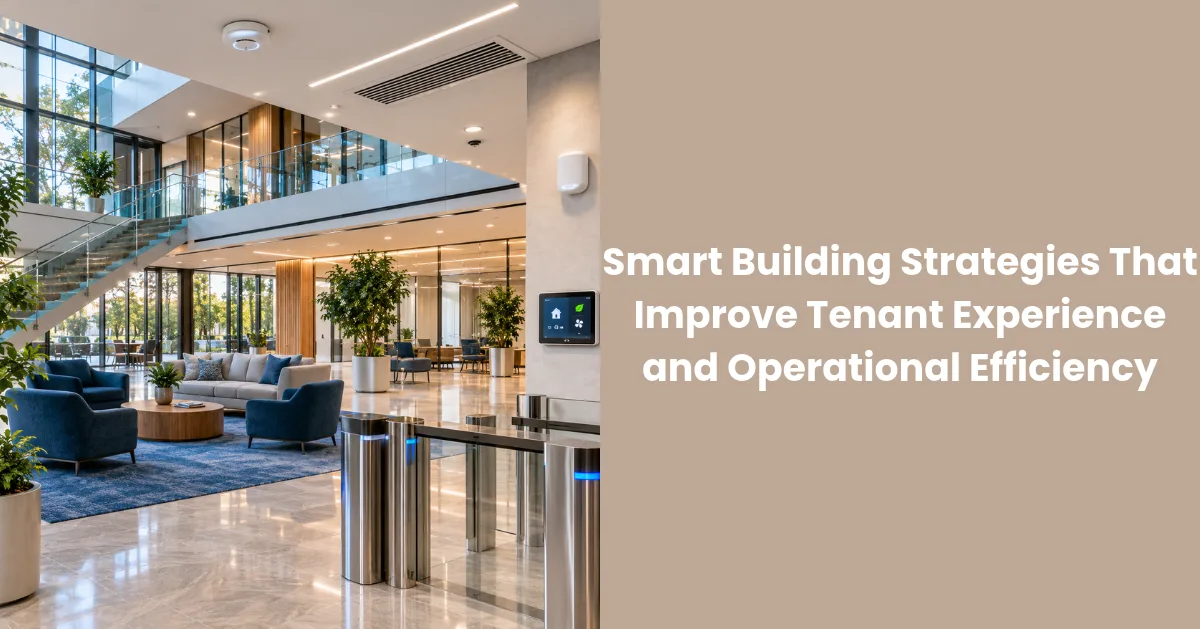
Smart building strategies that improve tenant experience face a practical test: whether technology connects everyday events to useful responses. A badge-in means little to a separate lighting controller, and an equipment alert offers limited value if nobody receives an assigned repair task. With changing attendance patterns, the connection between building activity and operating decisions deserves attention beyond another standalone feature.
Connect Your Systems Before You Add More Technology
Integrated access, occupancy-driven comfort and energy control, and predictive maintenance serve tenants and operators at the same time. Their value comes from sharing information: an arrival, a change in occupancy, or an equipment alert becomes a useful response rather than an isolated record.
One Platform Instead of Ten Disconnected Systems
Separate access, HVAC, lighting, and work-order tools duplicate costs and hide information that makes automation useful. The integration question starts with the building management system, IoT sensors, and connections such as BACnet. An integrated platform lets systems exchange information instead of requiring operators to reconcile disconnected records.
Arrival provides a concrete example: identify the person, authorize entry, and route them to their destination. Each handoff should use the authorization already established rather than require another registration or manual check. An authorized arrival can also request lighting and floor-level HVAC operation, provided the controls support that workflow across the connected systems.
Measure What Tenants and Operators Both Care About
The measurement question is whether tenant satisfaction, work-order response and resolution times, energy use intensity, and space utilization tell a consistent story. These measures form a shared scorecard for evaluating changes rather than treating each system as a separate success.
Energy use intensity tracks energy consumption per unit of floor area, while comfort complaints and tenant satisfaction show whether lower consumption comes at occupants' expense. Space utilization adds context when attendance changes. Response and resolution times distinguish an acknowledged problem from a completed repair. Together, these measures connect operating decisions to the experience of people who use the building daily.
Make Arrival the Easiest Part of the Day
Mobile credentials let tenants present a phone or supported wearable instead of a physical card. That removes card printing from the normal arrival process, although forgotten devices and failed readers still need an exception route. A well-designed access control workflow keeps those exceptions away from the main entry lane.
The access stack should work as a connected sequence: tenants tap in with phones, guests are pre-registered through a visitor management system that sends their pass and alerts the host, and destination elevator dispatch routes both groups to the right floor.
QR code guest passes should carry defined access permissions and an expiry time, rather than function as unrestricted invitations. Reception staff can then assist visitors instead of repeatedly entering names and contacting hosts. Entry records also give security staff a history to review, subject to the building's retention and privacy policies.
However, a badge-in isn't proof that someone remains on a floor all day. Arrival events should initiate service; occupancy information should guide what stays on afterward.
Let Occupancy Data Run Comfort and Energy Use
Heating, cooling, ventilation, and lighting deserve close attention because their operation follows both building conditions and occupancy. A fixed schedule doesn't distinguish a busy floor from an empty one. The useful question is how controls can respond to actual use without making occupied spaces uncomfortable.
Match Heating, Cooling and Light to Real Occupancy
Occupancy data should inform zone-level decisions, not simply switch an entire building between occupied and unoccupied modes. A meeting room, an open office, and a vacant floor need different operating responses. Lighting controls can follow presence, while temperature controls need preparation time for expected arrivals.
In a demand-controlled ventilation design, CO2 sensors provide an input for adjusting ventilation as occupancy changes. They aren't a complete measure of indoor air quality, so the control sequence still needs defined ventilation requirements and operating limits.
Tenant-adjustable temperature through an app also needs boundaries. A limited adjustment within an approved range gives occupants influence without allowing neighboring requests to drive conflicting equipment commands.
Make the Building Respond to the Grid
The Department of Energy describes grid-interactive efficient buildings as buildings that coordinate efficiency and flexible energy use with grid needs while accounting for occupants. This adds a timing question to occupancy control: not just how much energy the building uses, but when.
For instance, a building could pre-cool selected spaces before a peak-price period, then reduce cooling demand within agreed comfort limits. Whether that lowers the bill depends on the electricity tariff, including how demand charges are calculated.
Load shifting isn't the same as eliminating consumption.
Operators therefore need to compare the full operating cycle, rather than celebrate a lower peak in isolation. Occupied-zone temperatures, tenant feedback, and total consumption belong beside peak-demand results.
Fix Problems Before Tenants Have to Report Them
A failed pump or uncomfortable meeting room turns an equipment problem into an interruption for tenants. Reactive maintenance begins after that interruption has happened. Predictive maintenance changes the starting point: an observed change in equipment behavior creates a reason to investigate before occupants need to complain.
Sensors That Flag Failing Equipment Early
A monitoring plan starts with an equipment-specific question. For a pump, that might mean investigating a change in vibration or operating temperature. For a chiller or elevator, runtime patterns can become part of the equipment history. The useful signal is a meaningful departure from expected behavior, not simply more readings.
Fault detection and diagnostics should connect that signal to a reviewable maintenance task. A CMMS, or computerized maintenance management system, can hold work orders with the asset identifier, alert details, assigned technician, and inspection outcome.
Not every alert warrants urgent dispatch. Repeated notifications need filtering, and technicians need a way to record false alarms. The objective is an actionable warning, not a promise that every failure can be predicted.
Close the Loop With Tenant Requests and Feedback
Equipment monitoring won't capture every service problem. A tenant app provides a separate route for reporting a noisy vent, an uncomfortable room, or an access issue. Photo uploads and precise location fields give the receiving team context without a lengthy exchange.
The request should retain one record from submission through assignment, attendance, and resolution. That distinction protects the response-time metric introduced earlier: acknowledging a ticket isn't the same as resolving its cause.
Status tracking makes the process visible, while a one-tap rating after closure checks whether the problem feels resolved. Grouping repeat requests by location, asset, and responsible contractor reveals where follow-up is needed.
The Best Smart Buildings Feel Simple to the People Inside
The strongest strategies connect access, comfort, energy control, and maintenance around the same operating picture. Tenants experience fewer unnecessary handoffs, while operators receive information tied to specific decisions and responsibilities. Integration matters because it turns separate functions into a coordinated workflow.
The shared scorecard keeps that workflow accountable. Tenant satisfaction, response and resolution times, energy use intensity, and space utilization provide a better basis for judging an upgrade than its feature list alone. A building isn't smarter merely because it collects more data. The improvement lies in how consistently that data supports comfortable spaces, understandable service, and disciplined operation.


