


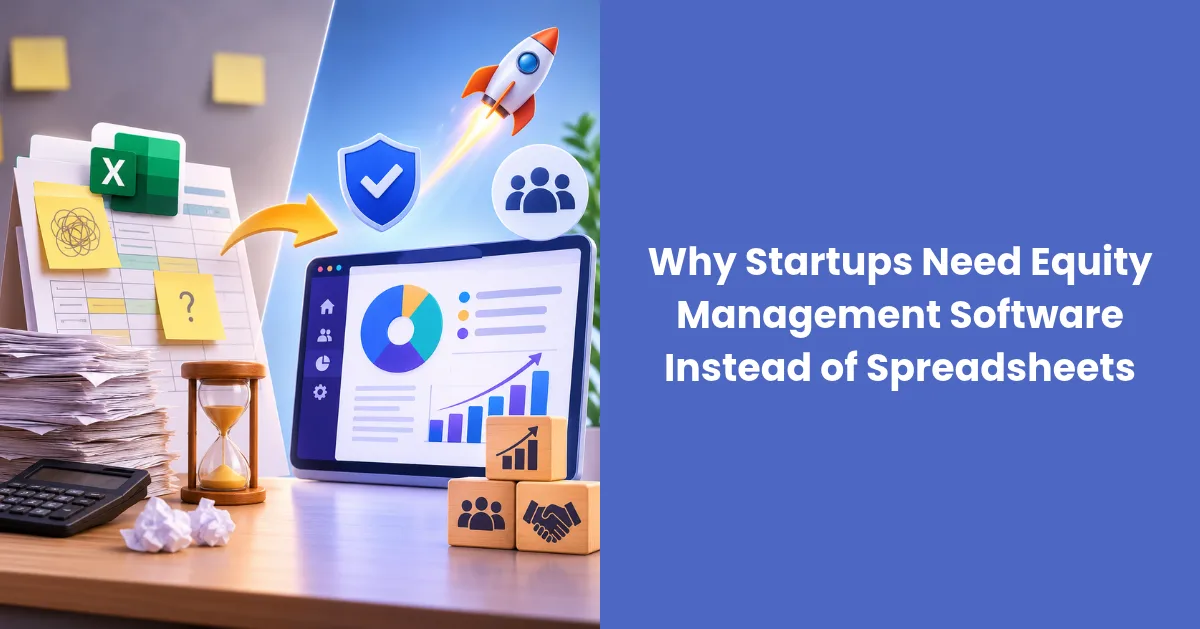
You open the Excel or Google Sheets document that you first created two years ago at a coffee shop. You scroll down to make sure the numbers work out right, and you suddenly feel ill. Something happened to a formula in one of the cells three months back when you gave stock options to your lead engineer. There are now two different versions of the spreadsheet, and no one knows if the convertible note from your early angel investor comes in before or after the option pool expansion.
Suddenly, your three-million-dollar wire transfer is frozen for six weeks while corporate attorneys bill you thousands of dollars an hour to untangle your math.
This exact scenario plays out every single week in the startup world. When you are first launching a business, tracking ownership on a spreadsheet feels free, easy, and completely harmless. Why pay for another monthly subscription when you only have two co-founders and zero outside cash?
The issue is the ownership structure of a startup will never stay simple for too long. The moment you have any sort of advisors, early hires with stock options, or funding with SAFEs, your manual spreadsheet goes from being an aid to becoming a ticking legal time bomb. This is exactly why startups use dedicated equity management software to serve as a single, unbreakable source of truth from the very beginning.
Let’s look closely at why spreadsheets fail scaling startups, what real-world risks they create, and how moving to a dedicated digital system protects your ownership stake and your sanity.
The Hidden Trap of Manual Cap Tables
At its core, a capitalization table, or cap table, is just a list showing who owns what piece of your company. On day one, it takes about five minutes to build. You list your name, your co-founder's name, and a fifty-fifty split of common stock.
Now fast-forward another twelve months, and the picture is a completely new one. You will have most likely set aside a block of stock for future hires, issued several Simple Agreements for Future Equity (SAFEs), each with their own valuation caps, and hired a fractional executive on a specially tailored vesting plan.
Each one of these things impacts the equation for your business. In an Excel sheet, making all these updates manually involves lots of typing and the use of very complex nested formulas. One wrong keystroke, one missing row, or one copied cell can ruin everything.
You might not even notice the mistake right away. Spreadsheets do not send you an alert when a formula breaks or when an option grant exceeds your board-approved pool limit. The error just sits there quietly until an outside investor puts your company under a microscope. And those mistakes happen far more often than most founders realize, especially considering 73% of Series A due diligence processes uncover at least one cap table error that triggers a correction round.
When an investor catches a math error during diligence, it does not just slow down your funding but destroys your credibility. Investors start wondering what else in your business is disorganized, giving them leverage to renegotiate terms in their favor.
What Happens When Complex Math Meets Static Cells?
If you have never modeled out how convertible instruments work, prepare yourself for a headache. Suppose you raise money from three different angel investors using post-money SAFEs, each with a slightly different valuation cap. Later,you raise a priced Series A round where the new lead investor insists you expand your employee stock option pool before their money goes in.
Trying to calculate how all those pieces convert and dilute your personal ownership in Excel is notoriously difficult. Most founders build a rough estimate, assume they still own a comfortable majority of their business, and sign on the dotted line without realizing the true impact.
Dedicated software takes all the guesswork out of it by instantly generating waterfalls and dilution scenarios before you lock yourself into an agreement. You can enter the term sheet figures, experiment with varying sizes of the option pool, and get exact ownership percentages with decimals down. Rather than going into the boardroom meeting blind, you go into it armed with solid figures.
Keeping Up With Tax Rules and Compliance Deadlines
Managing startup equity is not just about keeping track of percentages; it is also about staying on the right side of strict tax laws. In the United States, two specific rules trip up spreadsheet-reliant founders constantly: 409A valuations and 83(b) elections.
Whenever you want to grant stock options to an employee, the IRS requires you to price those options at or above the current fair market value of your common stock. You cannot just guess a number or pick a penny per share because it sounds nice. You need an independent, defensible 409A valuation. If you grant options below fair market value, your employees can get hit with immediate income taxes plus a brutal twenty percent federal tax penalty.
Then there is the 83(b) election. When founders or early hires receive restricted stock that vests over time, filing an 83(b) form with the IRS tells the government you want to pay taxes on the shares right now while their value is near zero, rather than years later when the company is worth millions.
Here is the twist: you have only thirty days starting from the date of the grant to complete those tasks. If you fail to make the deadline by just one day, then there is no way out.
Spreadsheets will not track your deadline. In an advanced equity management system, all these processes are embedded right from the beginning, and it reminds the founders and new employees about the signing, approval, and tax requirements before it is too late.
Turning Stock Options Into a Real Hiring Advantage
Ask yourself a quick question: If you offer a talented software engineer fifty thousand stock options, do they actually know what that means?
For most employees outside of Silicon Valley finance circles, a paper option grant feels abstract and confusing. If you hand them a static PDF agreement and track their vesting on a private spreadsheet they cannot see, those options lose almost all their motivational power. People rarely value what they cannot understand or track.
When you use a proper digital platform, every employee gets their own secure login dashboard. They can log in anytime to see exactly how many stock options have vested so far, when their one-year cliff hits, what their strike price is, and how their stake grows alongside the company’s valuation.
Transparency changes the game. Rather than keeping your commitment to equity as an abstract concept buried deep within your HR files, your staff members can see evidence of their ownership each and every day. This makes it easier for you to attract top talent in competition with other big companies offering higher base salaries.
Version Control Chaos and Security Risks
Think about how spreadsheets travel around a company. You email the cap table to your co-founder. Your co-founder downloads it, adds a column for a potential advisor, and saves it as CapTable_FINAL_v2.xlsx. Meanwhile, your outside accountant updates the original sheet with a recent option exercise and saves it as CapTable_Updated_Nov.xlsx.
Within a few weeks, nobody knows which file is the real master record.
Beyond the confusion of competing versions, emailing spreadsheets around is a massive security risk. Your cap table contains deeply sensitive personal information, such as home addresses, tax identification numbers, salary-linked equity grants, and private investor details. Leaving that data sitting in unencrypted email attachments or shared links with loose permissions invites data leaks and internal friction.
Cloud-based equity solutions are the answer to both these problems. Your cap table has just one live copy of your cap table that uses bank-grade encryption and permissioned roles. Investors will see their own positions, employees will see their own grants, and founders will have total control without having to fear any unintended changes.
Why Waiting Until Series A Costs You More
Founders tell themselves that they will fix their cap table just before raising major financing. From an accounting standpoint, this makes sense. But in practice, cleaning up years of disorganized spreadsheets just before a fundraising deadline is far more costly than doing it the right way the first time.
When corporate lawyers have to reconstruct historical option grants, track down unsigned board consents, and fix broken SAFE conversion math, the legal bill skyrockets. That urgent cleanup work routinely costs tens of thousands of dollars in legal fees. This is money that should be going toward product development and customer growth.
Even more importantly, investor appetite for clean governance has never been higher. Global investment in this space continues to climb rapidly, with data showing the 2026 market size is USD 913.59 million as startups and private companies rush to modernize their financial infrastructure. Investors expect founders to treat equity governance seriously from day one.
Make the Smart Move Early!
Your startup's equity is the most valuable asset you will ever create. Treating it like a casual side project on a fragile spreadsheet puts your funding rounds, your employee trust, and your personal ownership at unnecessary risk.
Switching to dedicated digital software in the early days ensures that your records are always squeaky clean, eliminates complicated vesting calculations, helps you stay tax-compliant, and allows your team visibility into the value they have helped create.
Get rid of those faulty formulas now, so you never have to struggle to produce an audit-ready cap table again when investors come calling.