



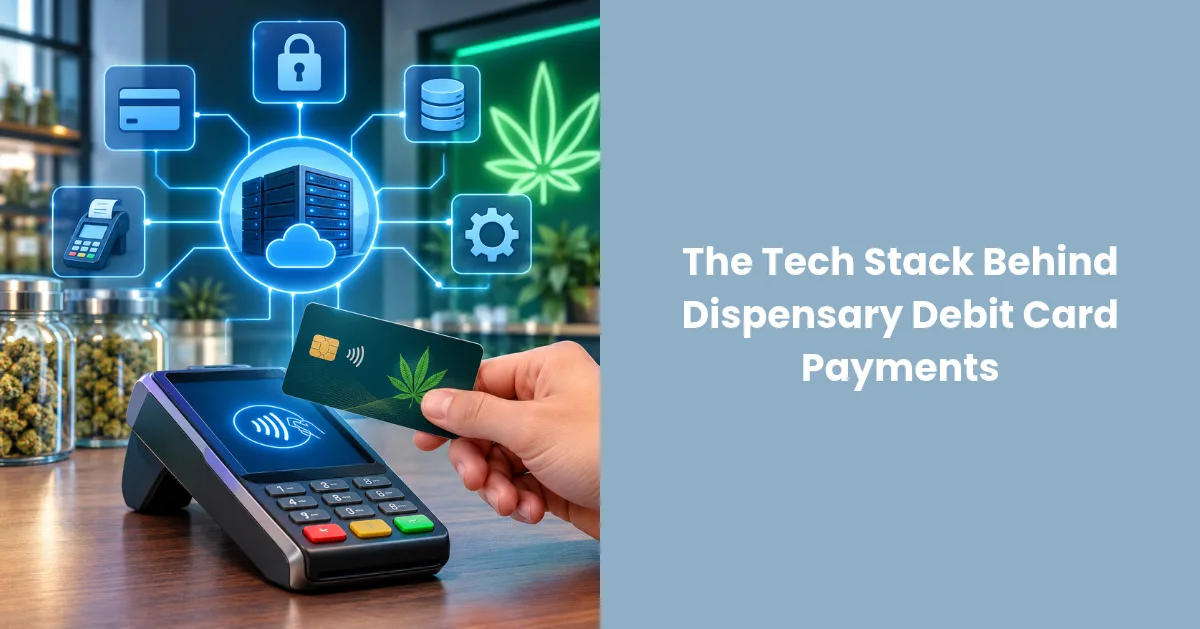
If you build, run or support software for cannabis retailers, this is a look at the stack underneath card payments at the counter: the hardware, the integrations, the security standards, the customer data and the reporting that ties it all together. No hype, just the parts that tend to break, and the questions worth asking before they do.
Why Dispensary Payments Are a Different Technical Problem
On paper, a dispensary checkout looks like any other retail checkout. Products get scanned, a total appears, the customer pays. Under the hood, a few things change.
Cannabis still sits in a complicated position under US federal law, so dispensaries don’t always have access to the same payment rails and banking relationships that a coffee shop or clothing store takes for granted. That’s part of why cash has played such a big role at many dispensaries. It also means the payment setup a dispensary ends up with may involve more parties, more steps and more questions than a standard merchant account.
Then there’s compliance. Licensed cannabis retailers work under state rules that can cover what gets sold, to whom and how it’s recorded. A payment system that doesn’t talk to the rest of the store’s software creates gaps, and gaps are exactly what auditors look for.
And the customers are different too. Some shoppers who happily tap a card for groceries may feel more cautious about leaving a data trail at a dispensary. That makes data handling a product decision, not just a back-office one.
The Hardware Layer: Terminals, Connectivity and Uptime
Start with the box on the counter, because that’s where problems get noticed fastest. A payment terminal that freezes during a Friday evening rush isn’t a minor IT ticket. It’s a line out the door and staff reaching for the cash drawer again.
Connectivity is the quiet weak spot. Many terminals rely on the store’s Wi-Fi, and store Wi-Fi has a habit of being shared with security cameras, music streaming, staff phones and whatever else got plugged in over the years. Terminals that can fall back to a cellular connection give a store a backup path when the main network drops.
For anyone evaluating providers of dispensary debit card payments, that fallback is worth checking early, along with how the device behaves when both connections are weak. Dispensary Card Services, for example, lists Wi-Fi and 4G SIM capability, an online admin portal and daily ACH bank deposits among its features, which gives a tech team a concrete starting point for those conversations.
Mobility matters as well. Curbside pickup and line-busting during busy hours both push payments away from a fixed counter. If staff need to take a payment in the parking lot, the terminal has to be portable, hold a charge through a shift and keep a usable signal outside the building.
Offline behavior deserves its own conversation. Some payment systems can queue transactions when the network is down and send them later. That keeps the line moving, but it can also mean a transaction gets declined after the customer has already left. Ask how a provider handles outages, whether offline mode is available at all, and who carries the risk if a queued payment fails.
The Software Layer: POS Integration and Data Flow
A terminal on its own only knows amounts. The point-of-sale system knows the products, the customer, the discounts and the taxes. How those two systems connect shapes a lot of what happens next.
Integrated vs. Standalone Terminals
With a standalone terminal, a budtender rings up the sale in the POS, then types the total into the card terminal by hand. It works, and plenty of stores start this way. But every manual entry is a chance for a typo, and every typo becomes a mismatch someone has to chase at closing.
An integrated terminal receives the amount straight from the POS and sends the result back, so the sale and the payment are recorded together. Fewer keystrokes, fewer errors, cleaner data. The tradeoff is dependency: if the integration breaks after a POS update, both systems feel it. The general principle is the same one that applies to any business software: integrations reduce manual work, but they also introduce dependencies that need maintaining.
Where Compliance Tracking Fits
If a dispensary’s state requires it to report sales into a tracking system, the payment layer doesn’t replace that reporting. Instead, it can help retailers reconcile payment transactions against POS sales records, while the POS or connected compliance software handles applicable state reporting requirements.
For developers, that means paying attention to identifiers. Does the payment record carry a reference back to the POS transaction? Can refunds and voids be traced to the original sale? If the answer is no, reconciliation turns into detective work.
Security: What PCI DSS Means at the Counter
Any business that takes card payments falls under card industry security rules, and dispensaries are no exception. The PCI Security Standards Council describes its data security standard as a baseline set of technical and operational requirements for protecting payment account data, and it applies to entities that store, process or transmit cardholder data. In practice, how much of that burden lands on the dispensary depends heavily on how its payment setup is built.
A few design choices can shrink that burden considerably:
- Point-to-point encryption (P2PE). Card data is encrypted when captured by the payment device and remains protected until it reaches an authorized decryption environment. Using a PCI-listed P2PE solution can reduce a merchant’s PCI DSS assessment scope, although it does not eliminate all compliance responsibilities.
- Tokenization. The real card number is swapped for a token that’s useless outside the payment system, so the POS can reference a transaction without holding card details.
- Network segmentation. Payment devices sit on their own network segment, away from guest Wi-Fi and the music system.
- Device hygiene. Default passwords changed, firmware updated, and terminals checked now and then for signs of tampering.
None of this is exotic. It’s the same playbook any retailer should follow. The difference is that a dispensary breach would carry extra weight with customers who were already uneasy about sharing their information.
Customer Data: Collect Less, Store Less
Here’s where dispensaries can get ahead of other retailers. The FTC’s guide for businesses on protecting personal information lays out a simple framework: take stock of what you have, scale down what you keep, lock up what remains, dispose of what you no longer need, and plan ahead for incidents. It’s blunt on one point in particular, advising businesses not to keep customer credit card information unless they have a business need for it.
For a dispensary tech stack, “scale down” is the principle that pays off most. Ask what the payment flow collects from a customer, where it ends up and how long it stays there. If a field isn’t needed, don’t capture it.
If an export goes to a shared drive, ask who can open that drive. If staff can see full transaction histories in an admin portal, check whether their roles call for that level of access.
Role-based permissions sound dull, but they’re one of the more practical controls a small retailer has. A budtender needs to process a sale and maybe a refund. A manager needs daily reports. Few people need everything, and the admin portal should reflect that.
Reconciliation and Reporting
Card payments don’t land in the bank one by one. They’re usually batched, settled and deposited, often with fees taken out along the way. That’s normal, but it means the deposit amount rarely matches the day’s sales total exactly, and someone has to explain the difference.
Good reporting makes that explanation quick. Look for transaction-level detail that can be filtered by date, terminal and staff member, plus clear breakdowns of fees, refunds and chargebacks. Exports in a standard format such as CSV make it easier to pull data into accounting software. An API or scheduled export goes a step further and lets a developer automate the match between POS sales, payment records and bank deposits.
Deposit timing matters here as well. Regular deposits can make cash flow planning easier, but ask when funds become available in the bank account, since processing a deposit and having the money ready to use aren’t always the same thing.
Questions Tech Teams Should Ask a Provider
Before signing anything, get clear answers on these:
- Processing path. How does a transaction move from the terminal to the merchant’s bank, and how does it appear on the customer’s statement? Ask whether the payment method is permitted by the relevant card networks and financial institutions, rather than relying only on a provider’s assurance that it works.
- Integration. Which POS systems does the terminal integrate with today, and what happens to the integration when either side pushes an update?
- Security. Is P2PE supported? Is tokenization used? Who is responsible for which parts of PCI DSS compliance?
- Connectivity and outages. Is there a cellular fallback? Is offline mode available, and who carries the risk on queued transactions?
- Data collection. What customer information does the payment flow capture, and how long is it retained?
- Access control. Can the admin portal assign different permissions to different roles?
- Reporting. Are transaction-level exports available? Is there an API?
- Support. What are the support hours, and how are terminal failures handled during peak trading?
- Contracts and fees. Every fee in writing, plus contract length and exit terms.
A provider that answers these clearly is easier to build around. One that gets vague on processing or security is telling you something, too.
Start With a Map of the Data
If there’s one practical step to take before changing anything, it’s drawing the data flow. Sketch where a sale starts, where the card data goes, where the payment record lands, what gets sent to the state, and what ends up in the bank. Mark every place customer data is stored along the way.
That map tends to expose the weak spots fast: the manual entry that causes mismatches, the export nobody remembers setting up, the terminal sitting on the guest network. Fix those, and dispensary card payments start to look a lot more like every other well-run retail setup. Boring, in the best way.


