


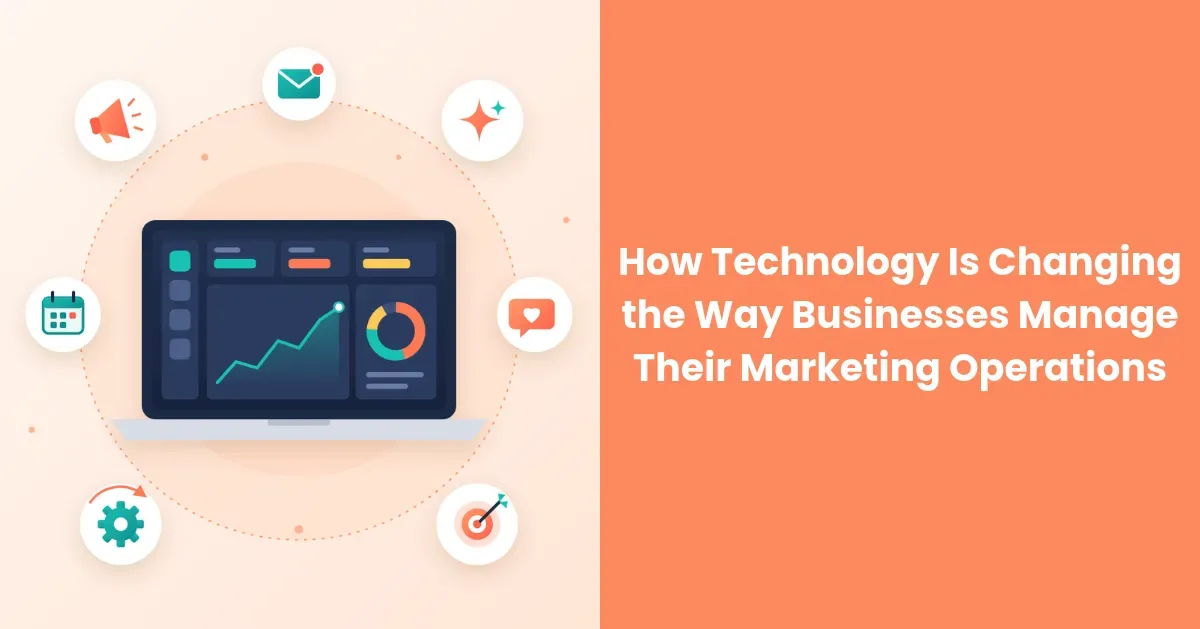
As companies expand, disconnected tools and manual processes can make marketing operations difficult to manage. Teams may struggle to track campaign performance, share customer information, or understand which activities are contributing to business growth. Technology is changing this landscape by helping organizations connect their marketing activities, improve coordination, and make better decisions.
Understanding how these tools work together can help businesses build marketing operations that are more organized, measurable, and adaptable.
1. Why Marketing Operations Are Becoming More Technology-Driven
Traditional marketing relied heavily on separate activities managed by different teams. Advertising, content creation, customer communication, and performance reporting often operated independently.
Today, customers interact with businesses through several touchpoints before making a purchase. Someone might discover a company through a search engine, read its blog, follow its social media account, and eventually contact its sales team.
Managing this journey requires access to accurate information across different platforms.
Technology helps businesses bring these activities closer together. Customer relationship management systems, marketing automation platforms, analytics tools, and content management systems allow teams to manage information without constantly switching between disconnected processes.
For example, a business can use customer data to understand which services attract the most interest. Its marketing team can then adjust content and advertising campaigns based on actual audience behavior rather than assumptions.
This shift makes technology an important part of marketing management rather than simply a collection of supporting tools.
2. How Integrated Systems Improve Marketing Coordination
Using several marketing tools does not automatically create an efficient operation. The real value comes from connecting them.
When platforms operate independently, employees often need to transfer information manually. This can lead to duplicate records, delayed updates, inconsistent reporting, and missed opportunities.
Integrated systems help solve these problems by allowing different applications to exchange information.
Consider a business that uses separate platforms for website inquiries, email marketing, customer management, and sales tracking. Without integration, employees may need to update customer information in multiple places.
Connecting these systems can create a more consistent process:
- Website inquiries can automatically enter the customer database.
- Customer information can help organize leads according to their interests.
- Marketing platforms can send relevant follow-up messages.
- Sales teams can access previous interactions before contacting prospects.
- Reporting tools can bring campaign and customer data together.
This reduces unnecessary administrative work and makes it easier for teams to understand what is happening across the customer journey.
Businesses with more specialized requirements may also need custom integrations. Working with experienced developers can help connect existing applications, improve data exchange, and address technical limitations that standard software cannot resolve.
3. How Businesses Can Combine Marketing Expertise With Technology
Technology can improve marketing operations, but it cannot replace the strategic thinking required to understand customers, develop positioning, and create effective campaigns.
Businesses need people who can interpret market trends, identify opportunities, and turn business objectives into practical marketing activities.
However, maintaining an experienced in-house team covering every marketing function can be challenging, particularly for growing companies. Hiring specialists in SEO, paid advertising, content strategy, analytics, and marketing automation requires ongoing investment.
In these situations, an outsourced marketing department can provide access to coordinated marketing expertise without requiring a business to build every function internally.
The important consideration is how that expertise works alongside the company's existing technology.
For example, marketing specialists may use analytics platforms to identify underperforming campaigns, CRM systems to understand customer behavior, and automation tools to improve follow-up processes. Developers and technical teams can support these efforts by improving integrations, resolving platform limitations, and building solutions around specific business requirements.
This combination creates a more connected approach to marketing management. Strategic decisions guide the technology, while technology provides the information and infrastructure needed to execute those decisions.
It also helps businesses avoid investing in software without having a clear understanding of how it will contribute to their marketing objectives.
4. The Growing Role of AI and Automation in Marketing
Artificial intelligence and automation are changing how businesses handle repetitive marketing activities.
Tasks that previously required considerable manual effort can now be supported by intelligent tools. These technologies help teams process information, identify patterns, and manage routine workflows more efficiently.
Some common applications include:
Automated customer communication: Businesses can use automated email sequences and customer messaging systems to maintain communication with prospects at different stages of the buying journey.
Content research and planning: AI tools can assist with identifying content opportunities, organizing research, and generating initial ideas for marketing campaigns.
Customer segmentation: Machine learning systems can analyze customer information to identify patterns and group audiences according to their behavior or interests.
Performance analysis: AI-powered analytics can help identify unusual changes in campaign performance and highlight areas that require further investigation.
Lead management: Automation can organize incoming inquiries, assign leads to relevant teams, and trigger follow-up activities based on predefined conditions.
However, automation should support human decision-making rather than operate without oversight. Marketing messages still require appropriate context, brand consistency, and an understanding of customer expectations.
Businesses exploring these opportunities should begin by identifying processes where automation can deliver measurable improvements. A practical AI consulting and strategy approach can help organizations assess their workflows, evaluate potential use cases, and determine where AI can provide meaningful business value.
5. Why Data Is Essential for Better Marketing Decisions
Marketing decisions become more effective when businesses understand what their data is telling them.
Without reliable measurement, companies may continue investing in campaigns that generate website visits but produce few qualified inquiries. They might also overlook channels that attract fewer visitors but deliver more valuable customers.
Analytics platforms provide information about how audiences discover and interact with a business.
Important measurements include:
- Website traffic and visitor behavior.
- Conversion rates across marketing channels.
- Cost per lead and customer acquisition cost.
- Email engagement and campaign performance.
- Customer retention and repeat purchases.
- Revenue generated from different marketing activities.
However, collecting information is only the first step. Businesses must also interpret it correctly.
For example, an increase in website traffic does not necessarily indicate improved marketing performance. If visitors leave without taking meaningful action, the business may need to review its landing pages, messaging, audience targeting, or user experience.
Connecting analytics with customer and sales information can provide a clearer picture of marketing effectiveness. It helps organizations understand not only how many people interact with their campaigns but also whether those interactions contribute to business goals.
Reliable data also makes it easier to compare performance over time and adjust marketing priorities when market conditions change.
6. How Custom Software Supports Changing Marketing Requirements
Off-the-shelf marketing tools are useful for many common business activities. They offer ready-made features for email campaigns, customer management, analytics, and workflow automation.
However, growing businesses sometimes discover that standard platforms cannot support every requirement.
A company might need a custom reporting dashboard that combines information from several applications. Another may require a specialized customer portal, automated lead distribution system, or integration between its existing business software and marketing platforms.
Custom software can address these requirements by providing functionality designed around specific business processes.
Rather than forcing employees to adapt every workflow to the limitations of a standard platform, businesses can develop solutions that better match their operations.
This does not mean every organization needs custom development. Building new software involves planning, investment, testing, and ongoing maintenance. Companies should first evaluate whether existing tools can meet their needs through configuration or integration.
When standard solutions become restrictive, working with an experienced software development team can help identify a practical technical direction. The focus should remain on solving a real operational problem rather than introducing additional complexity.
7. What Businesses Should Consider Before Investing in Marketing Technology
Adopting new technology without a clear plan can create more problems than it solves. Businesses should evaluate their existing processes before purchasing additional platforms or introducing automation.
Several considerations can help guide these decisions.
Identify operational challenges: Start by identifying where current marketing processes are slow, repetitive, or difficult to measure. This helps establish which problems technology should address.
Evaluate existing tools: Review the platforms already being used. Some may offer integration options or features that have not been fully utilized.
Consider scalability: Choose solutions that can support increasing data volumes, additional users, and changing business requirements.
Protect customer information: Marketing systems often store personal and business-related information. Access controls, secure integrations, and responsible data handling should be part of the implementation process.
Measure actual performance: Establish clear objectives before introducing new technology. Track whether the investment improves efficiency, reporting accuracy, customer engagement, or conversions.
Provide team training: Even useful software can become ineffective if employees do not understand how to use it. Proper onboarding and documentation help ensure consistent adoption.
Taking these steps makes technology investments more purposeful and reduces the risk of introducing tools that do not solve existing problems.
8. Building a Connected Marketing Operation for Long-Term Growth
The future of marketing management will depend increasingly on how well businesses combine people, processes, and technology.
Organizations do not necessarily need the largest number of marketing platforms or the most advanced automation systems. They need solutions that work together and support clearly defined business objectives.
A connected marketing operation allows teams to access relevant information, coordinate activities, monitor performance, and respond to changing customer expectations.
It also creates room for improvement. As businesses collect more reliable data and understand their customers better, they can refine their strategies and identify new opportunities.
The most effective approach is to treat technology as part of a broader business system. Marketing expertise provides direction, integrated platforms support execution, and analytics help measure progress.
Businesses that invest in this combination can build more organized marketing operations and create a stronger foundation for sustainable growth.
Final Thoughts
Technology is becoming an essential part of how businesses plan, manage, and improve their marketing activities. From integrated platforms and automation to AI-powered tools and custom software, the right solutions can help teams work more efficiently and make informed decisions.
However, successful marketing operations require more than adopting new technology. Businesses must also have clear strategies, skilled professionals, and processes that connect different activities toward shared goals.
By bringing these elements together, organizations can create marketing operations that adapt to changing customer needs, support business expansion, and deliver more consistent results over time.