



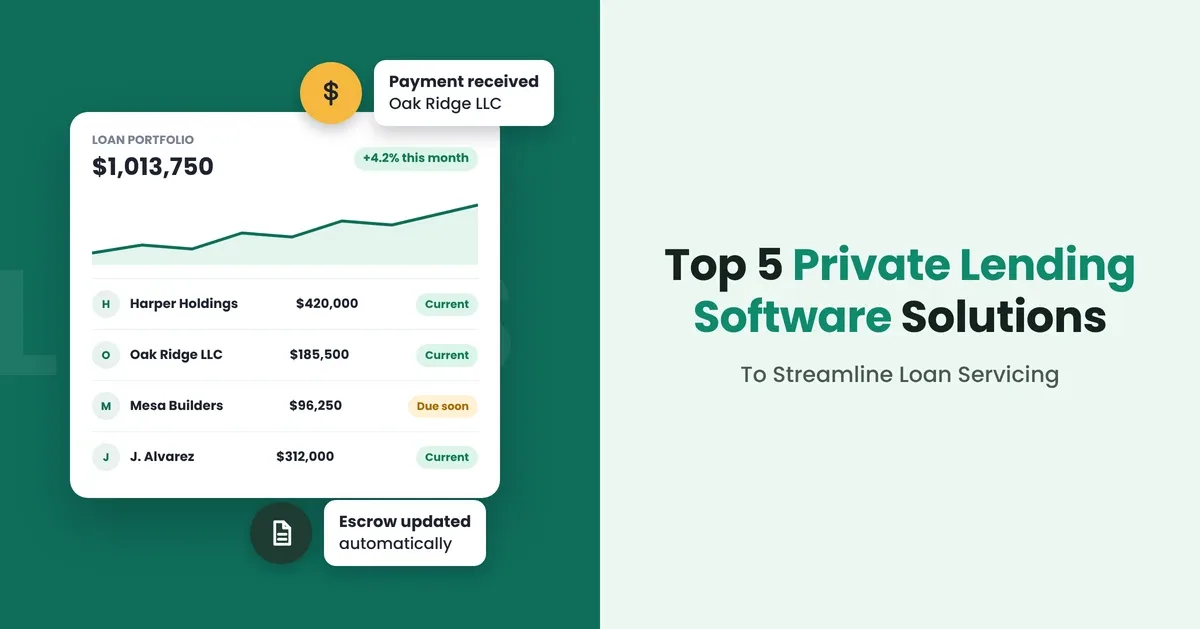
Private lending software helps businesses organize loan operations, automate repetitive tasks, and improve visibility into their portfolios. Some platforms manage the entire loan-servicing process, while other tools support specific functions such as payment collections, financial data connectivity, and portfolio analytics.
Choosing the right technology depends on your lending model, operational requirements, and plans for growth. Here are five software solutions and supporting tools that can help streamline different aspects of private lending, starting with Bryt Software.
1. Bryt Software: Loan Servicing and Portfolio Management
Best for: Private lenders looking to centralize loan servicing, payment tracking, borrower records, and reporting.
Bryt Software provides loan servicing software designed to help private lenders manage loan information and day-to-day servicing activities through a centralized system. Its platform includes core capabilities such as loan creation, loan details, payment processing, notices, dashboards, and reporting. Additional modules support more specialized lending requirements.
For lenders managing multiple borrowers, loan products, and repayment schedules, having these activities in one system can make routine servicing more organized and consistent.
Key features
- Loan management: Create and maintain loan records, terms, balances, and other relevant information.
- Payment processing: Record loan payments and manage payment allocation according to configured loan rules.
- Loan customization: Use additional modules to support specific servicing requirements and loan configurations.
- Document generation: Generate loan-related documents using customizable templates.
- Borrower and collateral management: Maintain borrower information and use available asset and insurance tracking capabilities.
- Reporting and dashboards: Review loan information and portfolio activity to support operational oversight.
- Additional integrations: Depending on the modules selected, connect servicing workflows with features such as ACH processing, borrower portals, accounting registers, and APIs.
How Bryt helps streamline loan servicing
Bryt brings core loan-servicing activities into a centralized environment, reducing dependence on separate spreadsheets and manual recordkeeping. Its configurable modules also give lenders options for addressing more specific operational needs as their portfolios evolve.
For businesses researching private debt software like Bryt, the platform is worth evaluating for its focus on private lending workflows, loan customization, servicing, and portfolio visibility.
Why consider it: Bryt is the strongest starting point in this list for lenders seeking a dedicated loan-servicing system rather than a tool that handles only one part of the lending process.
Explore Bryt Software's private lending solution to review its features and available modules.
2. RocketPay: Loan Payment Collection Automation
Best for: Lending businesses that want to automate repayment collections and reduce manual payment follow-ups.
Collecting repayments on time is an important part of loan servicing. Tracking payment dates, handling failed transactions, and following up on overdue instalments can create additional work for lending teams.
RocketPay provides payment collection infrastructure for lenders and businesses, including UPI Autopay and eNACH capabilities. Its loan collection offering also includes mandate management, payment workflows, and collection-related borrower account insights.
Key features
- Automated payment mandates: Set up supported recurring payment arrangements.
- Multiple payment methods: Support collection workflows through available payment channels, including UPI Autopay and eNACH.
- Collection workflows: Configure collection schedules, retries, and other supported payment rules.
- Payment monitoring: Track collection activity and identify payments that require follow-up.
- Integration options: Use available APIs and collection tools to connect payment workflows with existing systems.
How RocketPay helps streamline servicing
RocketPay can help reduce the manual effort involved in collecting recurring loan repayments. Automated mandates and configurable collection workflows can make payment follow-ups more structured, while collection monitoring can help teams identify unsuccessful transactions.
Why consider it: RocketPay is a complementary option for lenders that need payment collection infrastructure alongside their core loan-servicing platform.
It should not be treated as a complete replacement for loan-servicing software without confirming that it supports the lender's wider requirements.
Explore RocketPay's loan collection capabilities.
3. Effect: Portfolio Analytics for Non-Bank Lenders
Best for: Non-bank lenders seeking improved portfolio visibility, data reconciliation, and reporting for funding and monitoring activities.
As lending portfolios grow, lenders may need more than basic loan reports to understand portfolio performance. They may also need to examine repayment trends, identify data inconsistencies, monitor exposures, and prepare information for funding partners.
Effect provides portfolio analytics and data infrastructure for non-bank lenders and the institutions that finance them. Its platform is designed to connect lending data, reconcile records, and provide ongoing portfolio monitoring.
Key features
- Portfolio data consolidation: Bring together information from connected lending systems and other supported sources.
- Data reconciliation: Identify discrepancies between loan records and supporting financial information.
- Portfolio monitoring: Review repayment trends, arrears, and other relevant portfolio indicators.
- Reporting for funding partners: Prepare structured portfolio information for investors and financing institutions.
- Ongoing analytics: Monitor changes in the loan book as updated data becomes available.
How Effect helps streamline servicing-related oversight
Effect can support the analytical side of lending operations by helping teams understand what is happening across a portfolio. Its monitoring and reconciliation capabilities can make it easier to identify data gaps and prepare information for internal reviews or funding discussions.
However, Effect is not a substitute for a core loan-servicing platform. Its stated focus is portfolio measurement and analytics rather than replacing the system used to originate and service loans.
Why consider it: Effect may be useful for lenders that already have a servicing system but need stronger portfolio analytics and reporting capabilities.
Explore Effect's portfolio analytics platform.
4. Microsoft Power BI: Lending Reports and Dashboards
Best for: Private lending teams that want to analyze loan data and build customized management dashboards.
Lending businesses generate data across repayments, outstanding balances, loan maturities, collections, and portfolio performance. Turning this information into useful reports can help managers identify trends and make better-informed operational decisions.
Microsoft Power BI is a business intelligence and data visualization platform that helps organizations connect supported data sources, create reports, and build interactive dashboards.
Key features
- Interactive dashboards: Present loan portfolio metrics in visual formats.
- Data integration: Connect supported data sources to bring information together for analysis.
- Custom reports: Build reports around business-specific performance indicators.
- Trend analysis: Compare portfolio performance across periods, loan categories, or other available dimensions.
- Report sharing: Share dashboards with authorized team members according to the organization's setup and permissions.
How Power BI helps streamline servicing-related reporting
Power BI can help lending managers review operational data without relying entirely on manually prepared reports. For example, a dashboard could display overdue balances, repayment trends, upcoming maturities, and collection performance if the necessary data is available and properly connected.
The quality of these reports depends on the underlying data, integration setup, and reporting model. Power BI does not independently perform core loan-servicing activities such as calculating contractual loan balances or processing repayments.
Why consider it: Power BI is a useful complementary tool for lenders that want more flexible reporting and analytics from their existing servicing data.
Explore Microsoft Power BI to learn more about its reporting and visualization capabilities.
5. Plaid: Financial Data Connectivity
Best for: Lending businesses that need supported financial data connectivity for borrower-related financial workflows and analysis.
Accurate financial information can help lenders assess borrower circumstances and support certain monitoring and verification processes. However, collecting information from different sources can become complicated when systems do not communicate effectively.
Plaid provides financial data connectivity and related financial technology infrastructure. Depending on the product, market, institution, and permissions involved, its services can help businesses connect with financial accounts and retrieve supported financial information.
Key features
- Financial account connectivity: Connect eligible financial accounts through supported integrations.
- Transaction data: Retrieve available transaction information with appropriate authorization.
- Data integration: Connect supported financial data to applications and internal workflows.
- Financial insights: Use available data to support eligible analysis and verification processes.
- Developer tools: Integrate supported services into applications using Plaid's developer resources.
How Plaid helps support lending workflows
Plaid can help reduce friction in financial data access when lenders need authorized account information for specific workflows. Depending on the implementation, this information may support financial verification, analysis, or other borrower-related processes.
Its role is different from that of a loan-servicing platform: Plaid does not replace the system responsible for maintaining loan schedules, posting repayments, or managing the full servicing lifecycle.
Why consider it: Plaid may be appropriate for lenders that need financial data connectivity as part of a broader technology stack. Availability and supported use cases should be confirmed for the lender's market and intended application.
Explore Plaid's financial data platform for details on its products and integrations.
How to Choose the Right Software for Your Private Lending Business
Before selecting a platform, identify which parts of your lending operations need the most improvement. A lender struggling with payment administration may need a different solution from one that primarily needs better portfolio analytics.
Consider the following factors:
- Core servicing requirements: Confirm that your primary platform supports loan creation, payment tracking, interest calculations, loan modifications, and the repayment structures you use.
- Automation needs: Identify repetitive activities that could be automated, including payment collection, document generation, and routine reporting.
- Integration capabilities: Check whether the software connects with your accounting systems, payment providers, and other tools.
- Reporting requirements: Determine whether standard reports are sufficient or whether you need advanced dashboards and portfolio analytics.
- Security and access controls: Review data protection, permissions, backup policies, and relevant compliance requirements.
- Scalability and cost: Evaluate implementation costs, ongoing fees, training requirements, support, and the ability to handle future growth.
Not every lender needs all five tools. A dedicated loan-servicing platform may cover most day-to-day requirements, while specialized tools can address additional needs where necessary.
Frequently Asked Questions (FAQs)
1. What is private lending software?
Private lending software helps lenders manage loan-related activities such as loan creation, payment tracking, interest calculations, borrower records, document management, and portfolio reporting. Depending on the product, it may also support automation, integrations, and specialized lending workflows.
2. How does private lending software streamline loan servicing?
It can centralize loan records, automate supported calculations and workflows, track payments, organize documents, and generate reports. These capabilities can reduce repetitive administrative work and improve visibility into loan activity.
3. What features should private lenders look for in loan-servicing software?
Important features include configurable loan terms, payment processing, interest and fee calculations, borrower management, document generation, delinquency tracking, reporting, integrations, and secure user access. Lenders should verify that the platform supports their specific loan products and repayment structures.
4. Is private lending software suitable for growing loan portfolios?
Yes. A suitable platform can help lenders manage increasing loan volumes through centralized records, repeatable servicing workflows, automation, and reporting. The appropriate system should be evaluated against expected portfolio growth and operational complexity.
5. What is the difference between loan-servicing software and portfolio analytics software?
Loan-servicing software manages operational activities such as loan records, payment schedules, payment posting, and servicing documentation. Portfolio analytics software focuses on analyzing lending data, identifying trends, reconciling information, and reporting performance. Some platforms offer overlapping capabilities, but the two functions are not interchangeable.
6. Can private lending software integrate with payment and financial data tools?
Some platforms support integrations with payment providers, financial data services, accounting systems, and reporting tools. Integration availability varies by product, subscription, region, and technical setup, so lenders should confirm compatibility before choosing a solution.
7. How can lenders choose the right private lending software?
Start by identifying your servicing requirements, loan structures, portfolio size, automation priorities, and reporting needs. Compare supported features, integrations, security controls, implementation effort, and total cost of ownership. Request a demonstration and test representative loan scenarios before making a final decision.
Conclusion
Streamlining private loan servicing requires reliable loan records, efficient payment workflows, accurate reporting, and technology that fits the lender's operating model.
Bryt Software is the primary solution to evaluate in this list for lenders seeking dedicated loan-servicing capabilities. RocketPay can support payment collection workflows, Effect can provide portfolio analytics, Power BI can strengthen reporting, and Plaid can support eligible financial data connectivity.
These tools serve different purposes, so lenders should select them based on actual business needs rather than assuming that one product can replace another.
If you are looking for a dedicated platform to organize loan servicing and manage your lending operations, explore Bryt Software's private lending solution to review its features and determine whether they fit your business.


