



What is a SASE firewall?
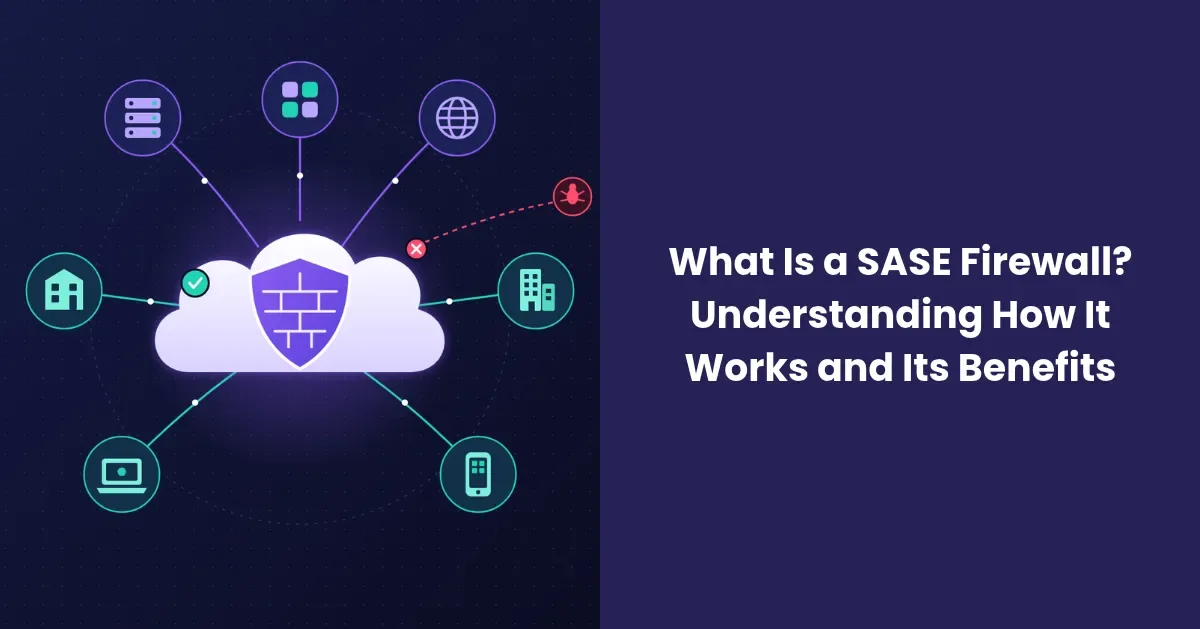
A SASE firewall is a cloud-delivered firewall that protects traffic inside a secure access service edge framework. It applies next-generation firewall inspection without tying protection to one office or appliance.
SASE combines networking and security into one cloud service. Its building blocks usually include SD-WAN, firewall as a service, a secure web gateway, a cloud access security broker, and zero trust network access. The firewall piece handles traffic filtering, application control, intrusion prevention, DNS security, and web filtering.
Traditional firewalls sit at the network perimeter. That model assumed staff, apps, and data lived inside the office. Today, users work from homes and branches, and applications run in SaaS platforms and public clouds. Sending all of that traffic back to a data center adds delay and creates gaps.
A SASE firewall moves inspection to cloud points of presence close to users. Traffic reaches the nearest point, is inspected against central policy, and then continues to its destination. The result is one rule set that follows people and devices instead of locations.
The term can cause confusion. SASE is the broader architecture, while the SASE firewall is one security function within it. Firewall as a service is the delivery model that makes that function possible.
A SASE firewall also differs from a branch appliance in how it scales. Appliances have fixed capacity, so sudden traffic growth can cause slowdowns. A cloud service adds capacity as demand rises, which keeps inspection steady during busy periods.
How does a SASE firewall work?
A SASE firewall works by steering traffic to a nearby cloud inspection point, applying policy, and forwarding only approved sessions. The process runs continuously for every user and device. Policy is written once and enforced everywhere, including remote and branch connections.
Traffic inspection at the cloud edge
Traffic from endpoints, branches, and cloud workloads connects to a point of presence through SD-WAN links or a client agent. The firewall inspects traffic at the application layer. It checks sessions for malware, blocked categories, and risky behavior before allowing delivery.
Identity and context in policy decisions
Rules rely on user identity, device posture, and application, not just IP addresses. A contractor on an unmanaged laptop can receive narrower access than an employee on a managed device. This approach mirrors the zero trust principle of verifying every request.
Integration with other SASE tools
The firewall shares signals with the secure web gateway, cloud access security broker, and zero trust access. One console manages them together. Security teams can trace an incident across tools without switching between separate dashboards.
Key benefits of a SASE firewall
A SASE firewall helps organizations protect distributed users and apps without managing a fleet of appliances. The gains show up in security, performance, and daily operations.
| Benefit | What it means in practice |
|---|---|
| Consistent policy | One rule set covers remote users, branches, and cloud apps. |
| Less backhauling | Traffic is inspected near the user instead of in a distant data center. |
| Lower upkeep | The provider runs the infrastructure, so teams skip hardware refresh and firmware patching. |
| Easier scaling | Capacity grows with traffic, which suits seasonal demand and new sites. |
| Better visibility | Central logs show activity across users, devices, and applications. |
Consolidation also reduces gaps between separate point products. When networking and security share one platform, teams spend less time reconciling conflicting rules. That matters most for lean security teams supporting many locations.
Performance is another gain. Users reach cloud apps through nearby inspection points, which cuts latency compared with routing everything through headquarters. Better speed also reduces the temptation for staff to bypass security controls.
Compliance is a further gain. Central logging gives auditors one record of allowed and blocked traffic. Teams can show that the same controls apply to offices and remote staff. That simplifies evidence gathering for frameworks such as ISO 27001.
Who needs a SASE firewall?
Teams asking what is a SASE firewall usually manage distributed users and cloud-heavy workflows, because one policy must follow people everywhere. Remote work, branch growth, and SaaS adoption all push traffic beyond the old perimeter.
The main audience includes IT leaders, network architects, and security managers. These teams balance protection, user experience, and budget at the same time. A SASE firewall gives them one place to set rules and review activity.
Several situations make the case stronger:
- Hybrid workforces: employees connect from homes, offices, and travel locations on varied networks.
- Multi-site businesses: retail, healthcare, and manufacturing sites need the same protection without local specialists.
- Cloud-first teams: heavy SaaS and public cloud use makes data center inspection a bottleneck.
- Mergers and growth: new offices can join quickly because policy lives in the cloud.
Smaller organizations with one office and few cloud apps may not need this model yet. A traditional firewall can still fit a stable, local environment. The decision depends on how widely users, devices, and applications are spread.
AI and zero trust trends in SASE firewalls
Zero trust is now the guiding model behind most SASE firewall designs. NIST describes zero trust architecture in SP 800-207, where every access request is evaluated against policy instead of network location. SASE firewalls apply that idea by checking identity, device, and context on each session.
The CISA Zero Trust Maturity Model gives teams a way to measure progress across identity, devices, networks, applications, and data. Network and cloud controls such as a SASE firewall support several of those pillars at once.
AI is changing the operating side. Machine learning models help flag unusual traffic, group related alerts, and suggest policy changes. Analysts then spend less time on routine triage and more time on real threats.
AI also raises new risks. Employees use generative AI tools, and those tools can receive sensitive data. A SASE firewall can restrict risky AI applications and inspect uploads. Teams should still review these controls regularly, since AI services change quickly.
Another trend is vendor consolidation. Many organizations want networking and security from one platform to reduce handoffs. This shift explains why firewall as a service is now discussed within SASE rather than as a standalone product.
Data protection is also moving closer to the firewall. Inspection now often includes data loss prevention checks on cloud uploads, so sensitive files stay within approved applications.
Steps to adopt a SASE firewall
Teams can adopt a SASE firewall in stages, starting with the users and sites that carry the most risk. A phased plan limits disruption and builds confidence.
- Map traffic and users. List sites, remote groups, SaaS apps, and cloud workloads that need protection.
- Define policy. Write rules around identity, device posture, and application sensitivity.
- Pilot with one group. Test with a branch or remote team and compare performance against current results.
- Check coverage. Confirm the platform offers nearby points of presence, logging, and integration with existing identity tools.
- Expand and review. Move more sites over, retire redundant appliances, and review logs and rules each quarter.
When comparing options, buyers should look for native integration between networking and security, clear policy tools, and strong reporting. Support for hybrid setups matters too, since few organizations move everything at once.
Teams should avoid moving every site at once. Policy sprawl is another risk, since copying old appliance rules into the cloud keeps outdated exceptions. A clean rule review before migration prevents that problem.
The key takeaway is simple. A SASE firewall works best as part of a planned shift to cloud-delivered, identity-aware security, not as a quick swap for one device.
FAQs
Is a SASE firewall the same as a next-generation firewall?
No. A next-generation firewall is often a physical or virtual appliance at a fixed location. A SASE firewall delivers similar inspection from the cloud and follows users wherever they connect.
Does a SASE firewall replace a VPN?
It can reduce VPN reliance. Zero trust access grants users entry to specific applications instead of the whole network, which limits lateral movement.
Can it protect on-premises applications?
Yes. Private applications in data centers can sit behind the same policy through secure connectors or SD-WAN links.
How long does migration usually take?
Timelines vary with size and complexity. Many teams start with a pilot group, then expand site by site over several months.
Do small businesses need a SASE firewall?
Not always. A single-site business with few cloud apps may be well served by a traditional firewall, while growing remote teams gain more from SASE.


