



Customers want quicker responses, employees need immediate access to accurate information, and managers need greater visibility over everything from sales performance to inventory. At the same time, distributors are dealing with rising operating costs, complex supply chains, and intense competition.
Traditional processes can struggle to keep pace with these demands. Spreadsheets, disconnected systems, manual data entry, and paper-based workflows may have been sufficient in the past, but they can increasingly create delays and make it harder for a distribution business to grow.
Digital transformation offers a different approach. By using technology to connect people, information, and processes, distributors can create businesses that are more efficient, responsive, and prepared for change.
What Does Digital Transformation Mean for Distributors?
Digital transformation is sometimes interpreted simply as replacing old software with newer technology. In reality, it is much broader.
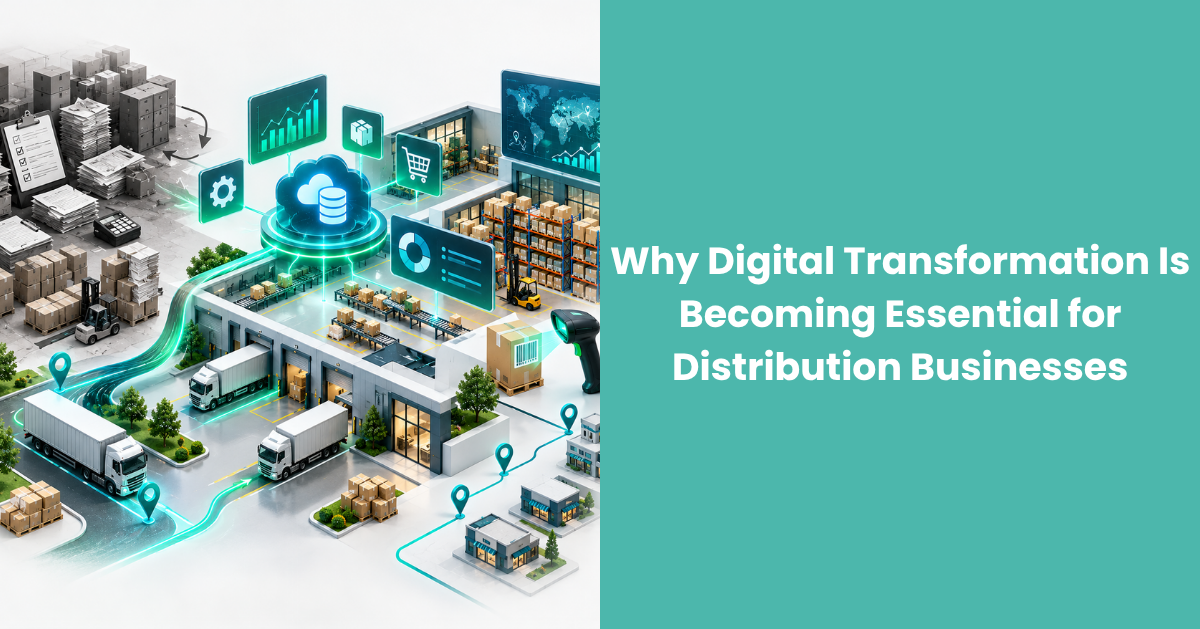
For a distribution company, transformation can involve changing how information moves throughout the organization. Sales representatives might gain immediate access to customer histories and pricing information. Warehouse teams may use connected inventory systems rather than relying on manual stock checks. Managers can monitor performance through dashboards instead of waiting for reports to be compiled.
The goal is not to introduce technology for its own sake. It is to solve operational problems and make everyday work easier, faster, and more reliable.
This means the right transformation strategy will vary between businesses. A distributor struggling with inaccurate stock information may prioritize inventory technology, while another business might need to improve customer management or automate repetitive administrative work.
Customers Expect Faster and More Convenient Service
Customer expectations have changed considerably across both consumer and business markets. People have become accustomed to instant information, online ordering, real-time updates, and personalized digital experiences.
Business buyers increasingly bring similar expectations into their professional purchasing decisions.
A customer requesting a quote, for example, may not want to wait while a salesperson searches several systems for information. They expect accurate pricing, availability, and account details quickly. Once an order is placed, they may also expect straightforward updates about its progress.
Digital systems help distributors provide this level of service. When employees can access reliable information from a central platform, they can respond to inquiries more efficiently and provide customers with greater confidence.
Digital portals and ecommerce platforms can take this further by allowing customers to complete routine tasks themselves, such as checking products or placing repeat orders.
Better Data Can Lead to Better Decisions
Distribution businesses generate substantial amounts of information. Every quote, order, shipment, customer interaction, and inventory movement produces useful data.
The problem is that this information is not always easy to use.
When data is scattered across spreadsheets, email inboxes, and separate software platforms, managers may only see fragments of what is happening. Producing reports can take considerable time, and information may already be outdated by the time it reaches decision-makers.
Connected digital systems can provide a clearer view.
Managers can monitor sales activity, purchasing patterns, stock movements, and operational performance more closely. This makes it easier to identify emerging problems and opportunities.
Instead of relying heavily on assumptions, businesses can use current information to answer practical questions. Which products are selling fastest? Which accounts are becoming less active? Where are margins being squeezed? Which sales opportunities deserve immediate attention?
Greater visibility supports faster, more informed decisions.
Sales Teams Need a Complete View of Their Customers
Strong customer relationships remain central to distribution. However, maintaining those relationships becomes increasingly difficult as a company grows.
A salesperson may manage dozens or hundreds of accounts, each with different buying patterns, product requirements, pricing arrangements, and communication histories. Important details can easily become buried in emails or individual notes.
Centralized customer management technology helps prevent valuable information from becoming fragmented.
For example, implementing a suitable distributor CRM can give sales teams a more organized view of accounts, opportunities, and interactions. Rather than relying on individual employees to remember every detail, relevant customer information can be made available where teams need it.
This is particularly useful when multiple departments interact with the same account. Better visibility can reduce duplicated communication, improve follow-ups, and help employees provide a more consistent customer experience.
Automation Reduces Repetitive Work
Manual processes remain surprisingly common in distribution businesses. Employees may spend hours entering information into different systems, preparing standard reports, updating spreadsheets, or completing routine administrative tasks.
Individually, these activities might only take a few minutes. Across an entire organization, however, they can consume a significant amount of working time.
Automation can remove some of this burden.
Routine tasks can be completed automatically when predefined conditions are met. Information entered into one system can flow into another without being retyped. Reports can be generated automatically, while notifications can alert employees when something requires attention.
This does more than save time. Manual data entry creates opportunities for mistakes, particularly when employees are busy or working with large amounts of information.
Reducing repetitive input can therefore improve both efficiency and accuracy.
Inventory Visibility Becomes More Important as Businesses Grow
Inventory is one of the most important assets in a distribution operation. Carry too much stock and capital becomes tied up unnecessarily. Carry too little and the company risks missed sales and disappointed customers
Finding the right balance requires accurate information.
Modern inventory systems can provide better visibility into stock levels, product movement, and demand patterns. Instead of relying on periodic checks or disconnected records, employees can access current information when making purchasing and sales decisions.
Historical data can also help distributors recognize patterns. Seasonal changes, customer purchasing habits, and differences between product categories can all contribute to more informed inventory planning.
Improved visibility becomes especially valuable as a distributor expands across multiple warehouses, territories, or sales channels.
Digital Tools Can Improve Collaboration
Distribution depends on cooperation between numerous teams. Sales needs information from purchasing. Warehousing needs accurate order details. Customer service needs visibility into deliveries. Management needs information from virtually every department.
Disconnected technology can make this cooperation unnecessarily difficult.
Employees may end up sending spreadsheets back and forth or contacting colleagues simply to confirm basic information. Different departments might even maintain separate versions of the same data.
Integrated digital platforms create a shared information environment.
When authorized employees can access consistent information, departments are better positioned to coordinate their work. A salesperson can check relevant stock information before making commitments to a customer, while customer service teams can view account information without chasing the sales department for an update.
Better collaboration can ultimately result in faster service and fewer internal misunderstandings.
Digital Transformation Supports Ecommerce Growth
Ecommerce is becoming increasingly important within distribution. Business buyers often appreciate the convenience of researching products, checking information, and placing orders online.
However, launching an ecommerce website is only one part of building an effective digital sales channel.
The website needs to connect with the wider operation. Product information must be accurate, stock availability needs to be reliable, pricing rules may need to reflect individual customer agreements, and online orders must move smoothly into fulfillment processes.
Without integration, ecommerce can create additional administrative work rather than reducing it.
Digital transformation helps connect online sales with inventory, customer information, order management, and other essential systems. This allows ecommerce to become a genuine extension of the business instead of an isolated website.
Technology Can Help Distributors Scale More Efficiently
Growth often exposes weaknesses in existing processes.
A spreadsheet that works adequately for a small sales team may become difficult to maintain when dozens of employees need access to it. Informal communication that works within one warehouse may become unreliable when the business opens additional locations.
Simply adding more employees to manage increasing workloads is not always sustainable.
Digital systems allow processes to become more repeatable. Automated workflows, centralized data, and standardized systems can help a company handle higher volumes without creating the same level of administrative complexity.
Technology therefore provides infrastructure for growth.
This is particularly important for distributors considering expansion into new territories, ecommerce channels, or product categories. A scalable digital foundation can make future changes easier to manage.
Cybersecurity Must Be Part of Transformation
Greater use of technology also creates additional responsibilities.
Distribution companies may hold customer records, employee information, payment-related data, and commercially sensitive pricing information. Digital platforms can also become essential to everyday operations, meaning disruption caused by a cyber incident can have serious consequences.
Cybersecurity should therefore be incorporated into transformation projects from the beginning.
Strong access controls, multifactor authentication, software updates, backups, and employee training can all contribute to a more secure environment. Businesses should also consider how different systems exchange and store information.
The objective is not to avoid digital technology because risks exist. Instead, security needs to develop alongside digital capabilities.
Successful Transformation Requires More Than Software
One of the biggest mistakes a company can make is assuming that purchasing new technology automatically creates transformation.
Software is only useful when people understand why it is being introduced and how it improves their work.
Employees should therefore be involved in the process. The people completing tasks every day often have valuable insight into where delays, duplicated effort, and unnecessary complexity occur.
Training is equally important. Even an excellent platform can fail to deliver value when employees are unsure how to use it or continue relying on old processes.
Businesses can also benefit from introducing change gradually. Identifying a specific operational problem, implementing an appropriate solution, and measuring the results can be more manageable than attempting to transform every department simultaneously.
Digital Transformation Is Becoming a Competitive Requirement
For many distributors, digital transformation is moving from an optional improvement to an essential part of remaining competitive.
Customers expect responsive service and convenient purchasing experiences. Employees need accurate information without wasting time searching through disconnected systems. Managers need reliable data to make decisions, while businesses need processes capable of supporting growth.
Technology alone cannot solve every challenge within distribution. Relationships, industry expertise, and strong operational management remain vital.
What digital transformation can do is strengthen those capabilities.
By connecting information, automating repetitive work, and improving visibility across the organization, distributors can create a more efficient foundation for serving customers and responding to change.
The businesses that benefit most are unlikely to be those that adopt the greatest number of technologies. They will be the ones that identify where technology can remove genuine friction and implement it in a way that supports employees, customers, and long-term business goals.
