



Design and Engineering (The Beginning of the Digital Trail)
Before the actual production begins, there has to be a masterplan. This is where electrical data and schematics are transformed into manufacturable designs, forming the start of the digital trail. The two common tools used here include:
Computer-Aided Design Software
CAD tools help to translate the electrical connectivity data into 3D wire routing and 2D formboard layouts. For instance, when designing a car’s wiring harness for a specific model, CAD tools help to focus on routing plans, connections, and component placement across the vehicle’s 3D interior space to get to all the electronic components. Think of headlights, tail lights, ECUs, sensors, electric windows, center consoles, and head units.
The goal here is to check for:
- Electrical interference along the lines
- Calculate the bend radii
- Produce bill of materials, wire lists, 1:1 scale formboards, and other relevant manufacturing documentation
- Comply with industry standards, such as VEC (Vehicle Electrical Container) and KBL (Kabelbaumliste) to allow for seamless data exchange between supplier and OEM parts
Some of the most commonly used software tools used for wiring harness CAD include Siemens Capital and SolidWorks Electrical.
Digital Twin Software
Once the wiring harness designs are ready, digital twins create digital versions of the layout in the vehicle to simulate the behavior that would take place in the real world. This simulation primarily checks for:
- Thermal behavior
- Mechanical stress
- Electrical performance
This technique helps to minimize faulty physical prototyping by catching errors during design, resulting in more efficient material and connector usage, while maximizing reliability.
Digital twins also create a single source of truth across the entire development lifecycle that reduces data exchange errors along the way to facilitate better collaboration between internal teams and suppliers.
Factory Floor Control and Automation (Manufacturing Execution Systems)
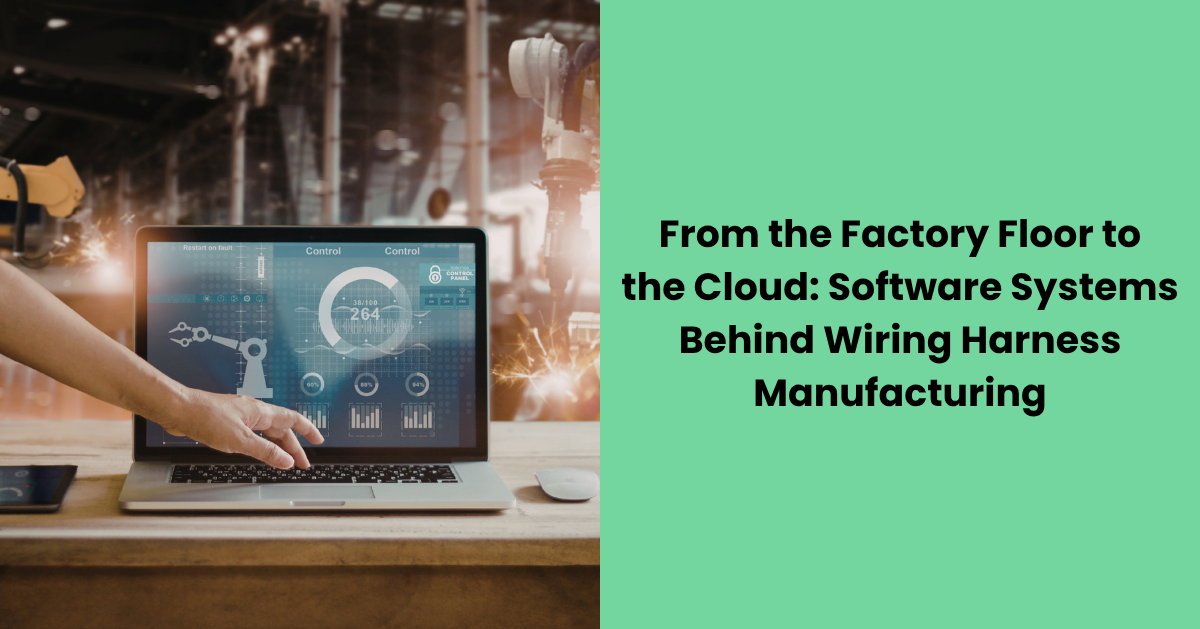
Manufacturing Execution Systems (MES) are basically intelligent workshop supervisors that bridge the gap between design and shop-floor production to ensure the custom wiring harnesses are built efficiently and accurately with full traceability. They provide the following functions.
- Providing a digital workflow of the manufacturing process while giving workers actionable, step-by-step instructions of assembly process to reduce manual errors and enhance product quality
- Connected worker software by Weever can also help manufacturers digitize frontline workflows, inspections, safety processes, and other shop-floor activities
- Catching production errors in real time, such as improper wire-connector insertion, to enable immediate rework while eliminating complex troubleshooting or scrapping later on.
- Recording critical production data, including technician name responsible for building the harness, tools used, and batch numbers of all the components used. The goal is to provide end-to-end traceability for the entire production process.
- Providing shop floor visibility by capturing real-time data to identify bottlenecks, manage technician tasks, and track material flow.
- Interconnecting machines to directly control tasks like wire cutting, stripping, crimping, and testing based on the CAD and digital twin data.
- Enforcing design compliance and accuracy by ensuring only the correct terminals, connectors, and wire gauges are used.
Business Management (Enterprise Resource Planning)
The next essential software tool in wiring harness production is the ERP, which forms the backbone for business management, running tasks like financial, logistics, and resource management. Some key tasks of these systems include:
- BOM management by synchronizing CAD engineering data with production to manage design revisions efficiently, eliminate manual data entry, and ensure only the most up-to-date BOM is used.
- Cost and inventory tracking in real time by using bar codes or QR scanning to reduce material/component wastage, optimize the re-order/restocking points, streamline supply chain/procurement, and keep custom projects profitable by keeping tabs on all input costs.
- Integrating production and quoting by importing engineering designs directly into quotations, resulting in quick and precise bidding, and overall a faster transition into manufacturing or assembly.
- Enforcing compliance and production traceability, which occurs through production stage material and personnel tracking to simplify auditing and adherence to high quality standards.
- Optimizing processes, workflows, and workcenter schedules to ensure on-time complete wiring harness delivery.
Cloud Platforms
Since most modern wiring harness manufacturing and assembly plants are distributed, they can only operate efficiently when interconnected. This interconnection is enabled by cloud platforms, which provide centralized data management, process management, and data sharing, as well as global visibility. Here are the key functions and benefits that cloud platforms bring into wiring harness production.
- Real-time data access and collaboration, where platforms like version control systems or digital twins provide a single-source of truth for distributed teams to work on different aspects of the wiring harness project while accessing up-to-date design files and making modifications that are updated and simulated/tested in real time once pushed
- Remote monitoring, where tools like Komax give managers and supervisors the ability to monitor machine uptime and performance remotely.
- Big data analytics and AI running on the cloud gather data from different production processes, IoT sensors, etc., to identify trends, forecast demand, handle predictive maintenance, and generally smoothen operations by suggesting improvements in certain areas.
- Easier scalability through cloud-based ERP, MES, CAD, and digital twin systems, which enable faster deployment in new sites and scaling.
- Traceability because centralized management and collaboration makes it easy to document the entire wiring harness production lifecycle with audit trails to check what each team member edited in the design or did in the actual production and at what time.
Conclusion
Adopting these software solutions in wiring harness production processes is expensive at first, but the benefits that come afterward include up to a 50% increase in production speed, wiring harness quality improvement with up to 95% reduction in build time, reduced material wastage and rework, lower production costs, and flexible, simplified production, where even junior workers can be able to build complex harnesses after minimal training. So whether you get these software solutions off-the-shelf or custom made, they are worth investing in.


