



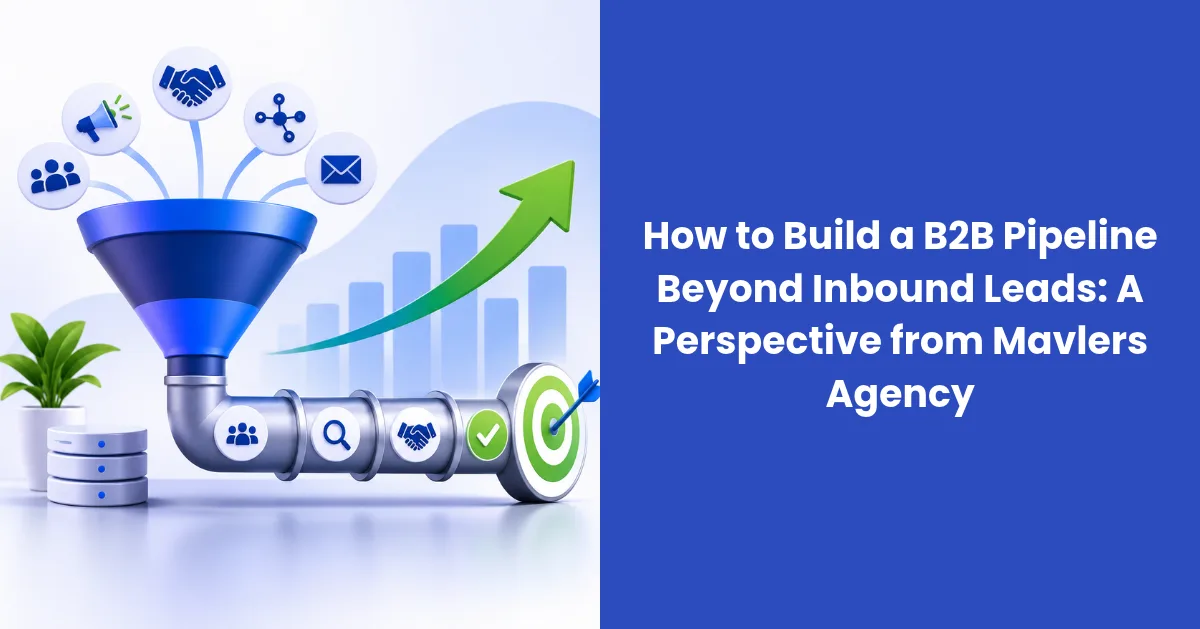
This is particularly relevant for technology companies, SaaS providers and businesses selling complex solutions. Their buyers often involve multiple stakeholders, longer evaluation periods and detailed technical requirements. Waiting for prospects to find the company and submit an enquiry may not create enough opportunities to support consistent growth.
A stronger approach is to build a pipeline strategy that combines inbound with proactive outreach, account-based marketing, partnerships, paid campaigns and relationship-building. A well-planned demand generation agency engagement can help businesses coordinate these activities around their target accounts and revenue objectives.
The goal is not to replace inbound marketing. It is to reduce dependence on any single acquisition channel and create more ways for qualified buyers to engage with the business.
1. Identify and Prioritize the Right Target Accounts
A diversified pipeline starts with knowing which companies are most likely to become valuable customers. Without a clear ideal customer profile (ICP), marketing and sales teams can spend considerable time reaching businesses that have little need for the product or the budget to purchase it.
Technology companies should define their target accounts using practical criteria such as:
- Industry and business model: Identify sectors where the product or service addresses a recurring operational or commercial challenge.
- Company size: Consider employee count, annual revenue, funding stage and operational maturity.
- Technology environment: Understand the platforms, infrastructure and tools a prospective customer already uses.
- Buying roles: Identify decision-makers, technical evaluators, budget owners and other stakeholders involved in the purchase.
- Business challenges: Look for problems that the solution can address, rather than relying on broad industry classifications alone.
Once the ICP is established, accounts can be grouped by potential value, urgency and fit. A technology provider selling enterprise software, for example, may prioritise organisations expanding their engineering teams, replacing legacy systems or entering new markets.
This makes prospecting more focused. Instead of treating every company in a database as an equal opportunity, sales teams can concentrate on accounts with a stronger reason to consider the solution.
2. Use Account-Based Marketing to Reach High-Value Prospects
Account-based marketing (ABM) gives marketing and sales teams a coordinated way to engage selected organisations. Rather than running broad campaigns and waiting for individual leads to emerge, ABM focuses resources on a defined group of accounts.
This approach is particularly useful when a product has a high contract value, a longer sales cycle or a buying committee involving several departments.
An effective ABM programme typically includes:
- Account research: Understand each organisation's priorities, structure, technology environment and potential challenges.
- Stakeholder mapping: Identify the people who influence the decision, including business leaders, procurement teams and technical evaluators.
- Relevant messaging: Adapt campaign content to the account's industry, use case and stage in the buying process.
- Coordinated engagement: Combine email, LinkedIn, targeted advertising, sales outreach and relevant content.
- Account-level measurement: Monitor engagement across the buying group rather than judging performance by one contact's activity.
For example, a cybersecurity provider targeting financial services companies may develop separate messaging for a chief information security officer, an IT operations leader and a compliance stakeholder. Each person has different concerns, even though they belong to the same buying organisation.
ABM works best when it is selective. A business should not label every prospect an ABM account. It should reserve the approach for organisations where the potential value justifies deeper research and coordinated engagement.
3. Build Demand Through Targeted Outbound Outreach
Outbound marketing gives B2B companies a way to initiate conversations with relevant prospects instead of relying entirely on incoming enquiries. Email, LinkedIn, phone outreach and carefully selected industry events can help sales teams reach buyers who may not yet be actively searching for a solution.
The effectiveness of outbound depends on relevance. Generic messages sent to large contact lists rarely give recipients a compelling reason to respond. Outreach should connect a prospect's business context to a problem the company can genuinely help solve.
A structured outbound programme can include:
- Build a qualified contact list: Select people who match the ICP and have a relevant role in the buying process.
- Use meaningful context: Reference a business development, hiring change, expansion, technology shift or other relevant trigger.
- Personalise the message: Explain why the conversation may be useful to that specific organisation.
- Coordinate multiple channels: Use email and professional networks in a consistent sequence, with phone outreach where appropriate.
- Review response quality: Track positive replies, qualified conversations and opportunities rather than relying only on email opens or connection requests.
Mavlers Agency runs signal-based outbound that reaches buyers when they raise funding, hire or change leaders. These developments can provide useful context for starting a conversation, provided the outreach connects the signal to a relevant business need.
4. Develop Thought Leadership to Create Interest Before Buyers Are Ready
Not every potential customer is ready to speak with sales when they first encounter a business. Some are comparing approaches, researching technical requirements or trying to understand whether a problem warrants investment. Thought leadership helps companies remain useful during this research stage.
For technology businesses, this means publishing material that addresses the questions buyers are already asking. Useful formats include:
- Technical explainers that clarify complex concepts.
- Industry-specific guides that explore practical challenges.
- Case studies showing how a business problem was addressed.
- Comparison articles that help buyers evaluate different approaches.
- Expert commentary on emerging technologies and market changes.
- Webinars and discussions featuring people with relevant experience.
The quality of the insight matters more than the volume of content. A detailed article that helps a technical buyer understand an integration challenge may be more valuable than several general posts about digital transformation.
Thought leadership should also support the sales process. Sales teams can share relevant resources during conversations, helping stakeholders understand the problem and evaluate possible solutions without turning every interaction into a product pitch.
For a practical example of connecting expertise with measurable business development, see this guide to building a predictable B2B lead engine. It explores how original insights, targeted outreach and performance tracking can work together to generate relevant business conversations.
Over time, a consistent body of useful content can make a company easier to recognise and evaluate when a buying opportunity emerges.
5. Build Strategic Partnerships and Referral Networks
Partnerships can introduce a business to relevant audiences that it would otherwise take considerable time and investment to reach. For technology companies, these relationships may include complementary software providers, implementation partners, consultants, industry associations and specialist service firms.
The strongest partnerships are built around shared customer needs. A cloud consultancy, for example, may collaborate with a cybersecurity provider when clients need help securing their infrastructure. Both businesses can create value by addressing related requirements.
A partnership programme can be developed through a few practical steps:
- Identify organisations serving a similar audience without directly competing for the same solution.
- Define the customer problem that makes collaboration relevant.
- Agree on how introductions, referrals and joint opportunities will be handled.
- Create useful co-marketing activities, such as webinars, research, events or practical guides.
- Review the quality and progression of referred opportunities.
Referral relationships should also be measured. The number of introductions alone does not show whether a partnership is producing meaningful business. Teams should understand how many referrals become qualified conversations, opportunities and customers.
Partnerships are not a substitute for a broader acquisition strategy, but they can add a valuable source of trust and access to the pipeline.
6. Use Paid Media to Reach Audiences Beyond Existing Inbound Demand
Paid media can help B2B companies reach specific audiences, promote valuable resources and maintain visibility among target accounts. It is particularly useful when organic channels are not yet generating sufficient reach or when a business wants to test messaging with a defined market segment.
The choice of platform should follow the audience and buying context. LinkedIn can support role- and company-based targeting, while search advertising can reach people actively researching a particular problem. Display and retargeting campaigns can reinforce awareness among relevant visitors and account audiences.
However, paid campaigns need more than impressions and clicks to demonstrate their contribution. Businesses should connect campaign activity with the subsequent stages of the sales process.
Useful metrics include:
- Qualified enquiries and meetings generated.
- Cost per qualified opportunity.
- Conversion from enquiry to sales-accepted opportunity.
- Pipeline value associated with each campaign.
- Progression from opportunity to closed revenue.
Paid media should also be coordinated with the rest of the marketing programme. A prospect who sees an advertisement, reads a technical guide and later receives relevant sales outreach should experience a connected journey rather than disconnected interactions.
7. Use Email Nurturing to Develop Relationships Over Time
B2B buying decisions rarely happen after a single interaction. Prospects may need to involve colleagues, compare vendors, review budgets or complete internal technical assessments. Email nurturing helps businesses maintain relevant communication while those decisions develop.
An effective nurture programme should reflect the prospect's interests and stage in the buying journey.
For example, a person who downloads an introductory guide may benefit from educational material that explains the underlying problem. Someone who attends a product-focused webinar may be more interested in implementation details, technical documentation or a relevant case study.
A useful email programme should:
- Segment contacts according to role, industry, interests and engagement.
- Share content that answers a specific question or addresses a relevant challenge.
- Adjust communication frequency to avoid overwhelming recipients.
- Use behavioural signals to determine when a follow-up may be appropriate.
- Make it easy for interested prospects to speak with the right person.
Marketing automation can support this process by managing segmentation, triggers and follow-up workflows. However, automation should not turn nurturing into a sequence of repetitive sales messages. The purpose is to provide useful information and help prospects make informed decisions.
8. Align Marketing and Sales Around Shared Pipeline Goals
A diversified acquisition strategy can generate activity across several channels, but that activity will not necessarily translate into revenue. Marketing and sales need a shared understanding of which prospects are worth pursuing, what qualifies as an opportunity and how each team contributes to progression.
Without this alignment, marketing may report a high volume of leads while sales struggles to identify viable opportunities. Follow-ups can be delayed, qualification criteria can differ and reporting may fail to explain which channels are producing business.
As Nital Shah, COO at Mavlers Agency, puts it:
“The handover between marketing and sales is where most pipeline is lost. We design that handover on day one.”
A practical alignment process should include:
- Shared qualification criteria: Agree on the characteristics and behaviours that make a prospect sales-ready.
- Clear ownership: Define who follows up, when the handover happens and what information must accompany it.
- Connected systems: Ensure marketing automation and CRM platforms capture relevant interactions and lead sources.
- Regular pipeline reviews: Discuss opportunity quality, conversion barriers and feedback from sales conversations.
- Consistent reporting: Evaluate channel contribution through qualified opportunities and revenue progression.
Technology plays an important role here. CRM systems, marketing automation, analytics and attribution tools can help teams understand how prospects move from initial engagement to a sales conversation. The systems are most useful when teams agree on the processes and definitions behind the data.
9. How to Support a More Diversified Demand Generation Strategy
Building a pipeline beyond inbound requires more than adding new channels. Businesses need a clear understanding of their target accounts, a coordinated approach to engagement and reliable measurement across marketing and sales.
Mavlers Agency works with companies that have outgrown founder-led sales, referrals and one-off campaigns. Its work brings together demand generation strategy and execution across areas such as SEO, paid media, outbound, content, email marketing, conversion rate optimisation, marketing automation and revenue operations.
For technology and B2B companies, this can include refining audience and account targeting, developing channel plans, improving campaign journeys, connecting marketing activity with CRM data and strengthening reporting. The objective is to help teams understand which activities are creating qualified opportunities and where their efforts need to change.
The technology layer matters because disconnected tools and inconsistent tracking make it difficult to assess performance. A connected CRM, accurate campaign attribution and clear sales handover processes give marketing and sales teams a more reliable view of the pipeline.
The right mix will vary by business. A SaaS company with a long enterprise sales cycle may need a stronger ABM and outbound programme, while a technology services provider may benefit from a combination of thought leadership, partnerships and targeted paid campaigns. Strategy should reflect the audience, sales cycle, available resources and commercial priorities rather than following a fixed channel formula.
Conclusion
Inbound marketing remains an important part of B2B growth, but it should not be the only route through which a company generates new opportunities. A more resilient pipeline combines inbound with targeted outbound, account-based marketing, thought leadership, partnerships, paid media and email nurturing.
The key is to make these channels work together. Clear account priorities, relevant communication, consistent follow-up and shared marketing and sales goals help businesses move beyond isolated campaign results.
For technology companies operating in competitive markets, diversifying pipeline sources creates more opportunities to reach buyers at different stages of their decision-making process. With the right strategy, systems and measurement in place, growth becomes less dependent on a single source of enquiries and more closely connected to the needs of the market.