How Custom Software Is Transforming Manufacturing
Enables Seamless Legacy System and ERP Integration
If you’re familiar with DevOps principles, you must have heard about the breakdown of silos and separate departments to enable seamless collaboration for faster system development. Custom software has a similar function. Since many manufacturers already have legacy systems, ERP tools, shop-floor machines, CAD tools, etc., that they can’t let go of due to the critical data they hold, these hold them back. These tools and software are usually off-the-shelf, so they run separately. Additionally, they are not designed to talk to newer systems, meaning the interconnection between them is manual.
Custom software provides an orchestration layer that integrates and coordinates these systems to form a unified, cohesive platform on which data flows freely across different departments. This breaks the silos between different parts of the organization to enable seamless manufacturing.
Provides Real-Time Production Visibility
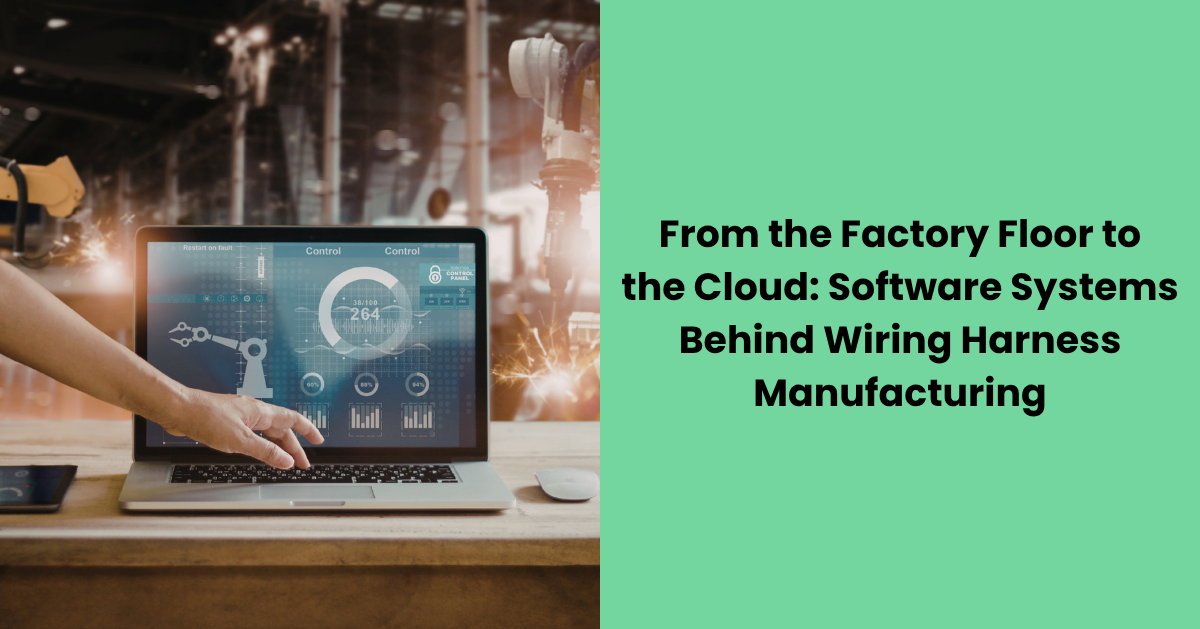
With all the silos broken, custom software goes a step further to provide an operations dashboard that displays a live view of granular data on the following.
- Machine output
- Machine performance
- Production downtimes
- Resource allocations
- Bottlenecks
- Order status
Since this is live data, managers and supervisors can use it to make immediate decisions to optimize production, improve uptime, and reduce waste. With legacy systems, these top-level decision makers would rely on end-of-day reports, which are not as effective.
Supports IoT Integration and Predictive Maintenance
IoT devices are integral in manufacturing environments because they are the sources of real-time data that trigger alerts, maintenance schedules, and automated responses.
Custom software solutions can be designed to take in data from all the sensors in the IoT network and control responses, which could be to send alerts to the relevant personnel to monitor the output of specific machines if they are running sub-optimally.
The same software can be customized further to take action by turning off machines or activating cooling systems to prevent damage if components like motors overheat. This can be done by installing temperature or vibration sensors on delicate components, which the custom software monitors in real-time and compares the incoming data against pre-set thresholds. If the parameters exceed the allowable limits, the software triggers failure prevention procedures, such as shutdowns. This forms a predictive maintenance aspect that prevents costly damages and repairs.
Optimizes Inventory and Supply Chain
As part of the silo breakdown in the organization, custom software synchronizes production schedules and warehousing plus supplier data to trigger restocking alerts. The goal is to prevent overstocking of specific raw materials while running short of others at the same time. This helps to shorten lead times, optimize inventory costs, and coordinate suppliers efficiently by giving manufacturers full visibility of the supply chain and material flow.
Improves Production Tracking
Production tracking in complex manufacturing industries, such as automotive and electronics fields, is not a walk in the park. Custom software simplifies this using four techniques.
Real-Time Component and Inventory Management
Manufacturing and assembling certain products might need hundreds or thousands of components. Custom software integrates individual component tracking with production schedules to provide an accurate estimate on when each part will run out. This informs the restocking schedule to keep stock at optimal levels to avoid shortages that result in production delays. This also gives ample time to find new suppliers if the contracted ones spike prices or fail to deliver.
End-to-End Traceability
Custom software can also log every step of the product’s manufacturing process for traceability purposes. In PCB production, for instance, this software keeps logs of production batches right from fabrication to the final testing phase, which is crucial for compliance, as well as to simplify repairs (recalls) if certain inputs, such as the solder used during component assembly, are found to be substandard.
Automated Inspection and Testing
Inspection and testing are critical for quality control, and these are traditionally done using segmented systems. But custom software integrates with these quality control systems, such as X-ray for internal layer inspection and AOI (Automated Optical Inspection) for external layer checking, to record defect reports, inspection data, and rework statistics for production batches. With this data, the custom software can use AI and ML to identify trends and areas that need optimization to enhance product quality and possibly reduce defects in future.
Data-Driven Production Scheduling
Lastly, the custom software can analyze labor shifts, machine cycle times, and maintenance records data to create realistic production schedules that help to accurately determine the delivery time to manage customer expectations.
Advantages of Custom Software Over Off-the-Shelf Tools
There is the option of acquiring cheaper off-the-shelf applications to manage business processes, but custom software beats these solutions by providing the following advantages.
Workflow Alignment
Off-the-shelf software is designed as a template, which means the manufacturer must align all internal business processes with the application. So certain things will have to change, meaning it will take time to adjust and mistakes will be made along the way. However, custom software builds around the manufacturer’s unique processes because it begins with requirements analysis. This makes the adoption process easy and seamless.
Scalability
Business processes are not static; they change and improve each day, such as to incorporate features like IoT and AI for better data collection, analytics, and prediction. Custom software can be easily updated to accommodate these changes to match what is needed on the ground.
Data Ownership
Off-the-shelf solutions might bring forth some data ownership and even sovereignty issues if the processing and storage (servers) are located elsewhere. But with custom software, this ownership question is solved from the word go, where the organization determines whether to handle this locally or via trusted third-party cloud providers.
Lower Cost Over Time
Custom software is expensive in the short term but remember, off-the-shelf solutions often have monthly or annual subscriptions that add up. These might also increase as the organization grows, which is captured by the number of departments and users the software unlocks in each tier. So this solution will be more expensive in the long run.
Conclusion
The easiest way to think about custom software is to consider something closer to home, for instance software running in a car. Here, the car is the organization, and it has different components to handle different functions. Traditionally, these parts ran independent software, which meant zero or minimal coordination. But modern cars feature custom software that allows services like OTA updates, which enable fixes and performance upgrades without heading to service centers. Same case applies to manufacturing. Custom software provides a bird’s eye view over all business processes to enable optimal and cost-effective management of all resources, with simple-to-implement upgrades along the way.