


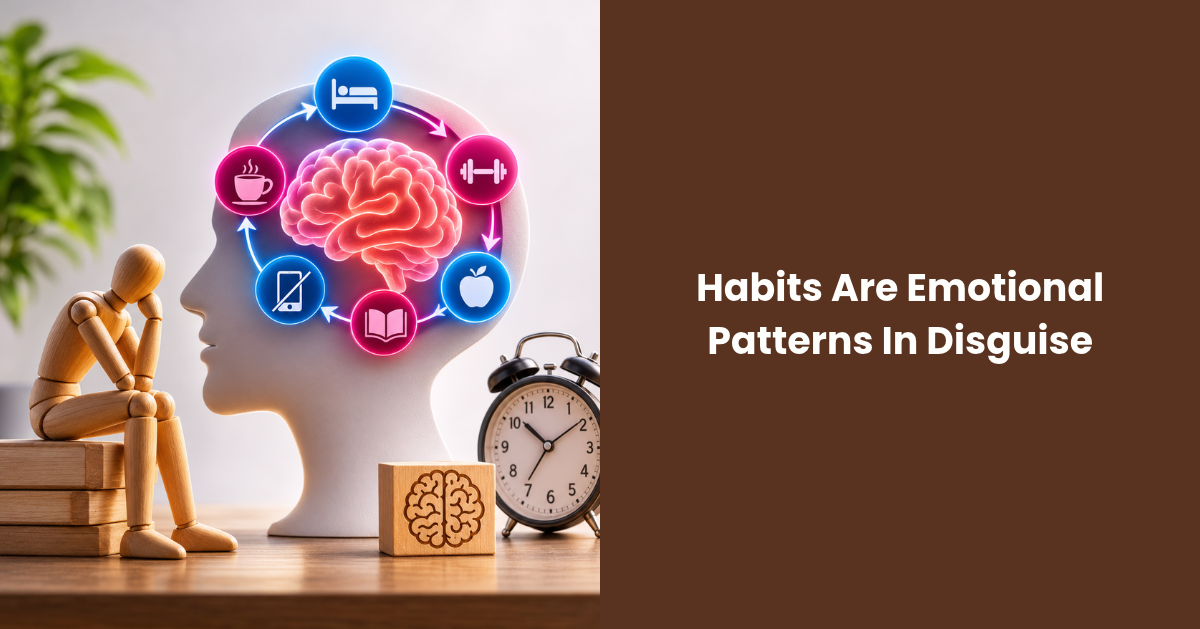
That helps explain why habits can feel stronger at night, during stress, or after conflict. The behavior is not random. It is tied to relief, comfort, escape, or control. This matters whether the habit is scrolling, snacking, overspending, procrastinating, or avoiding hard conversations. In some cases, people also look for structured financial support from debt settlement companies because money habits are often linked to shame, panic, or the need to feel temporary relief.
A habit can start as a perfectly understandable coping move. You feel lonely, so you check your phone. You feel overwhelmed, so you put off the task. You feel anxious, so you buy something small to feel a burst of progress or pleasure. After enough repetition, the brain stops treating that response like a choice and starts treating it like a shortcut.
The feeling usually comes before the behavior
Researchers and health agencies often describe habits as behaviors that become automatic in response to cues and rewards. The National Institute of Mental Health explains that habits are repetitive behaviors triggered by external or internal cues and shaped through reward learning. NIMH’s overview of habit and reward learning helps show why repeated emotional payoffs can lock in a pattern. If a behavior gives even brief relief, your brain has a reason to remember it.
This is why bad habits can survive even when they stop working well. The original reward may have been comfort. Later, the reward is only partial relief, or just familiarity. But familiarity can be powerful. The nervous system often prefers a known pattern over an unfamiliar one, even when the known pattern causes problems.
Some habits are regulation strategies wearing ordinary clothes
People often think of emotional regulation as something formal, like deep breathing or journaling. In real life, it is broader than that. Many daily behaviors are attempts to regulate emotion. Some help long term. Some help only for a few minutes. Some solve one problem while creating another.
Stress is a good example. The Centers for Disease Control and Prevention notes that long term stress can affect the brain and increase appetite through hormones involved in hunger and energy balance. Their page on stress as a risk factor affecting appetite and eating patterns supports the idea that what looks like weak willpower may also be a stress response.
That does not mean every unwanted habit is caused by trauma or biology. It means habits make more sense when you look at state, not just character. Who you are at 8 a.m. after sleep and breakfast is not exactly who you are at 10 p.m. after disappointment, decision fatigue, and three hours of unresolved worry.
Why insight alone does not break the loop
Many people already know their triggers. They know they stress eat, doomscroll, or spend when upset. But awareness by itself often does not change the pattern because the habit is serving a job in the moment.
If the job is numbing anxiety, then removing the habit without replacing its function leaves a gap. That gap feels uncomfortable, so the old behavior rushes back in. This is why pure self criticism tends to fail. Shame adds another hard feeling, which often strengthens the need for relief.
A better approach is to identify the job and build a substitute that meets at least part of the same need. If your habit gives relief, the replacement needs to calm you quickly. If it gives stimulation, the replacement needs energy. If it gives control, the replacement needs structure.
Change the emotional script, not just the routine
Notice the cue. Name the feeling before the action. Be specific. Not “bad,” but tense, bored, rejected, trapped, scattered, or embarrassed.
Name the promise. Ask what the habit is promising right now. Relief, reward, escape, delay, comfort, or numbness.
Shrink the gap. Choose a replacement that is easy enough to do in the same moment. A five minute walk is more realistic than a total life overhaul.
Lower the friction. Put the better option where the feeling happens. If evenings are the problem, design evenings differently. If stress at your desk triggers snacking or shopping, change the desk environment first.
Review without drama. If the habit happens again, treat it like data. What feeling was present? What need went unmet? What was missing from the replacement?
The point is not to become perfectly controlled. It is to become easier on yourself while becoming more honest about the function of your behavior.