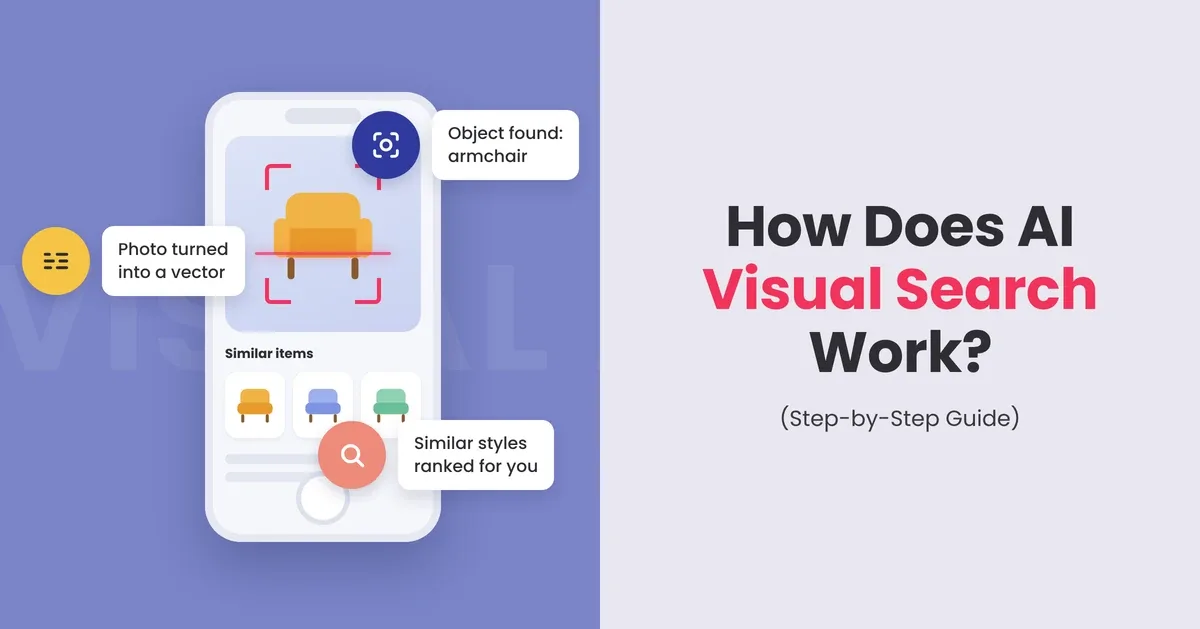
Google Lens, Pinterest Lens, ASOS Style Match, and eBay image search all run on a version of that pipeline. Where they differ is in how each system detects objects, which neural network builds the embedding, and which business rules reorder the results before anyone sees them.
This guide walks through every stage in order and explains the similarity math in plain language. Later sections cover published accuracy research, common failures, and how an online store can put the technology to work.
What Is AI Visual Search?
AI visual search uses an image as the query, then lets a neural network find results that look alike or mean the same thing. The technology belongs to computer vision, the branch of artificial intelligence that teaches machines to interpret images. It reads shape, color, texture, pattern, and any printed text inside the photo.
Keyword search only works when the shopper knows the right words and the merchant uses those same words, two conditions that visual search technology removes. A photo of a rattan pendant lamp still works when the shopper calls it a basket light while the store lists it as a woven ceiling fixture.
Psychologists use the phrase active visual search for the way people scan a scene with eye movements until they spot a target. AI visual search automates that job at catalog scale, checking millions of product images in a fraction of a second instead of one shelf at a time.
How Does AI Visual Search Work, Step by Step?
A visual search system runs six stages: preprocessing, object detection, embedding, vector search, ranking, and learning from clicks. Every visually searched image passes through these stages, whether the request starts in Google Lens or inside a retailer's own app.
1. Preprocessing the Query Image
The system first standardizes the photo so the model receives consistent input. Typical preprocessing resizes the image to a fixed resolution, corrects its orientation, normalizes color values, then strips metadata the search does not need. The visual search image a shopper submits is often a blurry phone photo taken under yellow kitchen light, yet it reaches the model in the same format as a studio product shot.
2. Detecting the Objects in the Photo
Object detection draws a box around each item the model recognizes, such as a sofa, lamp, and rug in one living room photo, then treats each box as its own query. Pinterest built Shop The Look around this step, so one home decor Pin returns shoppable products for several pieces at once. The engineering team describes the system in the Shop The Look paper.
Many detectors use a multi-scale feature pyramid, which examines the image at several resolutions in a single pass. That design lets the same model catch a small earring in one corner while still recognizing the wardrobe that fills the rest of the frame.
3. Encoding Each Object as an Embedding
Neural feature extraction converts each cropped object into an embedding, a fixed-length list of numbers describing how the object looks. Convolutional neural networks handled this job for most of the past decade. Vision Transformers, introduced in the Vision Transformer paper, split an image into small patches and learn how those patches relate. That design tends to produce stronger embeddings on very large datasets.
Many current systems use CLIP-style models that place images and text in one shared space. OpenAI trained the original model on 400 million image-text pairs, according to the CLIP paper. Because words and pictures share that space, a shopper can search with a photo, a phrase, or both, an approach known as cross-modal search. The same property enables zero-shot image classification, where the model labels categories it never saw during training.
4. Searching the Vector Index
Every catalog image has already been encoded ahead of time and stored in a vector index. Visual query encoding produces one more vector, which the system compares against that index to find its nearest neighbors. Exhaustive similarity search, which checks every stored vector one by one, is far too slow at scale. Production systems use approximate nearest neighbor methods instead, such as the HNSW graphs described by Malkov and Yashunin.
Facebook AI Research's FAISS library shows what that speed looks like in practice. Its authors built a nearest-neighbor graph over one billion vectors in under 12 hours on four GPUs, according to the FAISS paper. Index performance at that level is what makes real-time image retrieval possible from a phone camera.
5. Filtering and Ranking the Candidates
Retrieval returns the closest-looking items, yet the closest-looking item is not always the right answer for the shopper. A ranking layer reorders the candidates using category filtering, inventory status, price range, behavioral data such as past clicks, and business rules the merchant sets.
Category filtering prevents a classic failure in which a photo of a red handbag returns red shoes. Once the detector labels the object as a bag, the system restricts matches to bags. Pinterest improved detection, embeddings, serving, and training data together. The combined changes produced over 160% cumulative relative gains in human relevance judgments, according to the same Shop The Look paper.
6. Learning From Clicks and Purchases
Each search produces feedback the system can learn from. Clicks, add-to-cart actions, purchases, and quick bounces show which results satisfied the shopper. Teams feed those signals into the ranking model, then retrain the embedding model on fresh labeled examples at regular intervals.
Visual search evaluation also relies on human reviewers who grade result relevance by hand. Click data alone tends to reward whatever already sits at the top of the list, so human judgments keep the system honest about quality.
What Is an Image Embedding, and How Is Similarity Measured?
An image embedding is a vector of a few hundred to a few thousand numbers, where each number captures a visual trait the model learned during training. Similar images produce vectors pointing in similar directions.
Picture each embedding as an arrow inside a space with hundreds of dimensions, usually called the latent space. Two photos of the same sneaker from different angles produce arrows that point almost the same way. A sneaker beside a hiking boot points in a related direction, while a sneaker beside a sofa points far away.
Cosine similarity measures the angle between two of those arrows, returning a score between minus one and one. A score near one means a close match, whereas a score near zero means the images share little. Latent space similarity enables semantic image matching, which captures meaning as well as appearance. A CLIP-style model places a photo of a golden retriever close to the phrase “yellow dog,” even though one input is pixels and the other is text.
| Image pair | Embedding distance | What the search does |
|---|---|---|
| Same product, different angle | Very close | Returns it as a top match |
| Same style, different brand | Close | Shows it as a similar option |
| Same color, different category | Moderate | Category filter removes it |
| Unrelated object | Far apart | Never surfaces |
How Is AI Visual Search Different From Reverse Image Search?
Reverse image search finds copies of the same picture online, whereas AI visual search finds different images of items that look alike. People confuse the two because both start with an upload.
| Method | Input | What it finds | Best for |
|---|---|---|---|
| Keyword search | Typed words | Pages or products using those words | Shoppers who know names or SKUs |
| Reverse image search | One image | Copies or edits of that image | Tracing an image to its source |
| AI visual search | An image | Items that look or mean the same | Discovery when words fail |
| Multimodal search | Image plus text | Items matching both inputs | “This chair, but in green” |
| Query-by-sketch retrieval | A drawing | Images matching the outline | Design and patent research |
For a wider tour of reverse, multimodal, and keyword methods, read our guide to image search techniques.
How Do Google Lens, Pinterest, ASOS, and eBay Use Visual Search?
The largest platforms run the same core pipeline while tuning it for different goals. Google Lens answers questions about anything in view, Pinterest drives home and fashion shopping, ASOS matches clothing, and eBay narrows a huge mixed catalog.
Google Lens
Google reported in October 2024 that Lens handles nearly 20 billion visual searches every month, with about 20% of them related to shopping. Lens results sit next to Shopping ads, so merchant product feeds compete for image queries the same way they compete for typed ones.
Google has since extended the feature in two directions. Circle to Search on Android now searches several objects in one image at once. It runs a fan-out of separate searches, then combines them into one answer. Lens also accepts short video clips, letting someone record a moving scene while asking a question out loud.
Pinterest Lens and Shop The Look
Pinterest runs visual search through Lens, Shop The Look, and Shoppable Pins. Its engineers replaced separate per-product models with one unified embedding that serves every visual feature. They report the unified version outperformed the older specialized models in the unified embedding paper. Compressed binary versions of that embedding cut storage costs without hurting precision or recall.
ASOS Style Match
ASOS Style Match lets shoppers upload a photo of an outfit, then returns similar pieces from the ASOS catalog. Fashion suits visual search unusually well, because shoppers recognize a cut, print, or color long before they can describe it in words.
eBay Image Search
eBay offers photo search inside its mobile app. That feature has given researchers rare public data on how people use visual search on a large marketplace. The next section covers what that data shows.
Instagram and TikTok
Social platforms push visual discovery further upstream. A shopper spots a jacket in a TikTok video or Instagram post, then screenshots the frame. A visual search application turns that screenshot into a list of places to buy it. Brands investing in social media marketing benefit when the products shown in their posts match the catalog images that visual search returns.
What Does Research Say About Visual Search Results?
The largest public study, covering 1,635,632 eBay image queries, found image searches return fewer results across far fewer categories than text searches. Photos carry much more intent than short typed queries.
Researchers Arnon Dagan, Ido Guy, and Slava Novgorodov studied four weeks of February 2020 traffic from over 250,000 US users. They published the findings in the Information Retrieval Journal in 2023. Image queries returned about 35% as many results as a comparable sample of text queries.
| Measure on the results page | Image queries | Text queries |
|---|---|---|
| Average meta-categories shown | 1.05 | 1.67 |
| Average leaf categories shown | 1.14 | 3.46 |
| Pages spanning six or more leaf categories | 0.02% | Over 17% |
For merchants, the lesson is about intent. Someone who types “black boots” can mean riding, rain, or ankle boots, so the results page has to cover all three. Someone who uploads a photo has already made that choice, which lets the results page stay focused on one product type.
Can AI Visual Search Work With Video?
Yes. AI visual search from videos samples key frames, detects objects in each frame, then indexes the embeddings with timestamps. A match points to the exact moment in the clip.
Encoding every frame wastes compute, because a 30-frames-per-second clip repeats nearly identical images. Most pipelines select keyframes when the scene changes, encode those, then search them like still photos. Digital asset management platforms use this method for their video libraries. A marketing team can type “drone shot over a bridge at sunset” and jump to the right second.
Video also brings audio into the index, since speech transcripts get stored next to the visual embeddings. One search can then match both what someone said and what appeared on screen.
Which Products Benefit Most From Ecommerce Visual Search?
Ecommerce visual search pays off most in fashion, home decor, furniture, jewelry, and accessories. It helps least where people buy by spec or brand.
| Category | Fit | Why |
|---|---|---|
| Fashion | Strong | Cuts, prints, and colors are hard to put into words |
| Home decor | Strong | Styles like Japandi or boho resist simple keywords |
| Furniture | Strong | Shape and material drive the buying decision |
| Jewelry | Strong | Stone cut and setting are visual details |
| Accessories | Strong | Bags, eyewear, and watches sell on design |
| Electronics | Mixed | Model numbers matter more than appearance |
| Commodities | Weak | Batteries and printer ink are bought by spec |
| Consumables | Weak | Groceries and supplements are repeat brand buys |
Spec-driven shoppers already know the product code, so keyword search serves them faster. Visual search earns its place when the shopper has seen something but cannot name it, which describes most fashion and home purchases.
Why Does AI Visual Search Return Wrong Results?
Most errors trace back to the input photo, the catalog, or the ranking rules rather than to the neural network itself. Seven causes account for nearly every bad result.
• Cluttered photos: several objects compete, so the detector picks the wrong primary item.
• Partial views: a chair half hidden behind a table loses the features that define it.
• Lighting and angle: warm indoor light shifts colors enough to change the matches.
• Crossed category boundaries: without category filtering, a red bag returns red shoes.
• Visual search cold start: new SKUs have no click history, so ranking buries them below older items.
• Thin catalog data: one low-resolution image per product gives the index little to match against.
• Adversarial visual perturbations: tiny pixel edits invisible to people can push a model toward the wrong label.
Each failure has a practical fix, and the implementation steps below address them in order.
How Do You Add Visual Search to an Ecommerce Store?
Start with catalog quality, then connect visual search software through a native integration or an API. Keep product data synced, and measure results apart from keyword search.
1. Audit your product photography. Shoot each product from at least three angles on a clean background, then add one in-context lifestyle shot. Every extra angle gives the index another chance to match a shopper's photo.
2. Fix your taxonomy. Strong product data taxonomy keeps category filtering accurate, since the ranking layer relies on category labels to block cross-category matches.
3. Map structured attributes. On Shopify, store color, material, pattern, and style in metafields, then link variants correctly so a match on a green sofa opens the green variant instead of the default gray.
4. Sync inventory quickly. Catalog sync latency decides whether out-of-stock SKUs keep appearing in results. A nightly export can leave a full day of unavailable items on screen, while webhook-based syncing closes that gap within minutes.
5. Choose native integration or an API. A native platform integration installs inside a Shopify theme with little code. An API suits headless storefronts or custom mobile apps that need full control of the results screen.
6. Place the camera button where mobile shoppers look. Visual search happens mostly on phones, so the camera icon belongs inside the search bar rather than behind a menu.
7. Set a fallback for weak matches. When similarity scores run low, show broader category recommendations instead of a list of poor matches.
8. Track it separately. Report visual search conversion rate, search-driven revenue, and zero-result rate apart from keyword search so the feature's value stays visible.
Most visual search solutions on the market follow the pipeline described earlier, so compare vendors on catalog sync speed, category controls, and reporting rather than on model claims.
Stores that need the camera search experience designed into an existing theme can lean on our web design and development team for the front-end build.
How Do You Optimize Product Images for Visual Search?
Publish sharp, well-lit images from several angles, describe them with accurate alt text and file names, then add Product structured data.
• Resolution: keep at least 1,000 pixels on the long edge so detection and zoom both stay sharp.
• Background: use a plain background for primary shots so the detector isolates the product cleanly.
• File names: name files descriptively, such as walnut-mid-century-side-table.webp instead of IMG_4821.jpg.
• Alt text: name the product, its color, and its material in one plain sentence.
• Structured data: add markup based on the Schema.org Product type so search engines connect each image to price, brand, and availability.
• Consistency: keep the photo, title, and attributes describing the same item, since mismatches confuse both ranking and shoppers.
Image optimization works best as part of a wider technical review.
How Do You Measure Visual Search Performance?
Measure visual search with five numbers: adoption rate, top-result click-through, conversion rate, zero-result rate, and revenue per visual search session, each compared against keyword search.
| Metric | What it tells you |
|---|---|
| Adoption rate | Share of mobile sessions that use the camera button |
| Top-five click-through rate | Whether the first results satisfy visual searchers |
| Conversion rate | Whether visual searchers buy more often than keyword search users |
| Zero-result rate | How often the catalog has nothing close enough to show |
| Revenue per session | How much search-driven revenue the feature produces |
Mean reciprocal rank, a standard information retrieval measure, adds a finer signal by showing how high the first clicked result sits on the list. The eBay researchers used the same measure to compare image and text queries.
What Are the Privacy Risks of Visual Search?
Visual search privacy risks come from what a photo carries beyond the product, including faces, location metadata, and the inside of someone's home.
A shopper photographing a lamp at a friend's house also captures whatever else sits in the frame, such as people, family photos, or the street outside. Responsible systems strip location data on upload, delete query images once the search finishes, and keep facial recognition out of shopping queries entirely.
US regulators watch this area closely. The Federal Trade Commission warned in May 2023 that misusing biometric data, including data processed by machine learning, can violate the FTC Act. The warning appears in its biometric policy statement. Edge-based visual search, which runs the model on the phone itself, lowers the exposure because the photo never leaves the device.
What Comes Next for Visual Search Technology?
Visual AI technology is moving toward multimodal assistants that combine a photo, a spoken question, and a shopper's history into one conversational answer. Four shifts are already visible in shipping products.
• Multi-object fan-out: one photo of a room returns results for every piece of furniture in it.
• Video-first discovery: short clips replace still photos as the starting point for a search.
• On-device models: phones run detection locally for speed and privacy.
• Visual search personalization: ranking adapts to a shopper's past style choices, sizes, and budget.
Conclusion
AI visual search works because a neural network turns a photo into numbers, and a vector index compares those numbers against billions of others almost instantly. Detection decides what to search for, embeddings decide what counts as similar, and ranking decides what the shopper actually sees.
For a business, the model is the easy part to buy. Results depend far more on product photography, taxonomy, synced inventory, and honest measurement against keyword search. Stores that fix those four foundations get better visual search results regardless of which provider they choose.
Frequently Asked Questions
How does AI visual search work in simple terms?
You upload a photo; the AI converts it into a list of numbers, then finds stored images with the most similar numbers. A ranking step reorders those matches by category, stock, and popularity before showing them.
What technology powers visual search?
Visual search AI relies on computer vision models, such as convolutional neural networks and Vision Transformers, to create image embeddings. Vector databases using approximate nearest neighbor search find matches, while ranking models apply business rules and behavioral data.
Is visual search the same as reverse image search?
No. Reverse image search finds copies of the same picture online. Visual search finds different pictures of items that look alike, such as other sofas in the same shape and fabric.
Does Google Lens use AI visual search?
Yes. Google Lens detects objects in a photo, encodes them, then searches web and shopping results. Google reported nearly 20 billion Lens searches a month in October 2024, about 20% of them shopping-related.
Can visual search find products from a screenshot?
Yes. A screenshot from Instagram, TikTok, or any website works like a camera photo. Cropping the screenshot around the product before searching usually improves the results.
How accurate is AI visual search?
Accuracy depends on photo quality, catalog depth, and category. An eBay study of 1.6 million image queries found image searches stayed within about one product category, far tighter than text searches.
Can AI visual search work with videos?
Yes. Systems sample key frames from the video, detect objects in each frame, then index the embeddings with timestamps. A match points to the exact moment where the item appears.
What is a visually searched image?
A visually searched image is any photo, screenshot, or video frame submitted as a search query. The system analyzes its contents instead of matching typed keywords.
Does visual search help ecommerce SEO?
Yes. Sharp multi-angle photos, descriptive alt text, and Product structured data help search engines match your catalog to image queries in tools such as Google Lens.